Insurance
RFP and compliance response software for insurance companies
Insurance carriers respond to broker RFPs, reinsurance treaty negotiations, regulatory exam questionnaires, and customer due diligence at volume. RocketDocs is the response management platform built for insurance teams, with private AI, multi-product library structure, and the compliance trails your state regulators expect.
Trusted by insurance teams
J.P. Morgan | Prudential | Aetna | Voya | Tufts Health Plan | Securitas | HSA Bank
What insurance teams achieve
- 50%
- faster turnaround
- Broker RFPs, regulatory exams, and customer due diligence
- 2x
- capacity per responder
- Same team, more submissions handled
- 95%
- content reuse
- Across product lines, states, and lines of business
- 100%
- audit-ready
- Full audit trail across every regulator and state
Built for insurance
Built for insurance teams
Insurance is a response-heavy business that most response management platforms underestimate. Carriers handle broker-led RFPs across hundreds of agents and brokers. Reinsurance teams negotiate treaty questionnaires with multiple counterparties. Regulatory teams prepare for state insurance department exams and NAIC market conduct reviews. Customer-facing teams answer security questionnaires from corporate group benefit clients. Every response is high-stakes, every regulator and counterparty has its own format, and every line of business has its own product specifics.
RocketDocs handles all of it on one platform. Multi-product library structure for P&C, life, health, and specialty lines. Multi-state support for the state-by-state regulatory variations insurance has to live with. Private AI to keep underwriting data, claims history, and pricing models out of public AI models.
Use cases
Insurance use cases
Broker-led RFPs
Brokers send RFPs to multiple carriers when their corporate clients are buying or renewing coverage. Group benefits, P&C, cyber, D&O, and other commercial lines all flow through brokers. RocketDocs handles broker-led RFP volume with template-driven personalization and multi-product library structure.
Direct corporate insurance proposals
Large corporates negotiate insurance directly. Captives, alternative risk transfer, large-account property and casualty, and specialty lines often skip the broker entirely. RocketDocs supports direct proposals with the same multi-product structure.
Reinsurance treaty questionnaires
Reinsurance treaty negotiations include extensive operational, financial, and risk questionnaires from counterparties. RocketDocs handles the depth of reinsurance documentation with structured workflows and audit-ready responses.
Regulatory exam preparation
NAIC market conduct examinations, state insurance department reviews, and federal regulator inquiries (where applicable) all follow recurring patterns. RocketDocs library structure and workflow templates accelerate exam prep.
Customer security questionnaires
Cyber insurance, group benefits, and other corporate lines now require carriers to respond to customer security questionnaires (SIG, CAIQ, custom enterprise security reviews). RocketDocs handles these with multi-tab Excel processing and structured SME assignments.
Vendor due diligence
Carriers also conduct vendor due diligence on their own technology vendors. RocketDocs supports responding to those questionnaires.
Multi-product
Multi-product portfolio support
Most insurance carriers operate across multiple product lines: property and casualty, life and annuity, health, specialty, and reinsurance. Each line has its own products, its own compliance posture, its own SMEs, and its own response patterns. RocketDocs library structure supports per-product-line content with shared resources where appropriate and segregation where regulations requires it.
Multi-state
Multi-state regulatory support
Insurance is regulated state-by-state in the US, and country-by-country internationally. The same response may need state-specific variations for licensing, premium tax, market conduct, and consumer protection differences. RocketDocs library structure supports state-specific content variants, with the workflow engine routing the right variant to the right submission.
Compliance
Compliance frameworks supported
- NAIC Model Laws and regulations
- State insurance department regulations across all 50 states
- NAIC market conduct examination support
- Solvency II for European insurers
- Lloyd’s market standards (for syndicate-aligned carriers)
- IRDAI for India-regulated insurers
- CMS regulations for Medicare Advantage carriers
- SOC 2 Type II and ISO 27001 supporting your own customer security responses
What you get
What insurance teams get
- Private AI, RocketDocs-run: your underwriting data, claims history, and pricing models are never sent to public AI providers and never used to train any model
- Office-native LaunchPad: writers work in Microsoft Word and Excel
- Multi-product library structure: per-product-line content with shared library or strict segregation
- Multi-state content variants: state-specific content versions for the regulatory differences insurance providers have to live with
- Custom workflows and approval gates: configurable for broker RFPs, reinsurance, regulatory exams, and customer due diligence
- Salesforce integration: bidirectional sync for the proposal and opportunity tracking already running in your CRM
- Real-time reporting: response cycle time, win rates, broker performance, and library health by product line
- Audit trail by default: every action logged and every approval timestamped
What customers say
Trusted by the teams whose responses cannot be wrong
Our project load has consistently increased year over year for many years. I tie our ability to keep meeting that, without hiring more people, to RocketDocs.
Things that could have taken a half an hour can now take possibly a minute. It is absolutely a massive time saver in keeping hundreds and hundreds of answers ready to go for us to use.
Not only are sales representatives creating better proposals, but they’re also doing it in a fraction of the time it used to take, which frees them up to spend more time in front of customers or to pursue more sales opportunities.
FAQ
Frequently asked questions
Does RocketDocs support multi-state regulatory variation?
Yes. State-specific content variants are a default feature. The library structure supports per-state versions of content where regulation requires variation, with the workflow engine routing the right variant to the right submission.
How does RocketDocs handle reinsurance treaty questionnaires?
Reinsurance questionnaires follow recurring patterns with counterparty-specific variations. RocketDocs handles the depth of reinsurance documentation through structured workflows, multi-product library structure, nearest neighbor search and Refresh functionality to enable updates with a click of a button.
Can different product lines share content where appropriate but stay segregated where required?
Yes. Multi-product library structure is a default. Each product line gets its own library, with permissions enforced at the library or attribute. Cross-product-line content reuse is configurable.
Does RocketDocs support NAIC market conduct exam preparation?
Yes. NAIC market conduct examinations follow recurring patterns. RocketDocs library structure and workflow templates support recurring exams natively, with nearest neighbor search and Refresh functionality to enable updates with a click of a button with the audit trail providing the evidence regulators expect.
Will my underwriting data, claims history, or pricing models ever be sent to OpenAI or Anthropic?
No. RocketDocs runs its own private AI, with a dedicated document store for each customer. Your data is never sent to public AI providers and never used to train any model. That includes your underwriting data, claims history, and pricing models.
How does RocketDocs handle broker performance tracking?
Salesforce integration syncs broker-led opportunities back to your CRM, where existing broker performance reports already run. Project reports in RocketDocs also show response cycle time and win rates by broker, by product line, and by submission type.
How long does implementation take for an insurance carrier?
Most insurance deployments go live in 4 weeks for the primary product line, with additional product lines onboarded over the following months. Carriers with complex multi-product, multi-state structures may take longer because the configuration is deeper.
Free resource
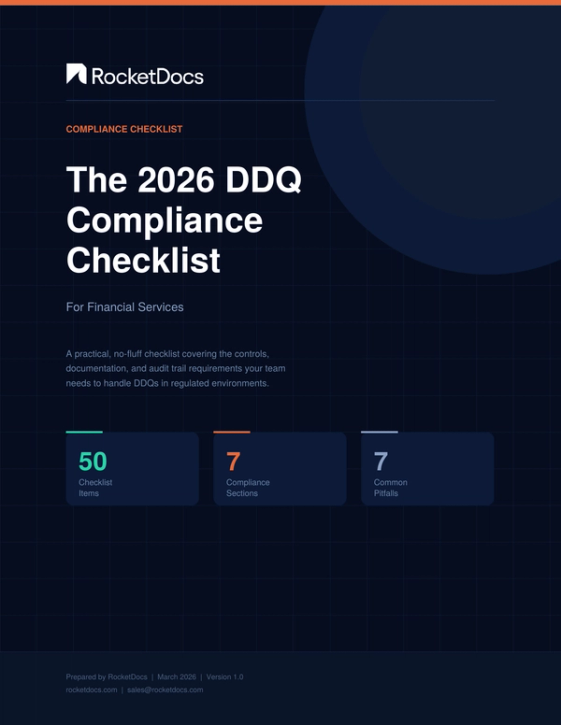
The 2026 DDQ Compliance Checklist
Get the 2026 DDQ Compliance Checklist. 50 items across encryption, access, audit trails, AI governance, and certifications. Built for insurance compliance teams handling regulatory exams and customer due diligence.
Ready to see RocketDocs for insurance?
A specialist will walk you through a configuration tailored to your structure, with multi-product library, multi-state content variants, and broker RFP workflow demonstrated end to end.