Banking
RFP and DDQ software for banks and bank holding companies
Bank-specific use cases need bank-specific platforms. RocketDocs handles regulatory DDQs, OCC vendor management questionnaires, customer security reviews, and the proposal volume that comes with serving thousands of corporate and institutional clients. Private AI keeps your data out of public AI models, every time.
Trusted by banks
J.P. Morgan | Bank of America | Deutsche Bank | HSA Bank
What banking teams achieve
- 50%
- faster RFP and DDQ turnaround
- Across treasury, wealth, custody, and corporate banking
- 2x
- capacity per responder
- Same team, more volume
- 95%
- content reuse
- From your approved library
- 100%
- audit-ready
- Full audit trail across every line of business
Built for banks
Built for banks
Banks have a response problem most platforms underestimate. The volume is high. The regulatory exposure is severe. The customer base is split across institutional, corporate, commercial, and consumer segments, each with different questionnaire patterns. Lines of business are siloed by regulation, not just by org chart. And the content review burden cuts across legal, compliance, risk, operations, treasury, and product teams who all have other day jobs.
RocketDocs has been deployed at banks since 1994. The platform reflects three decades of learning about how banks actually work: multi-LOB library structures, OCC vendor management workflow patterns, regulatory exam prep templates, and audit trails that support both customer security and post-incident reviews.
Use cases
Banking use cases
Customer security questionnaires
Corporate and institutional clients send security questionnaires before approving you as a counterparty, custodian, or service provider. SIG, CAIQ, custom bank-specific questionnaires, and ad hoc due diligence all run through RocketDocs with multi-tab Excel handling and audit-ready responses.
Regulatory DDQs and exam preparation
OCC, Fed, FDIC, FINRA, and state regulator examinations require the same patterns of evidence year after year. RocketDocs library structure and workflow templates accelerate exam prep, with nearest neighbor matching and the Refresh functionality for seamless updating.
OCC vendor management
Banks must respond to vendor risk reviews from their own customers and conduct vendor management on their own service providers. RocketDocs supports this process in both directions: your firm responding to vendor questionnaires, and your firm running vendor management programs internally.
Treasury services proposals
Cash management, lockbox, FX, and treasury technology proposals require segment-specific content libraries and personalized client material. RocketDocs handles the volume of treasury services RFPs at large banks.
Wealth management proposals
Private banking and wealth management RFPs require bespoke responses with personalized investor materials and confidential family office data. RocketDocs library structure supports the segregation these responses require.
Custody services proposals
Custody and asset servicing RFPs include extensive operational, technology, and risk content. RocketDocs handles the multi-thousand-page response patterns that custody RFPs often require.
Corporate and commercial banking RFPs
Commercial real estate, syndicated lending, equipment finance, and corporate banking proposals each have their own content patterns. RocketDocs library structure supports each segment with shared content where it applies and segregation where it does not.
Compliance
Compliance frameworks supported
- OCC: vendor management (Bulletin 2013-29 and successors), examination support, MRA response support
- Federal Reserve: examination support, capital and liquidity reporting alignment
- FDIC: examination support, vendor management alignment
- FINRA: broker-dealer compliance, examination prep
- SOX: financial reporting controls and evidence management
- GLBA: customer data protection and privacy
- BCBS: Basel III capital and risk reporting alignment
- SOC 2 Type II and ISO 27001: supporting your own customer security responses
- State regulators: alignment patterns for state-level banking exams
Multi-LOB
Multi-line-of-business support
Most banks have five to fifteen distinct lines of business. Each LOB has its own products, its own compliance posture, its own SMEs, and its own response patterns. Generic content management platforms force banks to either lump everything into one library (creating drift and accuracy problems) or run separate platforms per LOB (creating duplication and audit problems).
RocketDocs is built for the multi-LOB pattern. Each LOB gets its own library, its own workflows, and its own permissions, all on one platform with one audit trail. Cross-LOB content reuse where it makes sense. Strict segregation where regulation requires it.
What you get
What banking teams get
- Private AI, RocketDocs-run: your client data, transaction patterns, and risk frameworks are never sent to public AI providers and never used to train any model
- Office-native LaunchPad: writers work in Microsoft Word and Excel
- Multi-LOB library structure: per-business-line content with shared resources or strict segregation
- Custom workflows and approval gates: configurable to match your firm’s vendor management, regulatory response, and proposal review patterns
- Salesforce integration: bidirectional sync for the proposal and opportunity tracking that already runs in your CRM
- Real-time reporting: response cycle time, win rates, SME load, and library health by LOB
- Audit trail by default: every action logged and every approval timestamped
What customers say
Trusted by the teams whose responses cannot be wrong
Our project load has consistently increased year over year for many years. I tie our ability to keep meeting that, without hiring more people, to RocketDocs.
Things that could have taken a half an hour can now take possibly a minute. It is absolutely a massive time saver in keeping hundreds and hundreds of answers ready to go for us to use.
Not only are sales representatives creating better proposals, but they’re also doing it in a fraction of the time it used to take, which frees them up to spend more time in front of customers or to pursue more sales opportunities.
FAQ
Frequently asked questions
Does RocketDocs support OCC vendor management?
Yes. RocketDocs is used by banks for OCC vendor management response and evidence management, including the documentation patterns described in OCC Bulletin 2013-29 and its successors. Workflows can be configured to match your firm’s vendor management framework.
How does RocketDocs handle our customers’ security questionnaires?
Customer security questionnaires are a primary use case for banking deployments. SIG, CAIQ, custom bank-specific questionnaires, and ad hoc due diligence all run through RocketDocs with multi-tab Excel handling, structured SME assignment, and audit-ready responses with full version history.
Can we segregate content by line of business?
Yes. Multi-LOB library structure is a default. Each line of business gets its own library, with permissions enforced at the library and attribute levels. Cross-LOB content reuse is configurable.
How does RocketDocs handle examination prep?
Examinations typically repeat similar question patterns year over year. RocketDocs library structure and workflow templates support recurring examinations natively, with nearest neighbor matching and the Refresh functionality for simple response updating.
Will my client data ever be sent to OpenAI, Anthropic, or another AI provider?
RocketDocs runs its own private AI, with a dedicated document store for each customer. Your data is never sent to public AI providers and never used to train any model. That includes your client data, transaction patterns, and risk frameworks.
How does the platform handle multi-billion-dollar RFPs with hundreds of pages?
Volume is a primary design consideration. Customers regularly run RFPs with several hundred questions, multi-volume responses, and complex appendices. The platform is engineered for the response patterns that large bank deals require.
How long does implementation take at a large bank?
Most large bank deployments go live in 4 weeks for the primary line of business, with additional LOBs onboarded over the following months. Complex multi-affiliate, multi-LOB deployments may take longer because the configuration is deeper.
Free resource
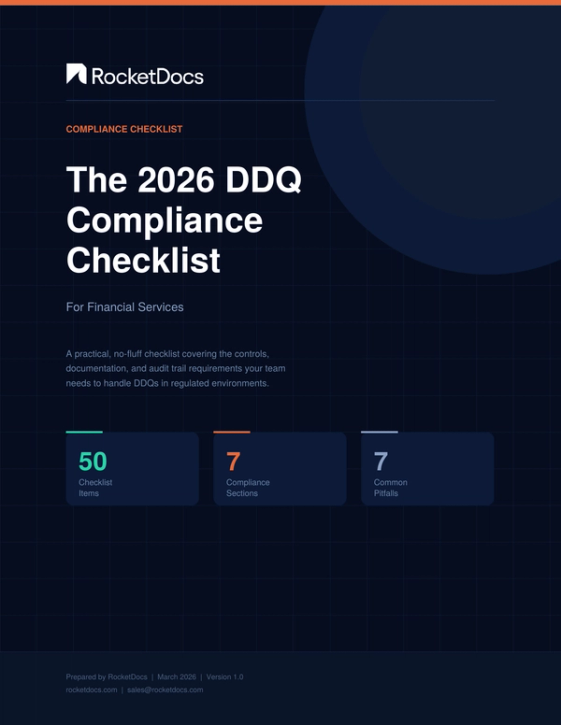
The 2026 DDQ Compliance Checklist
Get the 2026 DDQ Compliance Checklist. 50 items across encryption, access, audit trails, AI governance, and certifications. Built for bank compliance and vendor-management teams handling regulatory and OCC questionnaires.
Ready to see RocketDocs for banking?
A specialist will walk you through a configuration tailored to your bank’s structure, with multi-LOB library, regulatory workflows, and customer security review patterns demonstrated end to end.