Built for Life Sciences
Compliant response management for life sciences
Pharmaceutical companies, biotech firms, medical device manufacturers, and CROs face response volume from investors, partners, regulators, and clinical research stakeholders. RocketDocs is built with workflows aligned to 21 CFR Part 11 expectations: immutable audit trails, structured electronic approvals, and full history export. Private AI keeps your IP out of public AI models.
- 50%
- faster RFP turnaround
- 2x
- capacity per responder
- 95%
- content reuse from approved library
- 100%
- audit-ready
Why life sciences needs a different platform
The IP is the company
Life sciences has the highest compliance bar of any industry RocketDocs serves. The intellectual property is the company. Pre-clinical data, clinical trial designs, manufacturing process specifications, regulatory submission strategies, and licensing economics all live inside the response content. Sending any of it through a third-party AI provider is not a question of compliance. It is a question of viability.
RocketDocs is built for that bar. RocketDocs runs its own private AI, with a dedicated document store for each customer. Your data is never sent to public AI providers and never used to train any model. Audit trails are immutable. Approvals are structured for 21 CFR Part 11-aligned workflows. The same platform deployed at financial services firms whose customers have been auditing them for thirty years now serves life sciences firms whose customers are the FDA.
Life sciences use cases
Every response pattern from investor DDQ to CRO qualification
Investor and partner DDQs
Pharma and biotech firms respond to investor DDQs from venture capital, private equity, sovereign wealth funds, and strategic partners. The questionnaires are deep, the data is sensitive, and the cadence is recurring across the financing lifecycle.
Clinical research partnership RFPs
CROs, sponsors, and academic medical centers exchange RFPs as part of clinical research partnership formation. RocketDocs handles the operational, clinical, and regulatory content these proposals require.
Vendor due diligence
Life sciences companies field extensive due diligence from partners, sponsors, and regulators. RocketDocs helps your team respond to those vendor and qualification questionnaires faster, with answers drawn from your approved content library.
Business development and licensing proposals
Known in-house as BD and L, these proposals communicate data, terms, and structure of potential deals. RocketDocs supports business development and licensing workflows with multi-product library structure and structured approval gates.
CRO and supplier qualification
CROs and suppliers respond to qualification questionnaires from multiple sponsors, with overlapping but not identical content each time. RocketDocs helps them respond faster by reusing approved answers across every sponsor request.
Pharmacovigilance reporting
Pharmacovigilance teams maintain recurring reporting structures and respond to safety database questionnaires from regulators and partners. The library structure supports the recurring nature of these reports.
Quality management questionnaires
Quality systems audits, GxP qualification questionnaires, and post-marketing surveillance reporting all flow through structured response patterns that RocketDocs supports.
21 CFR Part 11-aligned workflows
Workflows aligned to 21 CFR Part 11 expectations
21 CFR Part 11 governs electronic records and electronic signatures in FDA-regulated environments. RocketDocs is built with workflow patterns that align to the regulation's expectations.
- Immutable audit trails: every action logged, with timestamp, user, and content fingerprint, exportable for inspection
- Structured electronic approvals: approval gates with action permissions per stage, supporting the controls 21 CFR Part 11 requires
- Full export history: every document has audit trails with version traceability
- Validated change control patterns: content change history with diff tracking, supporting the change control documentation FDA-regulated environments require
- Granular permissions: minimum-necessary access enforced at every level
Note that 21 CFR Part 11 alignment is a customer-led validation activity. RocketDocs supports the workflows. Customers conduct their own validation against their internal compliance frameworks.
Compliance frameworks
The frameworks life sciences answers to
- 21 CFR Part 11: workflow alignment for electronic records and electronic signatures
- ICH GCP: good clinical practice alignment for clinical research workflows
- GxP (GMP, GLP, GCP, GDP): general good practice alignment patterns
- EU MDR / IVDR: medical device regulation support for device manufacturers
- FDA submission support patterns: structured content for INDs, NDAs, BLAs, and 510(k) submissions
- EMA alignment: European Medicines Agency reporting structures
- PMDA alignment: Japan Pharmaceuticals and Medical Devices Agency reporting
- SOC 2 Type II and ISO 27001: supporting your own customer and partner security responses
Multi-product portfolio support
Different products, different evidence, shared resources where they apply
Most life sciences firms have multiple products at different stages: commercial, late-stage clinical, early-stage clinical, and pre-clinical. Different products have different evidence, different regulatory paths, and different IP boundaries. RocketDocs library structure supports per-product content with shared resources where applicable and segregation where IP boundaries demand it.
A multi-therapeutic-area pharma company answers DDQs differently for oncology, cardiovascular, immunology, and CNS programs. RocketDocs library structure supports therapeutic area-level customization within a product, with nearest neighbor search that respects the boundaries between TAs.
What life sciences teams get
Everything life sciences teams actually need
- Private AI, RocketDocs-run: your IP, clinical data, and regulatory strategies are never sent to public AI providers and never used to train any model
- Office-native LaunchPad: writers work in Microsoft Word and Excel
- Multi-product library structure: per-product content with shared library or strict segregation
- 21 CFR Part 11-aligned audit trail and approval workflows
- Custom workflows and approval gates: configurable for investor DDQs, partner RFPs, vendor qualification, and clinical research workflows
- Granular permissions: minimum-necessary access enforced at user, role, group, library, and project level
- Salesforce integration: bidirectional sync where life sciences firms run Salesforce for BD pipeline
What customers say
Trusted by the teams whose responses cannot be wrong
Our project load has consistently increased year over year for many years. I tie our ability to keep meeting that, without hiring more people, to RocketDocs.
Things that could have taken a half an hour can now take possibly a minute. It is absolutely a massive time saver in keeping hundreds and hundreds of answers ready to go for us to use.
Not only are sales representatives creating better proposals, but they’re also doing it in a fraction of the time it used to take, which frees them up to spend more time in front of customers or to pursue more sales opportunities.
FAQ
Frequently asked questions
Is RocketDocs 21 CFR Part 11 compliant?
RocketDocs is designed with workflow patterns that align to 21 CFR Part 11 expectations: immutable audit trails, structured electronic approvals, and exportable audit history. 21 CFR Part 11 compliance is a customer-led validation activity. The platform supports the workflows. Customers conduct their own validation against their internal compliance frameworks.
Will my IP, clinical data, or regulatory strategies ever be sent to OpenAI or Anthropic?
No. RocketDocs runs its own private AI, with a dedicated document store for each customer. Your data is never sent to public AI providers and never used to train any model. That includes your IP, clinical data, and regulatory strategies.
Does RocketDocs support FDA submission preparation?
RocketDocs supports the content management and response workflows that contribute to FDA submission preparation, including structured content for INDs, NDAs, BLAs, and 510(k) submissions. The platform is not an electronic Common Technical Document (eCTD) system. It is a response management platform whose content can feed into your existing submission workflow.
Can different products and therapeutic areas have different content libraries?
Yes. Multi-product and multi-therapeutic-area support is a default. Each product or TA can have its own library, its own workflows, and its own SMEs, with cross-product content reuse configurable based on your firm's policies.
How does RocketDocs help CROs and suppliers respond to sponsor questionnaires?
CROs and suppliers receive qualification questionnaires from multiple sponsors, often with overlapping but not identical questions. RocketDocs helps your team respond to each one faster by pulling from a single approved content library, so you maintain consistency across sponsors without rewriting answers each time.
Does RocketDocs integrate with our existing electronic Common Technical Document (eCTD) system?
RocketDocs is not an eCTD system. The platform integrates with eCTD systems through the Open API for content workflow handoffs, where customers want to maintain content in RocketDocs and submit through their existing eCTD platform.
How long does implementation take for a life sciences company?
Most life sciences deployments go live in 4 weeks for the primary use case. Multi-product, multi-TA pharma companies with complex 21 CFR Part 11 validation requirements may take longer because the configuration and customer-led validation are deeper.
Free resource
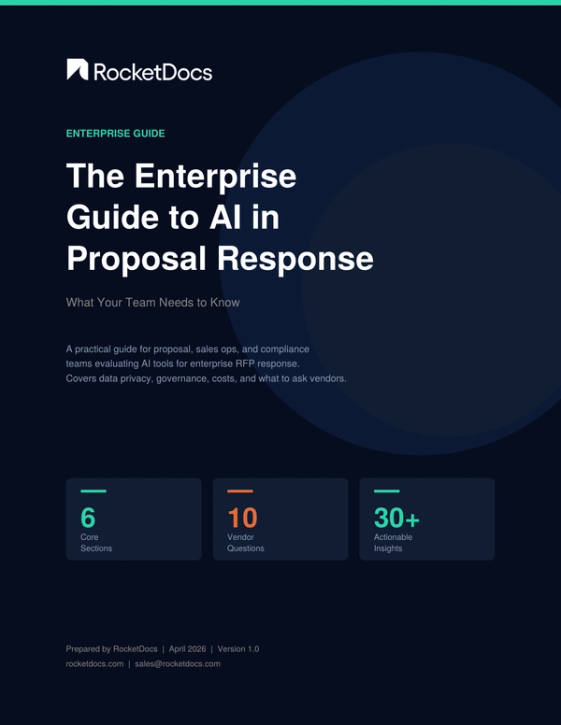
The Enterprise AI Guide
Get the Enterprise Guide to AI in Proposal Response. Private vs third-party AI, governance, real costs, and 10 vendor questions. Built for life sciences proposal and compliance leaders.
Keep every response accurate, compliant, and private.
A specialist will walk you through a configuration tailored to your firm's structure, with multi-product library, 21 CFR Part 11-aligned workflows, and private AI architecture demonstrated end to end.