
AI for RFPs: Form, Function, and What Actually Moves the Needle
Artificial intelligence is everywhere in the RFP software conversation right now, and for good reason. A well-implemented AI layer can compress a first pass from hours to minutes, surface the right answers from a library of thousands, and give proposal writers more time to focus on the parts of a response that actually require human judgment.
But not all RFP AI works the same way. Some tools use it as a surface-level feature. Others have built it into the core of how the platform handles content matching, confidence scoring, and workflow routing. Understanding the difference is what separates a good buying decision from an expensive disappointment.
How AI autofill works in RFP software
The most practical application of AI in proposal tools is autofill: the ability to detect questions in an incoming RFP document, match them against your existing content library, and populate answers automatically when a high-confidence match exists.
In RocketDocs, this process runs in three stages.
The first stage is question identification. When you upload a Word or Excel document, the platform scans it and isolates the questions that need responses. Shorter, simpler documents complete this step in seconds. More complex RFPs with nested sections and multi-part questions take slightly longer, but still measure in minutes rather than hours.
The second stage is meaning extraction. This is where natural language processing (NLP) earns its place. Rather than matching based on keyword overlap alone, the system interprets the intent behind each question. Two questions that are worded differently but ask for the same information, such as "Describe your data retention policy" and "How long do you store client records?", map to the same semantic meaning. That distinction matters enormously in practice, because RFP writers rarely ask the same question twice in exactly the same words.
The third stage is answer scoring. The platform compares the meaning of the incoming question against every question-and-answer pair in your content library and assigns a confidence score to each potential match. If the best match clears a defined accuracy threshold, the answer is inserted automatically. If no match clears that threshold, the field is left blank rather than populated with a low-confidence response. Inserting a wrong answer is worse than inserting no answer at all, and the system is built around that principle.
Why your content library is the real variable
This is the part of the AI conversation that does not get enough attention. The algorithm is not the ceiling on your autofill performance. Your content library is.
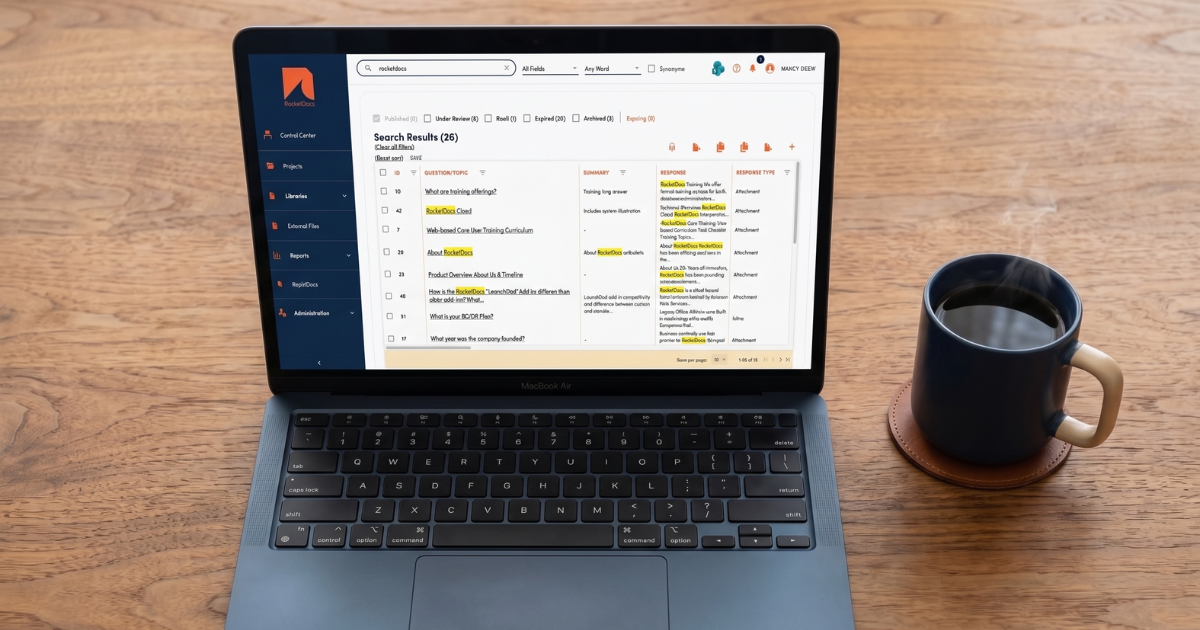
A content library that is current, well-organized, and tagged consistently gives the AI high-quality material to match against. A library that has outdated answers, duplicate records, and inconsistent terminology produces inconsistent results, regardless of how sophisticated the matching model is. If your database has five versions of your security posture answer and none of them has been reviewed in eighteen months, the AI has no reliable foundation to work from.
This is why content hygiene is a prerequisite for AI performance, not an afterthought. Teams that treat the content library as a living document, reviewing and updating records on a regular cadence, see substantially better autofill rates than teams that load content once and move on. RocketDocs' approach to content management is covered in depth on the content library page, and the post Beyond the Algorithm: Building Your Library of Truth covers the governance side in detail.
What happens when autofill cannot find a match?
No AI tool will answer every question in every RFP. That is not a flaw; it is an honest reflection of how new questions, edge cases, and proprietary asks work in practice. The question is what the platform does next.
RocketDocs provides three paths when autofill does not produce a result. Basic search lets the writer query the content library manually, reviewing suggested responses ranked by relevance. SME assignment routes the unanswered question directly to the subject matter expert who owns that topic area, with a tracked task and deadline. And for genuinely new answers that do not exist in the library yet, writers can draft a response directly in the document and push it back to the content library so it is available for future RFPs.
That last step is what separates a system that gets smarter over time from one that stays static. Every net-new answer that is reviewed, approved, and added to the library raises the floor for every subsequent autofill run.
AI confidence settings and multi-pass autofill
One of the more nuanced controls in RocketDocs is the autofill confidence slider, which lets teams set the threshold at which the system considers a match acceptable for automatic insertion. Teams with a mature, well-maintained library may run a higher confidence setting to maximize fill rate. Teams earlier in their content governance journey may run a lower threshold to catch more potential matches and review them manually before committing.
Multi-pass autofill extends this further. Teams can configure separate passes that draw from different libraries, filter by content attributes such as status or product line, and stack them in order of preference. A first pass might pull from a core approved library. A second pass might draw from a broader archive for questions the first pass could not match. The result is a more complete first draft without sacrificing accuracy.
Is AI worth the investment for your proposal team?

The answer depends on two things: the volume of RFPs your team handles and the quality of the content infrastructure behind them. Teams answering dozens of RFPs per quarter, with a well-maintained library and a consistent review process, will see the highest return. AI compresses the time-intensive first-pass work that currently consumes a disproportionate share of proposal writers' hours, freeing them to focus on customization, narrative, and win strategy.
Teams earlier in their maturity curve still benefit, but the priority should be building the content library first. AI amplifies what is already there; it does not replace the need for accurate, current, well-governed source material.
For a broader look at how proposal teams are benchmarking automation ROI, the Association of Proposal Management Professionals (APMP) publishes annual data on proposal process benchmarks at apmp.org. Gartner's research on intelligent document processing is also a useful reference point for evaluating AI claims from any vendor.
If you want to see how autofill performs against your own content, schedule a demo with the RocketDocs team.
Looking for the platform behind this? See the RocketDocs platform or book a demo.


