
RFP Automation for Greater Efficiency: A Comparative Guide
In proposal management, time does not just equal money. It equals opportunity. Every hour spent reformatting templates, chasing subject matter experts, or manually populating standard answers is an hour not spent on strategy, differentiation, or winning the next deal.
RFP automation tools exist to close that gap. They handle the repetitive, time-consuming work so that proposal managers, sales teams, and compliance professionals can focus on the work that actually moves the needle. This guide breaks down the core benefits of RFP automation, compares the leading platforms on the market, and explains where RocketDocs delivers a distinct advantage for teams in technology, asset management, and healthcare.
Why RFP Automation Tools Have Become Essential
Saving Time Across the Entire Response Cycle
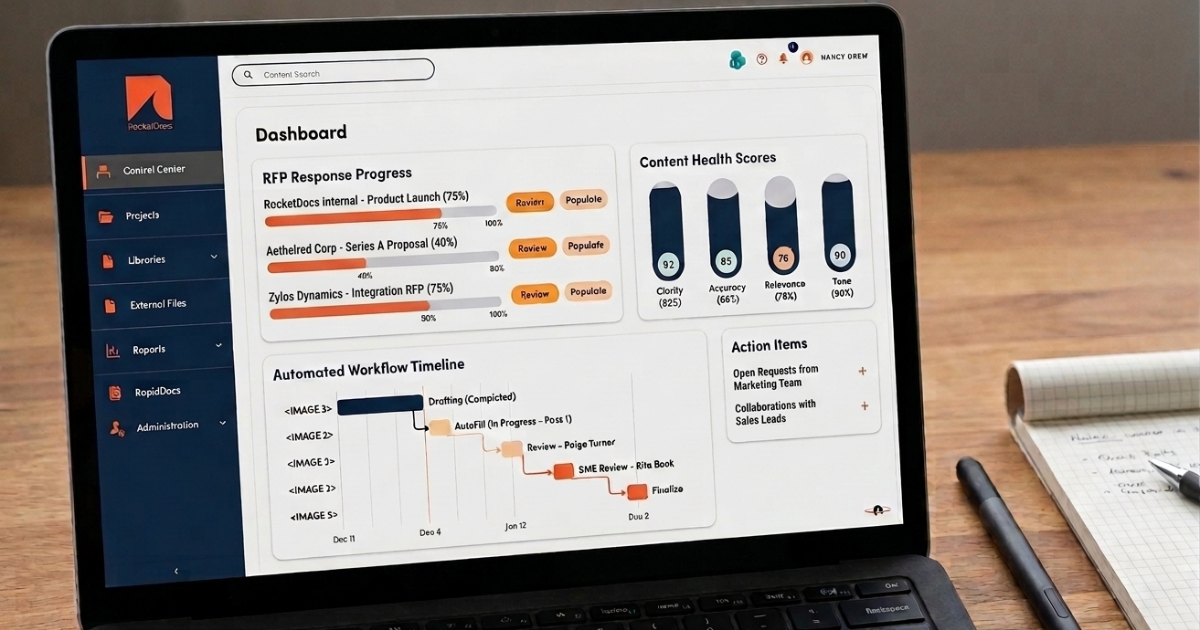
The most immediate benefit of RFP automation is time savings. Manual RFP work is labor-intensive by nature. Teams spend hours on data entry, template formatting, and rewriting answers to questions they have already answered dozens of times before.
Automation eliminates most of that. When a new RFP is ingested, the platform surfaces pre-approved answers from a centralized content library, pre-populates a draft, and flags only the gaps that require human input. What previously took days can be completed in hours, and that compression compounds across every proposal a team touches in a given quarter.
Improving Accuracy and Consistency at Scale
Accuracy is not just about getting the facts right. It is about ensuring that every proposal your organization submits reflects the same messaging, the same compliance posture, and the same quality bar regardless of which team member assembled it or how quickly it needed to go out.
Automation enforces that consistency. Content libraries store reviewed, approved answers. Automated review workflows flag content that has aged past its expiration date. The result is that teams stop guessing whether an answer is still accurate and start relying on a system that tells them.
Enabling Real Collaboration Across Distributed Teams
Proposal development rarely lives in one department. Sales, legal, security, product, and finance all contribute to a competitive response. Without a centralized platform, that coordination happens over email and shared drives, which creates version conflicts, missed updates, and bottlenecks.
RFP automation tools consolidate that collaboration into a single environment. Every stakeholder works from the same document, sees the same updates in real time, and knows exactly what still needs attention. For teams operating across time zones, that infrastructure is not a convenience. It is what makes the process function at all.
For a closer look, see how RocketDocs manages team collaboration within its platform.
Comparing the Top RFP Automation Tools
The three platforms that come up most often in enterprise RFP software evaluations are RocketDocs, Responsive, and Loopio. Each takes a different approach. Here is how they compare across the capabilities that matter most.
| CAPABILITY | ROCKETDOCS | RESPONSIVE | LOOPIO |
|---|---|---|---|
| Centralized content library | Yes, with automated review workflows | Yes | Yes |
| AI-assisted response generation | Private AI using only your data | Yes, uses third-party AI models | Yes, uses third-party AI models |
| Microsoft Word and Excel integration | Native via LaunchPad add-in | Limited | Limited |
| Proactive proposal generation | Yes, via RapidDocs feature | No | No |
| Audit trails and compliance tracking | Comprehensive, full action history | Available | Available |
| Role-based access controls | Yes | Yes | Yes |
| CRM integrations | Yes | Yes | Yes |
RocketDocs
RocketDocs is built around the idea that every RFP response should start from verified, pre-approved content rather than a blank page. Its centralized content management system gives sales, marketing, security, and compliance teams a single source of truth for all proposal content.
The platform's private AI architecture is a meaningful differentiator. Unlike tools that route your data through external AI models, RocketDocs generates responses using only your internal content library. No data leaves your environment. That matters significantly for regulated industries where data residency and confidentiality are non-negotiable.
RapidDocs, a standout feature, allows teams to generate fully customized proactive proposals in minutes by assembling pre-approved content blocks. For organizations that want to get in front of an opportunity before a formal RFP is even issued, that capability creates a real competitive edge.
The LaunchPad Microsoft add-in deserves specific mention for technology and financial services teams where Word and Excel remain the primary working environment. RocketDocs works inside those tools rather than requiring users to learn a separate interface, which accelerates adoption and reduces friction.
Responsive
Responsive offers strong workflow customization and is a solid choice for organizations that need to design complex, multi-stage review processes. Its collaboration features are robust, and its analytics capabilities give managers visibility into team performance and RFP win rates over time.
Responsive is well-suited for organizations that prioritize flexibility in workflow design and want detailed reporting on proposal activity. It is a capable platform, though teams in highly regulated industries may need to evaluate its AI data handling practices carefully relative to their compliance requirements.
Loopio
Loopio centers its experience on the response library, making it straightforward for teams to locate and reuse past answers. Its automation capabilities handle content review scheduling and version control reliably, and its CRM integrations make it a reasonable fit for sales-led organizations that want RFP data to flow directly into their pipeline management tools.
Loopio works well for teams that are new to RFP software and want a relatively low-friction entry point. Organizations with more complex security requirements or a need for proactive proposal generation may find it limiting over time.
See the full side-by-side breakdown.
A Closer Look at RocketDocs' Key Capabilities
Content Library and Automated Review
The RocketDocs content library functions as the organization's single source of truth for all proposal content. Every answer, boilerplate section, and compliance statement lives in one place, tagged, searchable, and assigned to a reviewer on a defined schedule.
When content approaches its review date, the platform automatically notifies the assigned owner and routes it through the approval workflow. Teams are never working from stale data, and content managers are freed from manually tracking what needs updating across hundreds of individual entries.
RapidDocs for Proactive Proposals
Most RFP platforms are reactive by design. They help you respond to documents that arrive in your queue. RapidDocs flips that model by enabling teams to generate polished, customized proposals from pre-approved content before a formal RFP is issued.
For technology and asset management firms that want to pursue relationships proactively, this feature shortens the time from initial interest to a complete, client-ready document. You can learn more about RapidDocs.
Security Questionnaire and DDQ Handling
Security questionnaires and due diligence questionnaires are among the most time-intensive documents a response team handles. They are long, highly specific, and require input from security and compliance teams who are already stretched.
RocketDocs automates the population of security questionnaire and DDQ responses by drawing directly from the content library, with AI flagging any questions it cannot confidently match for human review. The result is a complete draft in a fraction of the time, with every answer traceable back to a reviewed and approved source.
This capability is particularly valuable for financial services and healthcare organizations that handle dozens of DDQs each year. Explore the DDQ-specific workflow.
Microsoft Integration via LaunchPad
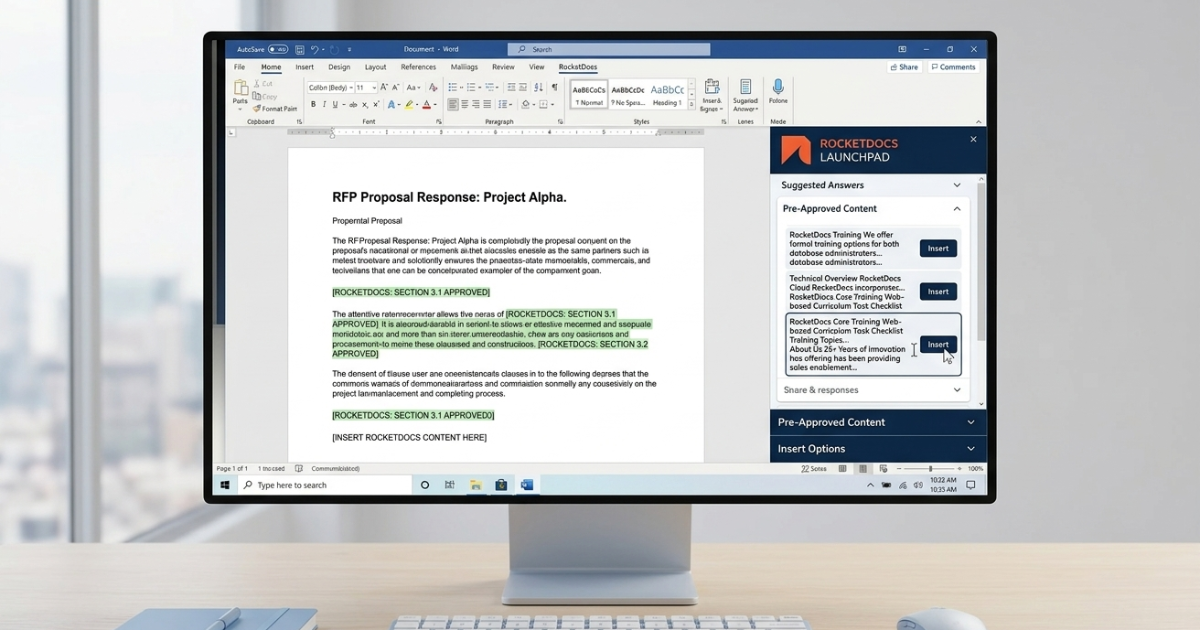
RocketDocs does not ask teams to abandon the tools they already use. The LaunchPad add-in integrates directly with Microsoft Word and Excel, so users can access the content library, insert pre-approved answers, and manage their proposal workflow without leaving their existing environment.
This integration is a practical differentiator for large organizations where Microsoft Office is deeply embedded in day-to-day operations and where asking teams to migrate to a new interface carries real adoption risk.
The Business Case for Investing in RFP Automation
The competitive case for RFP automation comes down to three compounding effects. First, teams submit more proposals in the same amount of time. Second, the quality and consistency of those proposals improves because they are built from verified content rather than assembled under deadline pressure. Third, the organization develops a compounding library of approved content that gets stronger with each proposal cycle.
For technology companies, asset management firms, and healthcare organizations handling regulated, high-stakes procurement, those three effects translate directly into win rate improvements and reduced compliance risk. The question is not whether RFP automation delivers value. It is which platform delivers the right combination of security, usability, and capability for your specific environment.
To see how RocketDocs fits your organization, explore the platform overview or calculate your potential time savings.
Looking for the platform behind this? See the RocketDocs platform or book a demo.


