
RFP Customization vs. Efficiency: Why You Don't Have to Choose
One of the most persistent myths in proposal management is that teams must pick between customization and speed. The assumption usually comes from experience: copying answers from old documents, manually rewriting content for each buyer, chasing approvals at the last minute. Under those conditions, personalization does feel slow.
But that tradeoff is a symptom of a broken process, not an inevitable reality.
The Real Cost of "Efficient" RFP Responses

When efficiency gets achieved by recycling outdated or overly generic answers, the result is not true efficiency. It is poor execution with a faster turnaround. Evaluators recognize one-size-fits-all responses quickly, and those responses tend to produce lower win rates.
The data backs this up. Teams using dedicated RFP software achieve around a 45% win rate, compared to roughly 41% for teams without software. That gap is meaningful at scale, especially when a single won contract can represent months of revenue.
The opposite extreme carries its own costs. Manually over-customizing every response leads to burnout, missed deadlines, and fewer RFPs submitted. Survey data shows that automation allows teams to respond to approximately 43% more RFPs per year, because time saved on repetitive work gets reinvested in strategic targeting and higher-quality writing.
The root problem is not choosing one value over the other. It is lacking a system that supports both at the same time.
How RFP Software Eliminates the Tradeoff
Modern response management platforms remove the friction that once made customization slow. Three capabilities do most of the heavy lifting.
A centralized content library gives teams a single source of approved answers, templates, and supporting materials. Rather than hunting through email threads or old proposal folders, writers pull pre-approved content and tailor it to the specific buyer, industry, or use case. The library grows smarter over time, making each future response faster without sacrificing consistency or brand voice.
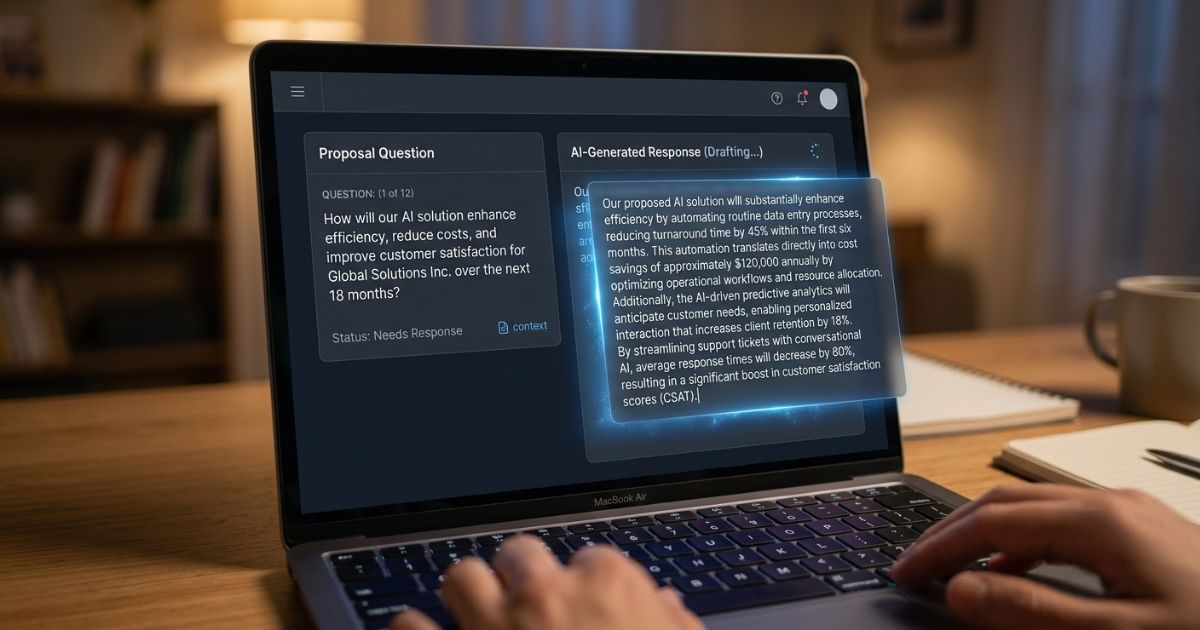
AI-assisted drafting accelerates the first pass without replacing human judgment. When an exact content match exists in the library, the AI surfaces it. When one doesn't, it drafts a context-aware response built from your approved knowledge base. The result is a starting point that requires refinement, not a blank page that requires invention. Teams using RFP software report average response time reductions of up to five hours per RFP, time that can be redirected toward the sections that require genuine strategic thinking.
Collaborative workflows reduce the review cycles that eat up the most time in a traditional process. With clear assignments, comment threads, and status tracking all in one place, subject matter experts can contribute without back-and-forth email chains, and managers can see progress without chasing updates.
Together, these capabilities shift proposal work away from coordination and copying, toward the part that actually influences win rates: aligning each response to what the specific buyer cares about.
RFP Customization at Scale with RocketDocs
RocketDocs is built around the idea that speed and quality are not competing priorities. The platform combines a structured content library, private AI, and built-in collaboration to help proposal teams respond faster without producing generic submissions.
The AI drafting experience in RocketDocs is designed to feel like support, not automation for its own sake. It surfaces relevant answers from your content library, flags gaps, and drafts context-aware responses when a direct match does not exist. Writers stay in control; the platform handles the repetitive work so they can focus on what differentiates the response.
The content library keeps every approved answer, template, and reference document organized and searchable. Teams stop duplicating effort across projects and stop worrying about whether the version they found is current. When a better answer gets written, it replaces the old one for everyone.
Workflow tools let the right people contribute at the right time without slowing the overall process. Reviewers see only what they need to review. Managers see the full picture. Deadlines stay visible to everyone.
The practical outcome is a proposal team that can pursue more opportunities, submit stronger responses, and spend less time on administrative coordination. Learn more about the RocketDocs platform or schedule a demo to see it in action.

Customization and Efficiency Are the Same Goal
The framing of customization versus efficiency assumes they pull in opposite directions. In practice, they describe the same outcome: a response that lands well with the buyer, submitted on time, without burning out the team.
The process that once forced a choice between them relied on manual effort for tasks that should be automated, and human creativity for tasks that software now handles better. Flipping that equation is what modern RFP platforms make possible.
Proposal teams that adopt that approach do not just move faster. They respond to more RFPs, win more of them, and build a content library that compounds in value over time.
If you want to see how your current process compares, take the RFP Efficiency Quiz to get a quick read on where you stand and where the biggest opportunities are.
Looking for the platform behind this? See the RocketDocs platform or book a demo.


