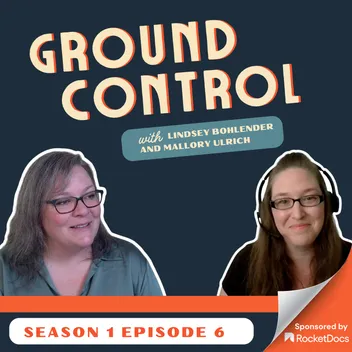
In this episode of Ground Control, Sr. Director of Customer Success Lindsey Bohlender and Customer Success Associate Mallory Ulrich sit down to tackle one of the biggest challenges facing proposal teams, content managers, and business development professionals today: how do you build a knowledge management system that actually stays current, organized, and valuable over time? Whether you are a brand new RocketDocs customer going through onboarding or a seasoned team looking to level up your content operations, this episode is loaded with practical, real world advice you can start applying immediately.
The conversation kicks off with a deep dive into content ownership and accountability, exploring how organizations of all sizes, from small teams without a dedicated content manager to large enterprises with multiple subject matter experts and compliance stakeholders, can create a culture where everyone takes responsibility for keeping information accurate and up to date. Lindsey and Mallory break down how leadership buy-in is the single most important factor in driving adoption of any new process or content management workflow, and how framing the conversation around efficiency, time savings, and risk reduction is the key to getting executives and team leaders on board.
From there, the episode gets into the nuts and bolts of organizing your knowledge base in a way that mirrors your actual business structure, including how to segment content by department, product line, deal size, and ARR tier so that autofill and automated workflows can do the heavy lifting when deadlines hit. They also cover how to use usage counts, content reporting, and date tracking to identify what is performing, what is stale, and what should be archived so your subject matter experts are not wasting time maintaining records that are never being used in live proposals, RFPs, DDQs, or security questionnaires.
Lindsey and Mallory also discuss the importance of proactive content review cycles, whether that means quarterly audits, annual cleanups during slower business periods, or automated review reminders built directly into your workflow, so your team is never scrambling to get fifty SMEs to review a two hundred question document the week it is due. The episode wraps with a conversation about how reducing that reactive, deadline driven chaos is not just good for efficiency but is also critical for compliance, audit trails, and demonstrating to regulators and clients exactly where your content came from and when it was approved.
If you are in proposal management, sales operations, revenue enablement, legal, compliance, or anywhere in between, this episode will give you a fresh perspective on how to build a knowledge base that your whole team will actually use, trust, and maintain.
00:00 Maximizing Value from Rocket Docs
02:41 Ownership and Responsibility in Content Management
05:38 Utilizing Reporting for Effective Content Management
08:55 Determining Focus Areas for Content Updates
11:22 Organizing Information for New Customers
15:09 Implementing Effective Workflows
18:30 Leadership Buy-In for Process Adoption
Show transcript
Lindsey: Hey Mallory. so I today we're going talk a little bit about what are the practices for making sure that you get the most value out of a system like RocketDocs also how does that reflect in your processes and your internal organization? ⁓ And I am really looking forward this conversation. I think that our ⁓ Mallory: Hey. Lindsey: existing customers and prospects and all the folks out there who are going to this can benefit from some of these approaches. So I I think I'd like to start by talking about one of the struggles that people bring to us even from ⁓ right the start with ⁓ onboarding. And that like who is responsible for ⁓ all this and keeping things ⁓ Flowing and keeping the information updated. And one thing I've noticed is that you know, a lot of organizations have kind of a centralized team who is responsible for keeping all of that information updated, maybe even a single content manager. But also there are some teams who kind of partner with different organizations or different portions of their organization to keep things like their ⁓ legal and compliance information updated and they really own that structure. So I'm curious, how does that show up in onboarding, for example? What do those conversations look like and how do you advise folks? Mallory: Yeah. I mean, honestly, like you said, this is totally something that I think everybody has this challenge of, you know, who's whose responsibility really is this? And I think the the true answer to that really honestly is anybody that's touching your content, they hold a level of responsibility. And I think that alignment helps with so much. But I think the biggest part of it also is is yeah, some teams are super blessed. To have a content manager, somebody that is manning the ship and making sure that we can have everything that we need when we need it. However, we are in times where we're doing more with less. And so how do we take care of it that way? And I think that that kind of goes back to just making sure that you have open lines of communication. That is part of why Rocket Docs is so popular right now, right? Is because we make it super simple, we make it so easy that you can just you can set it all up and it's automated and the system helps you to maintain that so and that way you don't have to babysit. But I think proper process, proper protocol and ⁓ continued ownership throughout the entire company, I think that's that's really a big hand on it. Lindsey: I I agree. Having buy-in from your leadership teams who then see the value in those workflows and processes and tools that you implement to keep this really valuable resource of your organizational knowledge updated and available, I think it's incredibly important. what are some of the things that you've noticed are helpful tools or tips ⁓ within the platform that ⁓ folks keep track of those? ⁓ workflows or the the processes that they implement. ⁓ Mallory: Yeah, I mean, huh, that's such a great question. And I'm gonna geek out a little bit because I love it. So I would say every team has a level of downtime, right? There's there's always that little bit of time that you have where it's a little quiet and it's so nice to catch your breath, but that is golden time. That is time you cannot buy. So you gotta use it. And the best way to do that is take a look at your content. See what you're using, see what you're not. That's another tool that's in Rocket Docs that I love is you have usage counts. You have really easy dates, and I mean like lots of dates to where you can see what's going on with your content, which gives you such valuable feedback to know is this stuff that we're actually using? And if not, let's stop maintaining it. Let's get it out. Let's get the noise gone, right? Like it's just, it's messy and it just clogs up. Lindsey: Right. Mallory: It's like having a table full of of rotten food and then you have good food. And now do you want the good food? No, because it's all covered by rotten. Exactly. So you gotta just clean out the well, make sure that it's not poisoned and make sure that you have really good content in there, which honestly you want to talk about maintaining and having buy in, right? Having people all taking ownership. Nobody takes ownership like somebody that feels like they only have five records instead of twenty. Lindsey: Yeah, agreed. And I, you know, I've ran I ran into that in my ⁓ private organization where I implemented an RFP ⁓ automation system really. ⁓ we had duplicates or overlapping content, it was really frustrating for the subject matter experts because they're like, I just reviewed this. so I think that that is a really good call out of if you have these little ⁓ you know, gold nuggets buried amongst a whole bunch of garbage, it's really hard to convince people to help you keep that updated. I wonder if you could talk a little bit about ⁓ some of the reporting or the pieces that can help some of the leadership or over ⁓ oversight that allows people to kind of see into what is being used, what's not, like are there tools that are Mallory: Definitely. Lindsey: more useful or more popular with with our customer base. Mallory: Yeah, I would say the reporting is a really, really helpful piece. great thing about this is that nothing is a better motivator with anybody better than competition. And healthy competition is always so good. And not only that, but good office camaraderie, right? Like I feel like since COVID, we've lost so much of this camaraderie in business. And AI is so cool, but it, you know, it takes you further away from having those inner person. Lindsey: Yeah. Mallory: connections. So I think the great thing about this is that you can utilize those reports to not only yes, for you know, leadership can get all of the information that they need and they are able to see what's working, what's not, but also they're able to see who are our rock stars, who are the people that are consistently week after week making sure their content's good, making sure that everything's going in the direction that they need to. And what a cool thing to be able to call that out and say, we have an SME of the week, of the month, of the quarter that just overperformed, did a wonderful thing. You know how many people are gonna try and beat them out the next quarter, especially if you throw like a five dollar coffee on it? five dollars. Who cares about five dollars? But it's that coffee, it's that camaraderie of I took over this leadership spot. You know, it's ⁓ I think that is a really great tool. That can help. But I think also, like I said, looking at that usage count, looking at the last time you touched those records, that is it's gold. It just tells you so much about it. Lindsey: Yeah, I I agree. I think keeping track of and having a process internally of, you know, how do we decide what to or remove from the, ⁓ know, everyday ⁓ in content, I I think that's important. ⁓ ⁓ so defining that within an organization of, you know, if ⁓ information hasn't been used in the last eighteen months, do we really want to spent have our SMEs spend time on reviewing that and updating information. ⁓ What have you noticed with the organizations that we work with that's most effective for determining which information needs to be really focused on versus maybe archived or reviewed less frequently? Mallory: Absolutely. Definitely. Well, usage always goes up there, right? But that tells us a whole lot about how often we're using it. That is a big, big one. ⁓ now on top of that, also just looking at things that are trending in your business, right? So what are the things that you're trying to push the most? What are the things that are the most popular within your own business? Making sure that that content is golden, making sure that that is solid information because if it's your most popular, you can Lindsey: So Mallory: Pretty much bet it's going to be on all of these documents. So having that and making sure that your staple things, the biggest part of your company and the most important pieces too, right? So legal responses, you got to be careful with those. You got to make sure that that stays current. Those types of things, that's the perfect stuff to really focus in on. What do you think, Lindsay? Do you agree or are there's others that you're thinking of? Lindsey: Right. Mm-hmm. No, I absolutely think that's ⁓ spot on. I would zoom out just a little bit and say also looking at your win-loss statistics. So ⁓ information is ⁓ consistently with winning bids, I think that's information that you can focus on. Or information that is associated with bids that you haven't won, you know, what's different about those? How can you ⁓ Mallory: ⁓ good call. Lindsey: shift some things around or maybe archive outdated content or language or things that aren't consistent with your overall tone of voice for the organization. taking a look at, you know, where has this been used, were those were those bids that we won ⁓ and dialing in your language there too. Mallory: Definitely. I think that's such a great call out. Having that reference to look back at is always super valuable. And to your point, like you it is important to p focus on what we're doing well, right? But it's also so important to see where are we failing? Where are the things are happening? And you will see trends. If you look at that, you will always see trends. And that is how you attack that. You you want to address that sooner than later. But Definitely to your point too, you really need to focus on those wins because that is huge for team morale. And once again, nothing's better than motivating a team by saying, We did so good at this last quarter, you guys. Let's keep up the good work. Let's keep it going. Lindsey: Yeah, I agree. ⁓ what have you noticed, because I know that you leading the charge a lot on our onboardings now, which is so great. what you noticed is helpful for keeping information organized or bringing information in from another resource? So say you add a new group or your brand new customer, how do you tackle that? there's a ton of content out there. And you want to make sure that it's something that ⁓ that you have some structure to it, right? Mallory: Definitely organization is so key to that. It is the most paramount importance that when you have a system, you have your knowledge base, whether it's with Rocket Docs or anybody else, it is the most important thing that you have this organized in a way that makes sense. I cannot tell you how many times that I see that these teams they'll create some sort of structure. That might make sense on paper, right? Like AI might say, ⁓ this makes sense, you guys, and just organize it this way. But the problem is, is that your business is like a fingerprint. It's special. It's like a snowflake's. You know, everybody's is going to be a little bit different. So the really cool thing about this that I love about Rocket Doc specifically is that you have that customization to make it so that way that your knowledge base can replicate your business. And going that route, being able to put in things like departments, right? Every company, the departments might be similar, but the naming convention can be vastly different. So lining up around that is a really great call because then if your knowledge base reflects the way that your business runs, it makes it really easy to see those parallels. It makes it very easy to see who should be updating this content, who should be my subject matter expert. Lindsey: Yeah. I agree. Mallory: But then also above that as well, you really need to think about your document. What are you doing? How are you having to parse this out? Is it done by a product? Right? Do you have different products that are going to behave differently? Also, I just had a client recently that, you know, depending on what kind of ARR that is associated with that account, right? Your the answer is going to be a little bit different. Lindsey: ⁓ my god Mallory: So I mean your development offer ⁓ offerings or ability to help another customer that's at twenty five thousand every year on ARR versus somebody that's an enterprise client that's paying you eight hundred thousand a year, it's going to be a big difference in your response. So having a way to distinguish is huge. Sorry, go ahead. Lindsey: Right. ⁓ Right. No, no. So like, sounds like, well, and I've come across this as well, that you have, of course, product lines or strategies that you have to align around because you may have specific language that's only applicable certain areas of your business or product offerings, but also you may have some standardized language that you use for certain ⁓ size deals and then you customize a bit more when it comes to some of those larger sales. Mallory: Exactly. So having a way to draw the lines in the sand and say this this deal or this document, this whatever it is, DDQ, whatever it is, applies to that kind of standard. It just makes your life so much easier to be able to segment your information, have systems in play that can help you. And one of the wonderful things with Rocket Docs is we have that autofill, right? We have a way to Lindsey: Yeah. Mallory: take care of that for you. So those filters are super important because it can get you up into first draft mode matter of minutes. But it's all about that so that filtering. You have to have that filtering right. Lindsey: Things aren't mean. Yeah. I I think think the best practices around kind of organizing, setting the foundation are so important. And then the next layer for me that I go through is okay, how do we maintain this? How do we make sure that this stays up to date ⁓ that my content doesn't get stale and ⁓ I the you know audit trail to say this was approved on this date, so I know I can use it and Mallory: Yeah. Lindsey: My SME, you know, has laid eyes on this information. So I wonder if you could talk a little bit about how our customers have been most successful utilizing workflows, both in ⁓ Docs, because that's a nice automation piece, but also in their organization and just having a process built around maintaining the information, updating, keeping things going. ⁓ Mallory: Yeah, I think once again that goes to the snowflake of every company, right? Some companies that we work with, you see that doing a quarterly audit totally makes sense. Totally makes sense. You go through, you do that. Also sometimes an annual audit, right? We might have ⁓ you know, Q four is never downtime for anybody, right? But maybe Q two. Q two might be a quiet time for the company, for the business. If that's the case, then wonderful. Utilize that time to do a full audit. Go through, clean it up, make it, make sure that it's really what you want it to be. Now, you know, some companies are privileged with the ability that they do not have any downtime. That is just not a thing. And in that case, then I think the best thing with that is to make sure that you're maintaining your processes and procedures. ⁓ having something like Rocket Docs where it automates that process, right? It tells you exactly when it's time you're able to associate that. and it also runs you through the the automated workflows, right? So having that organization up front, put it into the system, allow that to automate for you, and then just holding accountability amongst your team to make sure that they know that this is a priority. It's not a it's not a request. This is our process, this is what we need. Lindsey: I think having that definition is really important, but also ⁓ on the flip side of it, showing the value of it of hey, I know you know, you have to come in and review this information and it's it it's time time consuming and it can disrupt your day a little bit, but think about if you these five or ten questions now. I'm not going to ask you about this same information fifty times in the next six months. So it really is an investment in not having to address that over and over and over again and reducing the risk of having different responses or having some ⁓ version control issues if you're not, you know, referring to a a source of truth. would say ⁓ just to zoom out a little bit too on the the review process, I think whether it's Mallory: Definitely. Lindsey: In RocketDocs or anywhere in the ⁓ industries, you have to be able to show ⁓ things were reviewed, updated, and signed off. And this is super important. I've read ⁓ numerous about, you know, fines that have been assessed because they can't really show you where that information came from. And this getting more and more common in the age of AI adoption. So I ⁓ I just want to you know, put that plug out there for all of the folks that ⁓ we support and all of the folks in the industry is you keep track of where your information comes from because having that resource is really, really important. ⁓ any other ideas from your end about you know implementing workflows or processes or getting buy-in? How do we, ⁓ know, encourage folks to take part in this process and have ⁓ because ultimately you do have that buy-in, the information that you have is just gold. ⁓ so any ideas from your end, like what has been most effective in the in the organizations we work with. Mallory: Absolutely. Yeah, I would say ultimately just having leadership buy-in, that is that speaks volumes because nobody wants to go against leadership, right? And that it that's coming down as this is not a request, as I was saying earlier. This is our process. So adopting that can change everything. But even beyond that, also just having that kind of language with everybody to know, hey, you guys, we're adopting a new process or this is our process. It's non negotiable. That is part of that language. But I think a good point to this as well on the leadership side, on helping to get that buy in, is understanding that leadership is all about efficiencies, right? Making things as efficient as much as possible, saving the business money, right? Because that's super important. That's why AI got so big so fast, is because of that exactly. Lindsey: Right. Right. Mallory: It's saving you time, it's saving you money, it's making you more efficient in most cases. So I think the big thing about that is being able to see to your point, Lindsay, that you are not having this reactive state constantly where you're getting this document that needs to run through this whole process. And you have to stop midway through when your timeline, your deadline is in a week and a half, and now you need Lindsey: Okay. Right. Mallory: 50 SMEs in your company to see this entire document make their changes. You have to make your changes. That is incredibly stressful. And not only that, but it is an incredible waste of your resources, your people, your time. Having a process like this allows you to be proactive in your responses. It allows you to go in and make your edits, make sure that your entire knowledge base is ready use. Lindsey: ⁓ no. Mm-hmm. Mallory: So that way, when that timeline comes in, that deadline comes in of hey, this DDQ is required to be turned back in in a week, in a week and a half, or even by Friday, right? You can do it because you have it. And you don't have to stop for the SME approval on everything. You might have a 200 pay or 200 question document. If you have your knowledge base up to date, Lindsey: Yeah. Mm-hmm. Mallory: You can knock out eighty, ninety percent of that, and then you would only have that remaining ten percent or so to send off to SMEs. That's a handful of questions, not two hundred. Lindsey: Exactly. Well, and who does their best work under pressure, on deadline, and with a mountain of things to review, right? So if you can knock out those things that are ⁓ recurring language, they've already seen it when they weren't stressed out and on deadline. so their their best work can go into that and their best ⁓ you know, assessment of that response and how they want to represent the organization, then That 10% that's left over is big deal, right? You can really focus in on how do we want to represent ourselves in this particular RFP or tender. So ⁓ I think you're spot on if we have leadership bought in with hey, this is gonna save you ⁓ 50% your time on these questionnaires because you know, you don't have to go through and answer the same question a hundred times. Mallory: Completely. Lindsey: And it's going to reduce your risk because we're going to be thoughtful about how we're responding to these requests. I think that's huge. And then if that trickles down to the rest of the team of, you know, this is really long run saving you time and de stressing the process where you can review information, you know, a little bit at a time versus all in one big chunk when you're ⁓ breathing down your neck. I think that makes a difference. Mallory: And also I just want to add on the SME level, right? The subject matter expert that's reviewing this talk about being able to take some stress off. I mean, a lot of times you're dealing with people that are heading up compliance, when you're dealing with legal, they're already stretched thin, right? They already have so much to do. So having something that's proactive like this allows them to see this is my bucket of work that I need to do when I have time. Lindsey: Mm-hmm. Mallory: Then when they have five, ten minutes in between, they can go and they can check a record. Then they can just continue to do that throughout their week. Talk about efficiencies, right? Being able to fill in those little times, but also still maintain a big part of your business. Lindsey: Right. I agree. I agree. Mallory: It's a win win.
Listen elsewhere