
Knowledge-Centered Service (KCS) is a methodology that captures and improves knowledge as a byproduct of solving problems, rather than as a separate documentation project. Developed by the nonprofit Consortium for Service Innovation, it pairs a Solve Loop for daily work with an Evolve Loop for improving the knowledge base over time.
Knowledge-Centered Service, explained
The name causes confusion, so it is worth clearing up first. KCS originally stood for Knowledge-Centered Support, and a large share of search traffic still uses "knowledge-centered service." The Consortium for Service Innovation, the nonprofit that develops and maintains the methodology, now calls it Knowledge-Centered Success, because the practices proved useful well beyond the support desk. KCS is a service mark of the Consortium.
The idea underneath the naming is simple and slightly uncomfortable. Most organizations treat their knowledge base as a publishing project. Someone is assigned to write articles, a review cycle is scheduled, and the library slowly drifts away from what people actually ask. KCS inverts that. Knowledge is captured as a byproduct of doing the work, by the people doing it, and it is improved when it is used.
| DIMENSION | TRADITIONAL DOCUMENTATION PROJECT | KNOWLEDGE-CENTERED SERVICE |
|---|---|---|
| Who writes the content | A designated writer or content team | Everyone who answers a question |
| When content is created | In a scheduled project or content sprint | In the moment of solving, as a byproduct |
| What triggers an update | A calendar review cycle | Actual demand, when an answer is used and found lacking |
| What gets documented | What someone predicts will be asked | What was actually asked |
| How quality is judged | Editorial polish before publication | Fitness for use by the next person who needs it |
| Where the effort goes | Creating articles nobody requested | Improving articles already in demand |
| Main failure mode | A library that quietly ages out of date | Requires coaching and discipline to sustain |
The two loops that make it work
KCS is usually described as two loops running at different speeds. Both are documented in the Consortium's KCS Practices Guide, which is published openly along with the principles and core concepts behind the model.
The Solve Loop
The Solve Loop is what an individual does in the moment. Search the knowledge base before answering anything. If an article exists, use it and reuse its wording. If it exists but is wrong, incomplete, or hard to find, fix it right then. If nothing exists, capture what you just worked out, in the requester's words, structured so the next person can find it. The discipline is that capture happens inside the workflow, never in a cleanup session afterward.
The Evolve Loop
The Evolve Loop is what the organization does over time. It looks at patterns across the whole library: which articles get reused, which get rewritten on every submission, which domains are thin, which owners are overloaded. That analysis drives coaching, structural changes, and content investment. The constraint that makes it work is that improvement effort follows demand. Articles nobody uses do not get polished.
Why knowledge-centered service fits RFP and questionnaire teams
Response work is an unusually good fit for KCS, arguably better than many of the functions that adopt it. Three structural reasons stand out.
Demand is repetitive and measurable. The same encryption control, the same firm ownership question, the same implementation timeline shows up across RFPs, DDQs, and security questionnaires all year. You do not have to guess what to document. The incoming questionnaires tell you.
Every response already produces an answer. A team writing a proposal is authoring knowledge whether or not anyone calls it that. The only real question is whether that answer lands in a governed library or dies in a Word file on someone's desktop.
The cost of stale content is unusually high. In most functions, an out-of-date article wastes someone's time. In a regulated response, an out-of-date answer about encryption, headcount, or a certification is a factual misstatement submitted to a client or a regulator.

How to apply KCS to a response library
Capture inside the response workflow
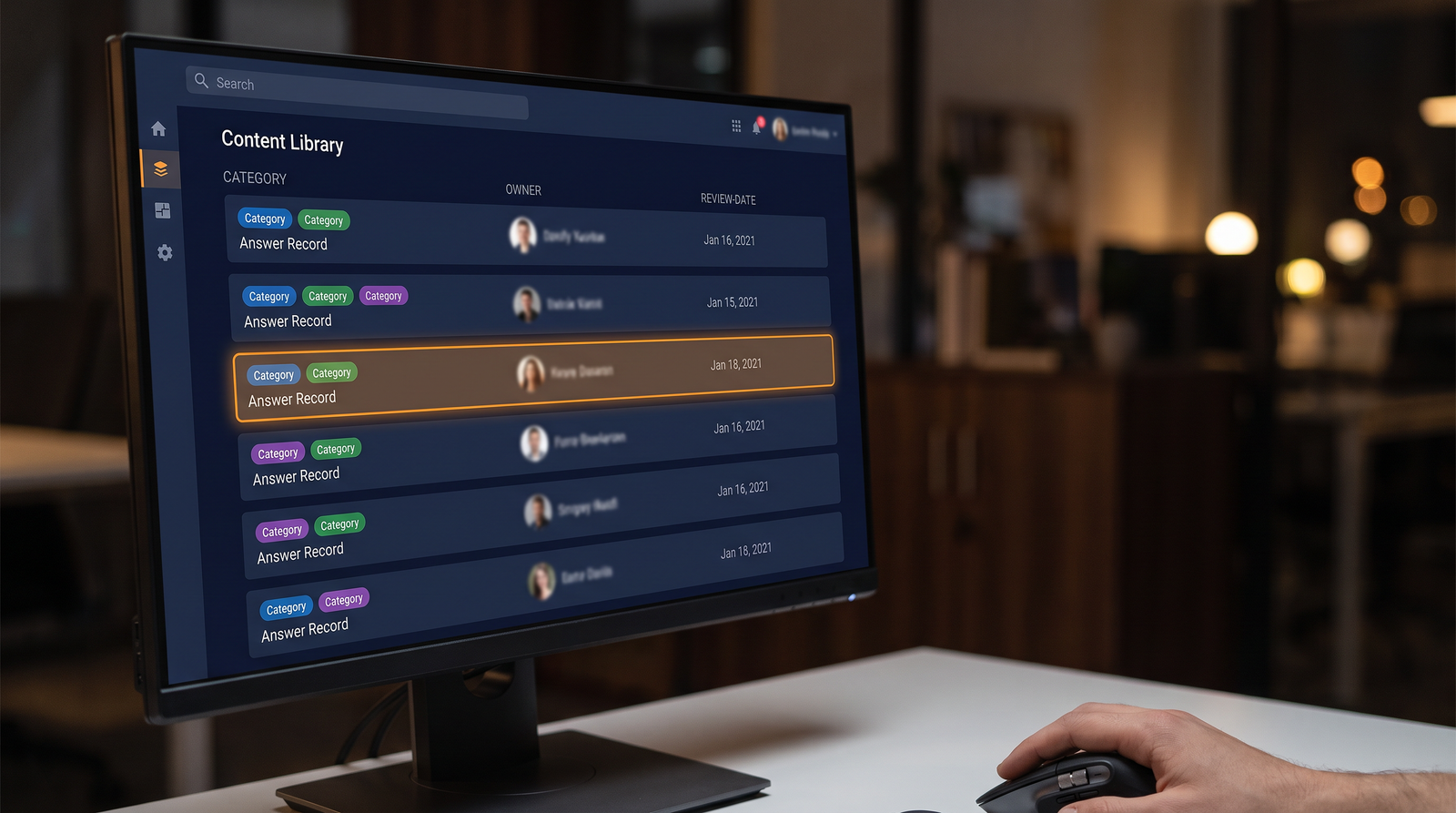
The most common failure is asking people to contribute to the library as a separate task. It never survives quarter-end. Capture has to happen where the work happens: when a subject matter expert answers a question in a live questionnaire, that approved answer should become library content in the same action, with an owner attached. That is the whole design principle behind a governed content library. The library is a system of record, not a filing cabinet somebody remembers to update.
Let demand set the review queue
Calendar-based reviews treat every article as equally important, which guarantees that effort goes to the wrong places. A demand-driven queue asks better questions. Which answers were used most last quarter? Which were edited before every single submission? Which were flagged by an SME and never resolved? Those are the articles worth expert time. Structured review workflows make that routable instead of aspirational.
Judge content by fitness for use
KCS sets a deliberately low bar for capturing an article and a high bar for reusing one. An article does not need to be beautiful. It needs to be correct and findable by the next person who needs it. For response teams, that means accepting a slightly rougher first capture in exchange for coverage, then letting the Evolve Loop improve the answers that actually get pulled.
What changes when it works
Two things move. Reuse goes up, because the library finally covers what is actually asked. Cycle time comes down, because responders stop rewriting answers that already exist somewhere in the organization. The second-order effect matters more than either: institutional knowledge stops living in the heads of three senior people. When a lead responder is out for a week, the RFP response still goes out on time.
That is the real argument for treating your answer library as a knowledge base rather than a document repository. Knowledge management is not overhead bolted onto response work. Done properly, it is the response work, captured once and paid back on every questionnaire after it.
If your team is rewriting the same answers every quarter, the gap is usually workflow, not effort. Book a demo to see how capture, ownership, and review run inside a single response workflow.
Looking for the platform behind this? See the RocketDocs platform or book a demo.


