
Why Your RFP Content Library Is Always One Step Away From Costing You a Deal
You built the business case for a response management platform. You engaged RocketDocs, aligned on sales goals, and worked with a Customer Success Manager to build a library structure around industry best practices. Then the RFPs started coming in, and the content library quietly drifted.
This is one of the most common challenges RocketDocs clients raise: keeping content current. And it makes sense. When you are moving from one deadline to the next, content management feels like a luxury. It is not. A library full of outdated, inconsistent, or unvalidated responses is a liability that shows up in your proposals whether you notice it or not.
This guide lays out a repeatable, practical framework for managing your RocketDocs content library so it works for your team instead of against it.
The Three-Part Content Management Framework
Strong content management rests on three pillars: ownership, archiving, and validation. Get these right and the rest of the process follows naturally.
01. Establish a Content Owner
Every library needs a single accountable person. The content owner serves as the gatekeeper for all additions, edits, and removals. They build the content management plan, set the review calendar, and make final calls when SME input conflicts or goes silent.
This role does not have to be a full-time position, but it does need to be a named responsibility. Without it, content management defaults to whoever has a spare moment, which usually means no one.
What the content owner should do on a regular cadence:
- Meet with writers to surface information gaps, rewrite suggestions, and friction points
- Check in with SMEs to strengthen relationships and keep subject matter experts informed of process changes
- Monitor usage data in RocketDocs to flag responses that are being skipped or consistently edited before use
02. Systematically Archive Obsolete Content
Outdated responses slow searches, increase the risk of writers pulling stale information, and force last-minute SME reviews during active RFPs. Neither outcome serves your win rate.
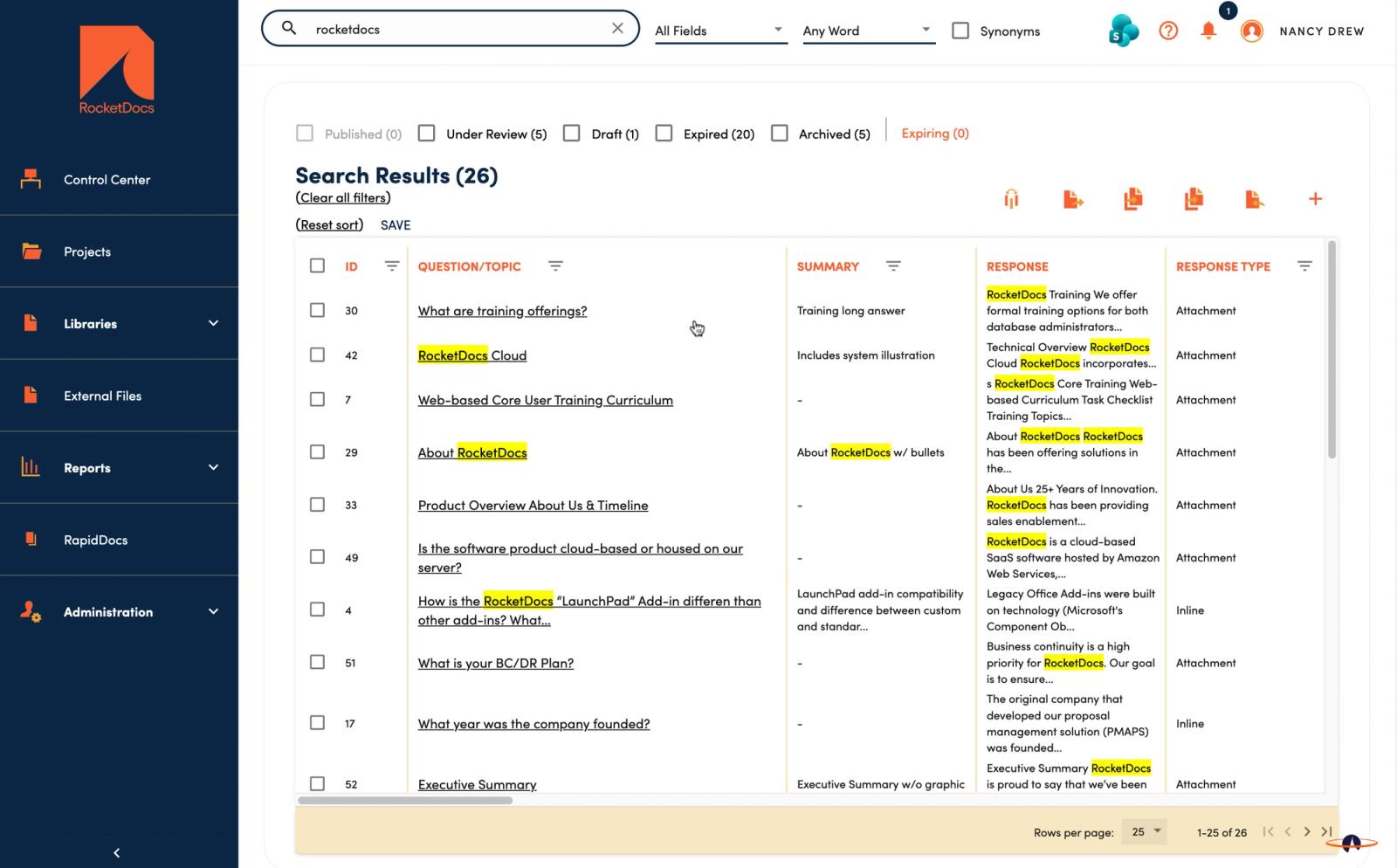
RocketDocs captures usage data at the record level. Use it. If two similar responses exist and one has not been selected in twelve months, that is a strong signal it should be archived. Keeping the library lean makes searching faster and gives writers more time to personalize and polish rather than sort through duplicates.
A useful rule of thumb: if you would hesitate to use a response as-is in a live RFP, it should be archived or rewritten before it can cause damage.
03. Validate That Content Is Accurate, Consistent, and Compliant
This is the most labor-intensive step, especially the first time through. It is also the most important. Validated content builds trust across your team. Writers stop second-guessing what they pull. Compliance teams stop firefighting. Reviewers spend time improving answers rather than correcting them.
RocketDocs includes built-in tools to automate much of this process, which are covered in detail below. Your CSM is also a resource here. If you are unsure how to structure a review cycle for your library's size, ask them before you start.
Launching the Content Management Process
Before you roll out a content management plan, have the content owner audit the existing library to confirm every record is assigned to the right SME. Misassigned content means reviews land with the wrong person and either get ignored or come back with inaccurate edits.
Once the audit is complete, consider hosting short one-on-one kickoff meetings with each SME. The goal is to surface known issues, establish expectations, and get buy-in before the first review cycle begins.
A practical agenda for those meetings:
- Show examples of known library issues that illustrate why a content management plan is needed
- Present the proposed solution and review cadence
- Agree on review frequency (see below)
- Set editing expectations and explain what good looks like
- Introduce the negative consent rule
- Close by connecting this work directly to their goals: fewer ad-hoc requests during live RFPs, faster turnaround, and more confidence in the content they own
Review Frequencies
There is no universal answer here, but a practical starting point is annual reviews for all active content, with quarterly reviews for content that changes more often, such as pricing, product capabilities, regulatory language, or team information.
If an SME is uncertain about what frequency makes sense for their content, start quarterly and adjust after the first two cycles. The first review is always the most time-consuming. After that, the delta between cycles shrinks quickly, and the review becomes a quick check rather than a full rewrite.
| CONTENT TYPE | SUGGESTED REVIEW FREQUENCY |
|---|---|
| Regulatory and compliance language | Quarterly or as regulations change |
| Pricing and product capabilities | Quarterly |
| Company background and team bios | Semi-annually |
| Process and methodology responses | Annually |
| Evergreen educational content | Annually |
Editing Expectations
When you send content to an SME for review, be specific about what you need from them. A vague request to "take a look" produces vague results.
Ask reviewers to:
- Correct factual errors
- Update data points and statistics
- Clarify language that is ambiguous or overly technical for a non-specialist reader
- Confirm the response still accurately and concisely answers the question it was written for
- Remove repetitive or redundant phrasing
Always require tracked changes. This is not optional. Tracked edits allow the content owner to catch tone inconsistencies, identify when a single change affects related records, and maintain an audit trail. If you have an editorial review layer after the SME review, tell your SMEs so they can focus on accuracy and leave grammar to the editorial pass.
Building in Urgency and the Negative Consent Rule
RFPs do not pause while your content is under review. Make that clear from the first meeting.
The most effective tool for keeping reviews on schedule is the negative consent rule: if an SME does not submit edits by the agreed deadline, it is assumed no changes are needed and the content is approved as-is. One follow-up reminder is appropriate. More than one creates a pattern where SMEs learn they can ignore the first (and second, and third) request.
This shifts responsibility where it belongs. The content owner is not a chaser. The SME is accountable for the accuracy of their content. Framing it that way in the initial meeting tends to produce significantly better response rates.
What Good Content Management Unlocks
The downstream benefits of a well-run content management process compound over time.
Writers spend less time hunting for reliable responses. SMEs field fewer emergency requests during active deadlines. Compliance teams have confidence that what goes out the door meets current standards. New team members can onboard faster because the library reflects how the organization actually operates, not how it operated two years ago.
For a deeper look at the RFP response lifecycle, see our guide on RFP response lifecycle phases. For teams managing multiple response types, the post on streamlining RFP and DDQ processes covers how a shared library structure can serve both workflows.
External resources worth bookmarking: the Association of Proposal Management Professionals (APMP) publishes benchmarking data on proposal team structures and content practices, and AIIM's content management resources offer broader context on information governance that applies directly to proposal libraries.
Automate Your Review Process With RocketDocs
The framework above is manageable even without automation. With RocketDocs, it becomes significantly faster.
Using the platform, your content owner can:
- Assign content owners and SMEs at the record level
- Set review cycles that trigger automatically
- Track which content is approved, expired, or pending review
- Configure notifications and alerts so SMEs receive timely reminders without the content owner manually following up
- Bulk-send records for review or stagger them as individual records expire
- Use workflow automation to route content through multi-step review processes
At scale, what previously required manual coordination across a dozen SMEs can be managed in a few clicks per cycle.
To see how this works in practice, book a free RocketDocs demo and ask to walk through the content review workflow.
Looking for the platform behind this? See the RocketDocs platform or book a demo.


