
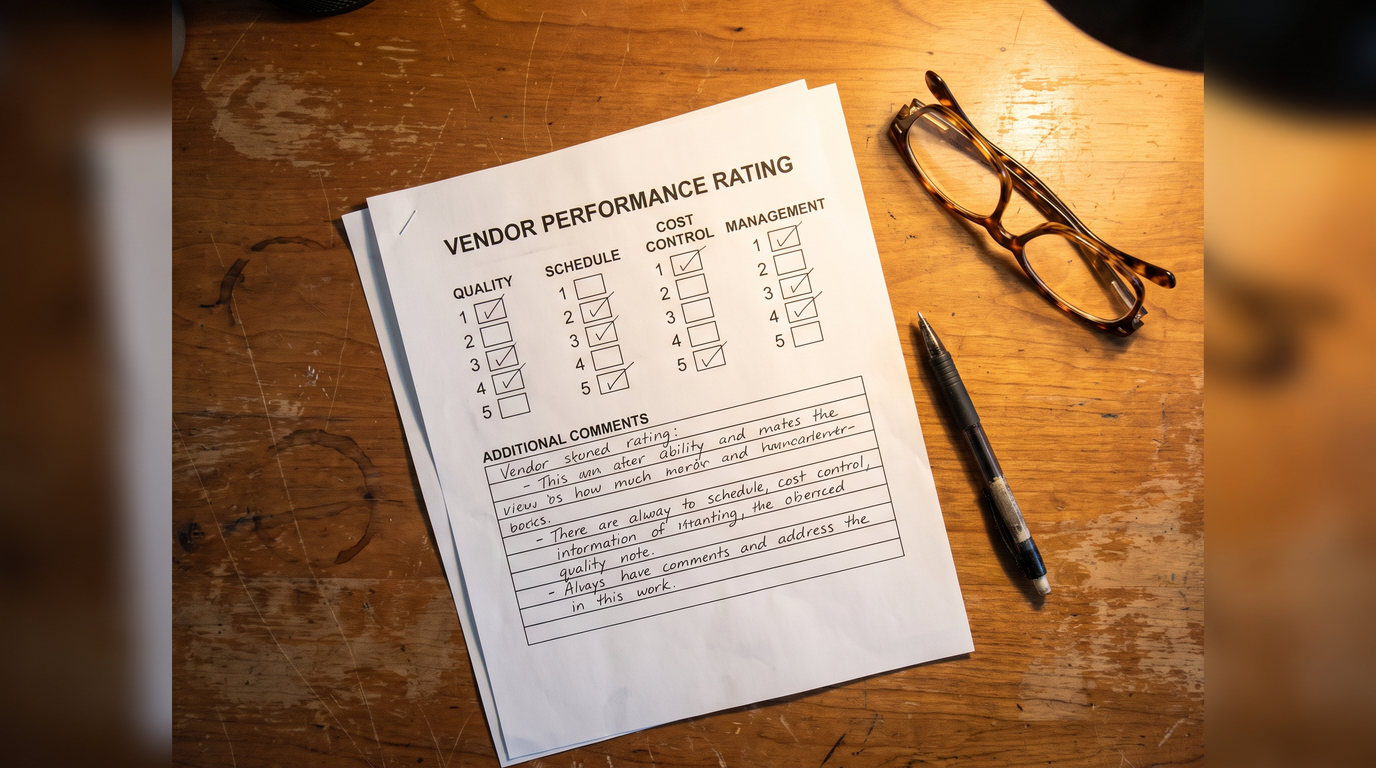
A past performance questionnaire (PPQ) is a standardized reference form a buyer asks your former clients to complete about your work. It usually rates quality, schedule, cost control, and management on a fixed scale, and the completed form goes directly to the evaluator, not through you.
For proposal teams, the PPQ is the one part of a bid you cannot write yourself. Someone outside your company fills it in, and it can decide whether a strong technical score survives the comparison. Knowing what the form asks, how it differs from the government's own performance record, and how to get it returned on time is the difference between a real past performance rating and a blank one.
Past Performance Questionnaire vs CPARS vs Reference Check
Buyers gather past performance three ways, and the three get confused constantly. A questionnaire is a form you help route. The Contractor Performance Assessment Reporting System (CPARS) is a federal record you do not control. A reference check is an unstructured call. Here is how they differ.
| ATTRIBUTE | PAST PERFORMANCE QUESTIONNAIRE | CPARS EVALUATION | REFERENCE CHECK CALL |
|---|---|---|---|
| Who completes it | Your former client or their contracting officer | The government program and contracting office | The evaluator, from a phone conversation |
| Who controls timing | You, by chasing the reference before the deadline | The agency, annually and at contract completion | The evaluator |
| Format | Fixed rating scale plus written comments | Five point adjectival scale plus supporting narrative | Unstructured conversation |
| Where it goes | To the evaluation team for that one solicitation | Into the governmentwide CPARS record | Into the evaluator's notes |
| How long it counts | Only for the solicitation that requested it | Three years after performance ends, six for construction and architect-engineer work | Only for that bid |
| Your input | You select references and supply context | You may submit comments, with 14 calendar days from notification | You select references |
The CPARS column is set by regulation. Under FAR subpart 42.15, agencies prepare past performance evaluations at least annually and again when the work is complete, rate contractors on a five point scale running from exceptional to unsatisfactory, and give contractors up to 14 calendar days to comment. CPARS is the official source for federal past performance information, and evaluations are filed at cpars.gov. A past performance questionnaire sits outside that system. It is a solicitation attachment, so the buyer decides what it asks, who may complete it, and where it is returned.
What a Past Performance Questionnaire Asks
Forms vary, but most questionnaires, commercial and public sector alike, borrow the evaluation factors the federal government already uses. FAR 42.1503 sets the minimum set for a federal assessment, and it is a reliable preview of what any reference form will cover:
- Technical performance, meaning the quality of the product or service delivered
- Cost control, where the contract type makes it relevant
- Schedule and timeliness, including the administrative side of performance
- Management and business relations, covering responsiveness and problem resolution
- Small business subcontracting, when a subcontracting plan applies to the contract
Two things on the form matter more than the ratings. The first is the free text comment box, where one specific sentence about a delivery your team saved carries far more weight with an evaluator than a column of high marks. The second is some version of would you select this contractor again, which is the line evaluators read first and remember longest.
How Evaluators Use Past Performance
FAR 15.305 directs federal evaluators to weigh the currency and relevance of past performance information, its source, its context, and the general trend in a contractor's performance. Relevance is the part responders underestimate. A glowing reference on a contract half the size, in a different domain, scores lower than a merely satisfactory reference on work that closely resembles the requirement being bid.
The same section requires the solicitation to describe how past performance will be evaluated and to give offerors a chance to identify past and current contracts, including federal, state, local government, and private work. It also tells evaluators to consider predecessor companies, key personnel with relevant experience, and subcontractors performing major aspects of the requirement. That is how a newly formed entity can still present a credible record.
If you have no relevant record at all, FAR 15.305(a)(2)(iv) says you may not be evaluated favorably or unfavorably on past performance. That neutral treatment is not a penalty, but it is not a differentiator either, so it is almost always worth surfacing commercial references rather than leaving the factor empty.
Commercial and financial services buyers run a lighter version of the same logic. The scoring is less codified, but the weighting is real, and past performance usually sits inside the experience and qualifications criterion. Our guide to RFP evaluation criteria covers where that criterion typically lands in the overall weighting.
How to Manage a Past Performance Questionnaire Without Missing the Deadline
Most lost past performance points are logistics, not performance. The reference was picked late, briefed poorly, or never returned the form at all.
Choose references for relevance, not warmth
Match scope, dollar value, contract type, and recency against the requirement before you match enthusiasm. Build the shortlist while you are qualifying the opportunity, not the week the proposal is due. On federal work that means starting at the market research stage, when a sources sought notice first tells you what kind of experience the agency intends to ask about.
Brief the reference before the form arrives
Call the reference, confirm the right individual and their current contact details, tell them what is coming and when it is due, and remind them of the specifics: the scope, the dates, the problem you solved. A reference reconstructing a three year old engagement from memory writes vague comments, and vague comments read as lukewarm.
Track every outstanding questionnaire as a deliverable
Put each questionnaire on the proposal schedule with an owner, a send date, a follow up date, and an internal cutoff several days before the solicitation deadline. Many solicitations require the reference to return the form directly to the contracting officer, which means you will never see it land unless you ask. Confirm receipt rather than assume it.

Where Your Answer Library Fits
Past performance is the most reusable content a response team owns and the least often stored properly. The same contract descriptions, scope summaries, outcome metrics, and reference contacts get rebuilt from scratch for every bid, usually by someone who was not there. Keeping them in a governed content library alongside your approved answers turns reference management from an archaeology project into a lookup, with named owners, review dates, and an audit trail showing who approved which claim.
That capture, reuse, and improve discipline has a name outside proposal work. The Consortium for Service Innovation formalized it as Knowledge-Centered Success (KCS), a methodology that treats knowledge as a byproduct of doing the work and keeps each answer current through use rather than through an annual cleanup. Past performance records behave the same way. They get more accurate every time a live bid forces someone to check them.
RocketDocs helps regulated response teams keep reference data, contract histories, and approved answers in one governed library. See how our RFP response solution supports past performance and reference management, or book a demo with your next solicitation in hand.
KCS® is a service mark of the Consortium for Service Innovation™.
Looking for the platform behind this? See the RocketDocs platform or book a demo.


