
RFP questions and answers is the formal period when bidders submit written questions about a solicitation and the issuer publishes its replies to every bidder. It clears up unclear requirements, scope, and rules before proposals are due, and it keeps competition fair because all vendors receive the same answers at the same time.
RFP Questions and Answers: What Bidders Can Ask
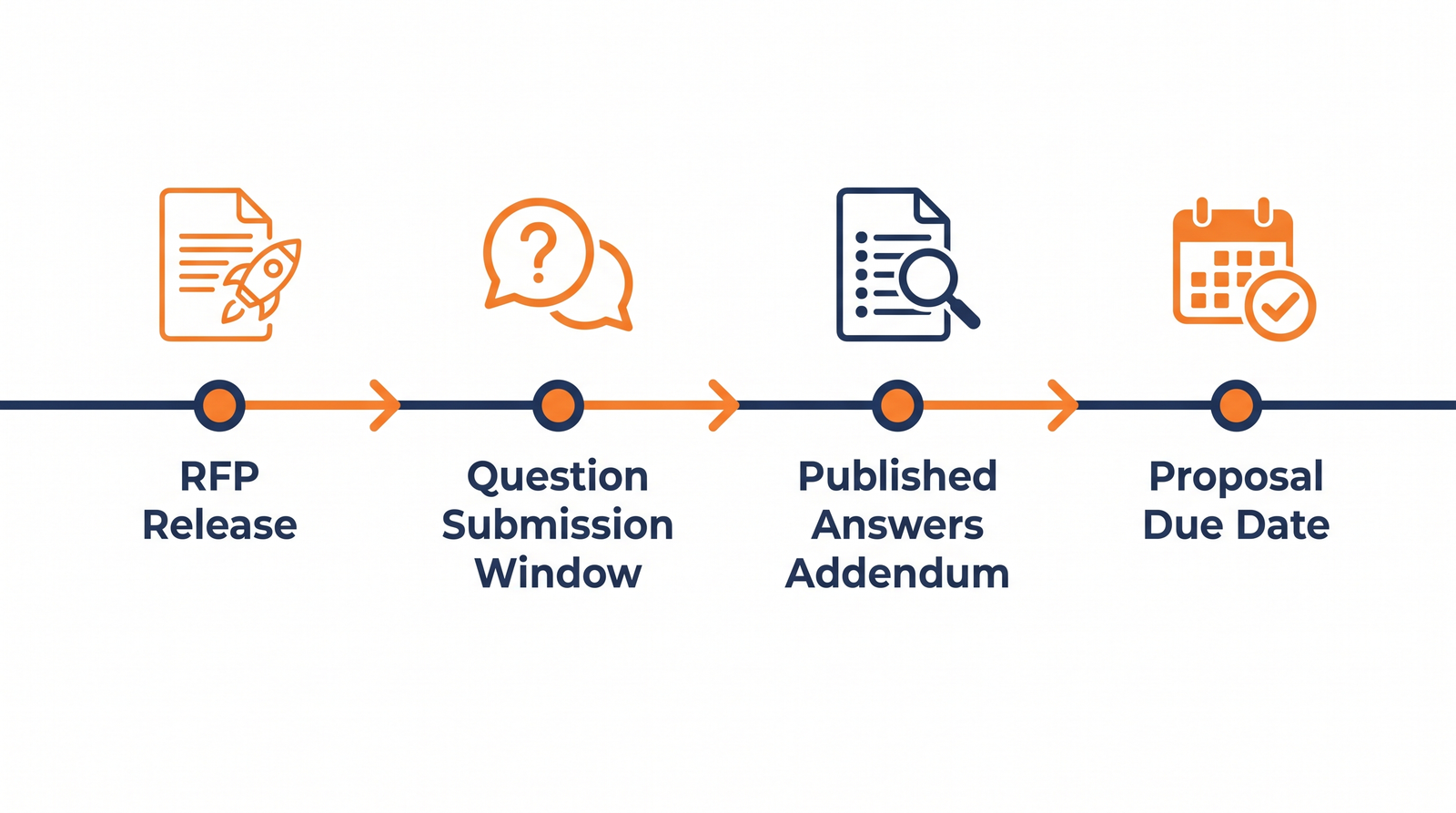
Most solicitations set aside a window for written questions, then publish consolidated answers. The mix of questions that earns a useful reply is narrow: specific, tied to a section, and focused on producing a compliant response. The table below sorts the common question types by what they clarify.
| QUESTION TYPE | WHAT IT CLARIFIES | EXAMPLE WORDING |
|---|---|---|
| Scope | What is in and out of the work | Section 3.2 lists onboarding. Does it include data migration? |
| Requirements | Mandatory versus optional items | Is the SOC 2 report in Section 5.1 required at submission or at award? |
| Evaluation | How responses are scored | Are the weights in Section 7 applied to each sub-criterion? |
| Format | Page limits, file types, portals | Do appendices count toward the 25 page limit? |
| Pricing | Cost model and assumptions | Should pricing assume a three-year or five-year term? |
| Timeline | Dates and milestones | Is the stated award date firm? |
How the Q&A Period Usually Works
Mechanics vary by issuer, so the RFP instructions always win. One public example is Arizona State University, which asks suppliers to submit questions two weeks before the RFP closes and posts answers to all suppliers through an addendum or its sourcing portal. Other issuers hold a pre-bid conference, accept questions by email, or use a portal with a hard cutoff.
In United States federal buying, the principle behind this is equal access. FAR 15.201 requires that when specific information about a proposed acquisition is disclosed to one or more potential offerors, it must be made available to the public as soon as practicable, no later than the next general release of information. That is why a private answer to your question usually becomes a public answer to everyone.
Treat the deadline as your real deadline
The question cutoff arrives long before the proposal due date, often while your team is still reading the document. Build the cutoff into your schedule on day one, and work backward from it to set an internal deadline for submitting your list.
Why the Questions Period Improves Your Response
A well-timed question prevents a costly misreading. As VisibleThread notes in its overview of clarification questions, asking warranted questions when permitted shows diligence and can reduce risk by clarifying ambiguous or silent areas, and the answers can lead to amendments that change the requirements.
The published answers are also a window into the field. Questions from other vendors, once the issuer strips names, reveal which requirements are unclear, which are being challenged, and where the buyer may be flexible. Read the whole answer document, not just the replies to your own questions.
How to Write Questions the Issuer Will Answer
Issuers answer clear, narrow questions faster and more completely. Use these habits:
- Cite the section and page number so the issuer can find the text without guessing.
- Ask one issue per question, so a partial answer does not leave you with a gap.
- Propose language when a requirement conflicts with another section, for example by stating which reading you plan to follow.
- Avoid questions that reveal your pricing, strategy, or differentiators, since answers are shared with every bidder.
- Ask about silent areas such as volumes, incumbent systems, and integration points that affect your solution design.
A Team Workflow for the Q&A Period
The weakest teams collect questions in scattered emails and miss the cutoff. A repeatable workflow fixes that:
- Read the full RFP once and log every ambiguity in a single question log with the section, the question, the owner, and the status.
- Send subject matter experts only the items in their area, and ask for a short written reply by an internal cutoff two business days before the issuer deadline.
- Consolidate, edit for clarity, remove anything that exposes strategy, and submit the questions in the format the issuer requires.
- When answers arrive, update your compliance matrix, pricing assumptions, and outline, and note any addendum the RFP requires you to acknowledge.
Teams that run many responses at once benefit from tracking this in the same place as the rest of the project. RocketDocs workflows assign each section and question to an owner, track due dates with escalating notifications, and log approvals. For a broader view of the response steps around the Q&A window, see our guide on how to respond to an RFP.
Common Mistakes to Avoid
The most frequent error is waiting until the final week to read the requirements, which leaves no time for questions. The second is asking questions that really belong in the proposal, such as how to win. The third is failing to read the addendum, which can change dates, scope, or required forms. Finally, avoid contacting anyone at the issuer outside the stated channel, because many RFPs restrict communication and may disqualify bidders who ignore the rule.

If your team answers RFPs often, a structured process for the Q&A period is one of the cheapest improvements available. Explore how RocketDocs supports RFP response with private AI, Office-native workflows, and a full audit trail.
Looking for the platform behind this? See the RocketDocs platform or book a demo.


