
A compliance matrix is a table that maps every requirement in an RFP to the exact part of your proposal that answers it, along with the owner and the compliance status. Proposal teams use it to prove full compliance, avoid disqualification on a technicality, and give evaluators a clear trail from each requirement to your response.
Miss one mandatory requirement and a strong bid can be thrown out before anyone reads your win themes. A compliance matrix is the control that stops that from happening. This guide explains what a compliance matrix includes, how to build one step by step, and how to populate it faster by reusing approved content.
What a compliance matrix includes
At its core, a compliance matrix is a requirement-by-requirement checklist. Every row is one obligation pulled from the RFP, and every column records how you meet it and who is accountable. The exact columns vary by team, but a reliable structure captures the requirement, your compliance status, where the response lives, and the owner.
| COLUMN | WHAT IT CAPTURES | EXAMPLE |
|---|---|---|
| Requirement ID | A unique reference to each RFP requirement | Section 3.2.1 |
| Requirement text | The exact language quoted from the RFP | Vendor must provide 24/7 support |
| Compliance status | Whether you comply fully, partially, or not | Fully compliant |
| Proposal location | Where the response lives in your bid | Volume 2, page 14 |
| Owner | The person or SME accountable for the row | Security lead |
| Notes | Risks, assumptions, or follow-ups | Pending legal review |
Keep the language in each requirement row verbatim from the RFP. Paraphrasing is where teams accidentally soften a mandatory shall into an optional should and lose the traceability an evaluator expects.
Why a compliance matrix matters for RFP responses
Most competitive solicitations, especially in government and regulated procurement, score compliance before they score quality. Evaluators often work from their own checklist derived from the same requirements, so a matrix that mirrors their structure makes their job easier and your bid harder to mark down. The U.S. Federal Acquisition Regulation formalizes this expectation of responsiveness in public procurement.
A compliance matrix also protects the team internally. It turns a vague did we cover everything into an auditable list with named owners, which shortens review cycles and makes bid decisions defensible. The Association of Proposal Management Professionals treats requirement compliance as a foundational discipline. For a deeper look at how evaluators assign points, see our guide to RFP evaluation criteria.
How to build a compliance matrix
Building a compliance matrix is a repeatable process. These five steps work whether you keep it in a spreadsheet or inside proposal software.
1. Shred the RFP into discrete requirements
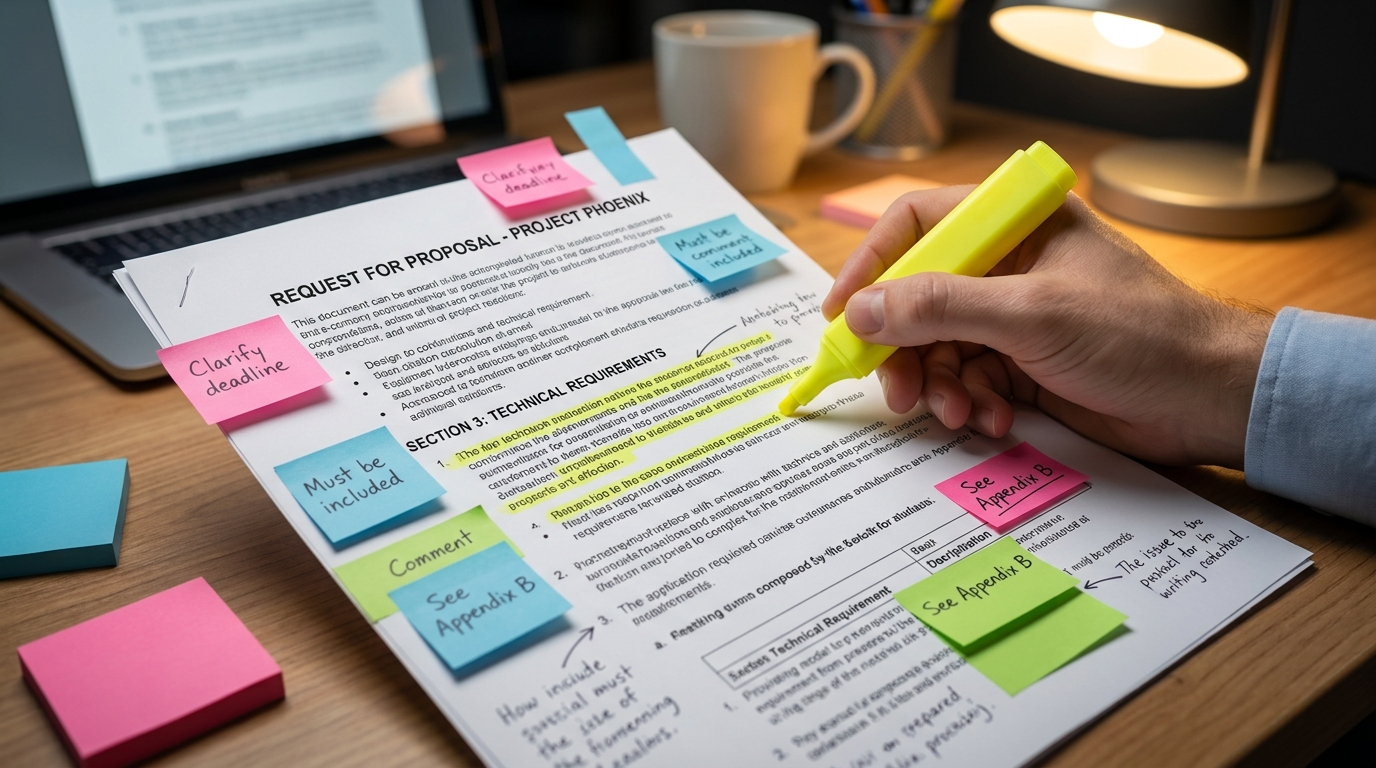
Read the full solicitation and break every shall, must, and will into a single, numbered requirement. This step, often called shredding, is tedious by hand but is the foundation everything else sits on. Do not skip appendices, attachments, or the statement of work, where requirements frequently hide.
2. Set up your columns
Add the columns from the table above: requirement ID, requirement text, compliance status, proposal location, owner, and notes. A three-tier status of fully compliant, partially compliant, or non-compliant is usually enough; add compliant with exception if your deals involve negotiated terms.
3. Assign an owner to every row
Every requirement needs one accountable person, usually a subject matter expert. Unassigned rows are the ones that slip. Sharing the matrix early also surfaces requirements no one can meet while there is still time to plan a partner, an exception, or a no-bid.
4. Populate responses and status
Fill in where each requirement is answered and mark the current status. As drafts mature, the matrix becomes a live dashboard of how compliant the bid is at any moment, not a document you assemble once at the end.
5. Review for gaps before submission
Do a final pass to confirm no requirement is unassigned, unanswered, or marked non-compliant without a decision behind it. This review is your last defense against a disqualifying omission. Our step-by-step guide to responding to an RFP covers where this review fits in the wider timeline.
Populate your compliance matrix faster with reusable content
The slowest part of any matrix is writing the same answers you have written many times before. A maintained content library of pre-approved responses lets you drop proven language into each row instead of drafting from scratch, which is where most of the cycle-time savings come from.

This is a knowledge-reuse problem, and the discipline that addresses it well is Knowledge-Centered Success (KCS®), the methodology developed by the Consortium for Service Innovation and previously published as Knowledge-Centered Service. It treats every answer as a reusable asset that improves with use, an approach set out in the KCS Practices Guide. Applied to proposals, it means every compliant answer you write once is captured, rated, and reused across future matrices.
See how response teams build a content library that keeps answers current so the matrix pulls from a single source of truth rather than a pile of old proposals.
Common compliance matrix mistakes
The failures are predictable: paraphrasing requirements instead of quoting them, leaving rows unowned, treating the matrix as a one-time artifact instead of a living document, and hiding it in a personal spreadsheet no reviewer can see. Each one reintroduces the disqualification risk the matrix exists to remove. For how a compliant response is structured end to end, see our RFP response templates and examples.
A compliance matrix is only as fast as the content behind it. RocketDocs pairs requirement tracking with a governed content library and AI-assisted response, so your team can shred an RFP, assign owners, and fill compliant answers in a fraction of the time. See how it works on the RocketDocs platform.
KCS® is a service mark of the Consortium for Service Innovation™.
Looking for the platform behind this? See the RocketDocs platform or book a demo.


