
Win-loss analysis is the structured review of why your proposals win or lose. Proposal and RFP teams gather data from buyers, evaluators, and internal reviewers after each decision, then turn recurring patterns into changes that raise the win rate. Done consistently, it converts scattered anecdotes into a repeatable competitive advantage.
Most teams already sense why they lose. The trouble is that those reasons live in inboxes, hallway conversations, and the memory of whoever wrote the response. A structured win-loss program replaces gut feel with evidence. The table below shows the difference between an ad hoc debrief and a real win-loss analysis.
| DIMENSION | AD HOC DEBRIEF | STRUCTURED WIN-LOSS ANALYSIS |
|---|---|---|
| Timing | After a memorable loss | After every closed bid, win or loss |
| Data source | The proposal owner's memory | Buyers, evaluators, and the internal team |
| Objectivity | Colored by who is in the room | Standardized questions and reason codes |
| Output | A vague lesson soon forgotten | Tracked reasons and assigned actions |
| Effect on win rate | Rarely measurable | Compounding and measurable over time |
What win-loss analysis actually measures
A win-loss analysis looks past the final yes or no to the factors that drove it. Price is the reason teams cite most often, yet it is frequently a symptom rather than the cause. Buyers reach for price when a proposal fails to make the value obvious. A disciplined review separates the deals you lost on genuine price gaps from the ones you lost on unclear differentiation, missing proof points, slow response times, or a mismatch with the buyer's evaluation criteria. Industry bodies such as the Association of Proposal Management Professionals have long argued that teams who study outcomes systematically qualify harder and write more responsive proposals over time.
Why win-loss analysis matters for proposal teams
Every hour your team spends on a proposal is an hour it cannot spend elsewhere, so the return on that time depends on two things: chasing the right bids and answering them well. Win-loss analysis improves both. It sharpens your bid/no-bid decisions by showing which opportunity types you actually convert, and it feeds concrete edits into the responses themselves. If loss reviews keep flagging a weak implementation-timeline answer, that is a fixable content problem, not a mystery. Pairing the findings with proven RFP response strategies is how a team turns insight into a higher win rate.
How to run a win-loss analysis
You do not need a dedicated analyst or expensive software to start. You need a consistent process and the discipline to run it after every closed bid. Here is a practical sequence.
Capture the decision data
Log the outcome the moment a bid closes: the opportunity, the buyer, the deal size, the competitors, the final result, and the stated reason. Capturing this while it is fresh is what makes later analysis trustworthy.
Interview the buyer
A short debrief with the buyer is the highest-value step and the one most teams skip. Ask open questions: what stood out, where you fell short, and how you compared with the winner. Buyers are often more candid than you expect, especially when a neutral third party asks rather than the salesperson who owns the relationship.
Debrief your own team
Run a parallel internal debrief with the writers, subject matter experts, and the deal owner. Compare their read against the buyer's. The gap between what your team thought happened and what the buyer says happened is often the most useful finding in the whole exercise.
Code the reasons
Group every outcome into a small, fixed set of reason codes such as price, product fit, differentiation, response quality, relationship, and timing. Consistent codes are what let you see patterns across dozens of deals instead of reacting to the last loud loss.

Turn win-loss insights into a stronger content library
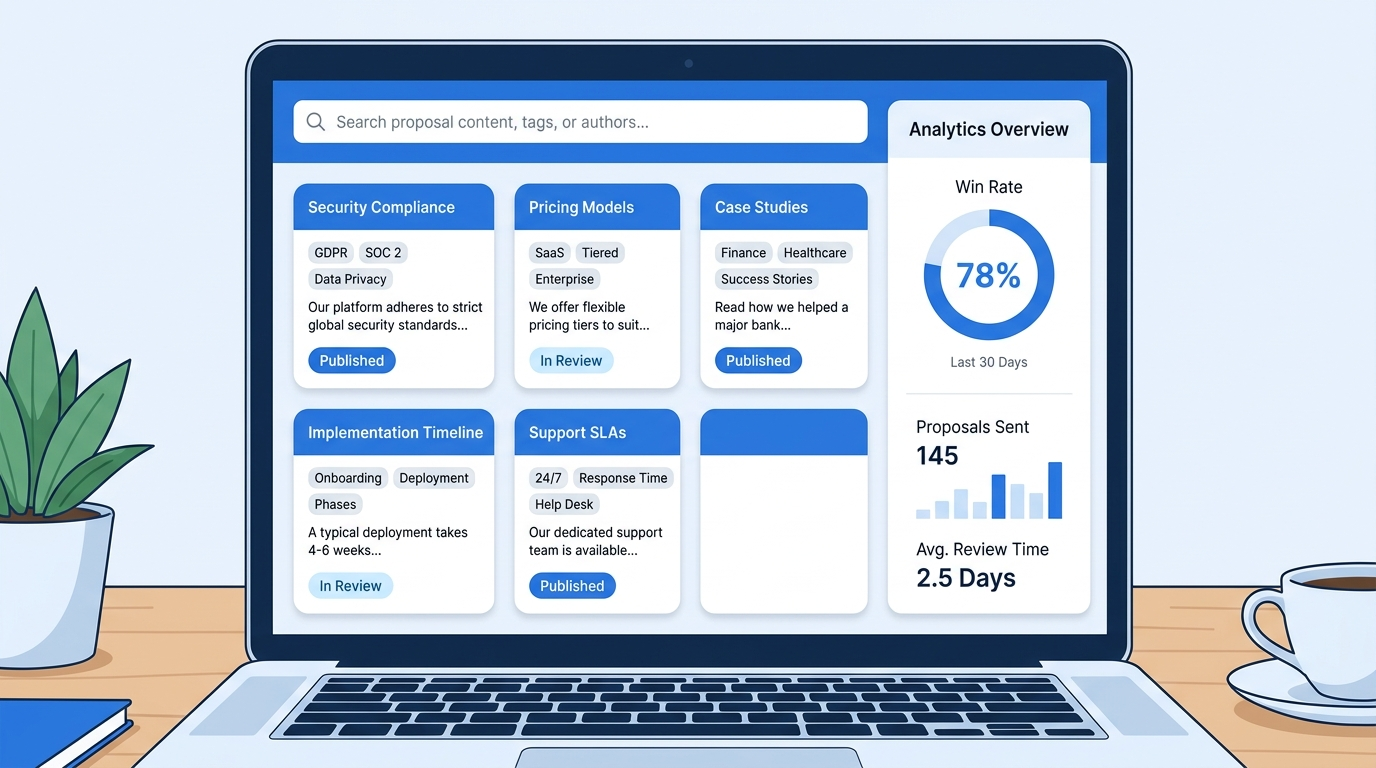
Analysis only pays off when it changes what your team does next. The most durable place to capture that learning is your content library, the approved answers your team reuses on every response. When a loss review shows that your security answer read as boilerplate, the fix is to rewrite that library entry so the next ten responses inherit the improvement automatically. This is knowledge management applied to proposals, and the discipline behind it is well established.
The Consortium for Service Innovation formalized this approach as Knowledge-Centered Success, better known as KCS®, a methodology built on capturing knowledge as a byproduct of solving problems and improving it through reuse. Its principles map directly onto a proposal library: capture what you learn in the flow of work, structure it so it is easy to find, and let real demand drive what you refine. Teams that want the detail can work through the KCS Practices Guide. A modern content library adds review cycles and ownership so those improvements do not quietly decay.
Win-loss metrics worth tracking
A handful of numbers turn the exercise into a trend you can manage. Track win rate by opportunity type, not just overall, so you can see where you are genuinely competitive. Track the distribution of loss reasons to find your biggest fixable gap. Track the ratio of bids you declined to bids you pursued, since a healthy program should make you more selective. And track how many content-library updates each quarter trace back to a loss review, which tells you the feedback loop is actually closing.
Win-loss analysis is where better proposals begin, but the payoff depends on getting those lessons back into the responses your team sends every week. See how RocketDocs RFP response turns an approved, continuously improved content library into faster, more competitive RFP and DDQ responses.
KCS® is a service mark of the Consortium for Service Innovation™.
Looking for the platform behind this? See the RocketDocs platform or book a demo.


