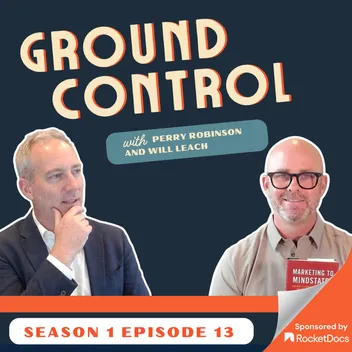
Most B2B proposals lose before anyone reads a word of the pricing. In this episode of Ground Control, the podcast on AI, proposals, and governance sponsored by RocketDocs, host Perry Robinson talks with Will Leach, best-selling author of Marketing to Mind States and founder and CEO of the Mind State Group. A former military engineer turned behavioral scientist, Will spent 25 years studying why people really buy and the answer is almost never the reason they give you.
The core lesson: 95% of decisions are made below conscious awareness, inside temporary emotional states Will calls mind states. Identify the four factors behind one goals, motivation, regulatory approach, and cognitive biases and you can write a proposal, email, or RFP response that fits how the reader actually decides, instead of competing on features.
Along the way Will covers the PULL framework for qualifying real opportunities, how he uses AI to embed psychological cues in his deliverables, the graphic-novel trick that makes buyers feel like the hero, selling to committees you never meet, and Bevi, his behavioral intelligence system that lets brands ask a virtual customer what it thinks. His closing line: all we did was put science around intuition.
Connect with Will Leach
Work with Will: https://mindstategroup.com/
LinkedIn: https://www.linkedin.com/in/will-leach/
Get the book (Marketing to Mind States): https://a.co/d/0cnopkoY
Find Ground Control
Apple Podcasts: https://podcasts.apple.com/us/podcast/ground-control-sponsored-by-rocketdocs/id1896052098
Spotify: https://open.spotify.com/show/00xAPsKE61ff5X5YC4ndRA
YouTube: https://www.youtube.com/@rocketdocs6075
All episodes: https://rocketdocs.com/resources/podcast
Find RocketDocs
The response management platform built for regulated industries - trusted since 1994.
Website: https://rocketdocs.com
Book a demo: https://rocketdocs.com/demo
Show transcript
Perry: hey everybody, welcome to ground control. We've got Will Leach with us today. He's the author of Marketing to Mind States. and and and the CEO of of the Mind State Group. That's where he Business he founded is a behavioral research firm. Right. Now I I can't help but saying that we've got a best selling author on the show, right? So Marketing to Mind States, a practical guide to applying behavioral design to research and marketing. It's a lot of words. You're going to learn a lot about it from Will. Part of the reason that Will is an author on this is that he's passionate about the subject, right? And that part's gonna come out too. he's so much so that he actually is an instructor at SMU's Cox School of Business. that's in the Dallas-Fort Worth area for those that don't know, which is where he resides. But he also is an instructor at Texas AM's applied behavioral economics program, right? So we've legitimately got an expert in the field on the show with us today. 25 years. Experience and behavioral insights, great professional background. Will is definitely widely regarded as one of the world's leading experts on subconscious mind state research. And because of that, there are a lot of businesses out there that consult with him in order to grow their brands using behavioral research. Will, welcome to ground control. Will Leach: Woo! Perry, thank you for having me. I feel very lifted and honored after that that that that introduction. It was great. Perry: Well, you know, it's interesting. You know, we've got all sorts of different folks that we get on the show these days. but, you know, occasionally we'll get, you know, the good luck of having somebody who's as well established as you and and prominently so, because I think a lot of the people that we have, they're definitely experts in their space. but a lot of them are are quietly experts in their space where they're they're known by their clients or they're known by their team members. But when you get to the stage of writing a book, then it definitely puts you out there in in the public space. and when that book becomes a best-selling book, right, then you kind of become a little bit of a celebrity, right? So, you know, when you're walking down the street, well, do people recognize you, pull you aside and ask for autographs yet? Will Leach: yeah, I I usually wear the sunglasses, especially at these really cool market research conferences, you know, where everyone goes Perry: yeah. Will Leach: to the market research conference. I'm a big deal in that little space. No, no, no. Nothing like that at all. Nothing like that. Yeah. Perry: It's there they're like tens and tens of thousands of folks, I know, so it's it's a it's a tough one for you. It's a tough life. Will Leach: Yep. I yeah, I deal with it, you know, humbly as as best as I can, you know. Perry: well aside from the great humility, tell me like what what made you decide to write a book? and and what made you actually let's start it just a little bit earlier. What got you into the field in the first place? Will Leach: Yeah, you know, it's probably like many guests that you have. I wandered into it. So I started my career in the US military as an engineer. I thought I'd be in the military for my entire life, but quickly I learned being enlisted that if you're gonna do a military bat you know, you're gonna do a military job, you ought to be an officer. So I went to I Perry: Yeah. Will Leach: got out of the military to go into an ROTC program at the University of Florida, just because I grew up in Florida. And it didn't take me but just a few days to realize that. The civilian world is okay. There's nothing wrong with the civilian Perry: Yeah. Will Leach: world. So so I I I went down the traditional business line. I was in economics, and then I did my master's at at Tech St. University, applied econometrics. And I went into the world of market research, just working for big brands, trying to understand human behavior. I did not come from a sociology background, a psychology background. I was a quant jock, right? Perry, I was a data guy. And I found my way, I was in energy for a while, moved away into biotech, but Where I was introduced to behavioral science was over at PepsiCo. So the division of Free to Lay Perry: Yeah. Will Leach: is headquartered in Dallas. I moved to Dallas for a job. I wound up over at Free-Doly. And about 2009, we had a CMO who came in from Kraft. And you know how CMOs are, they when they come to the new organization, they have to blow up something and they he blew up research. He's like, you don't know how you're doing how to do research. Fine, that's your deal. But he invested about $20 million into behavioral science. So, for you guys out there that don't know this, it's the study of the subconscious and all these factors that influence decision making. So, we brought Perry: Mm-hmm. Will Leach: in neuroscientists, culture anthropologists, and I was running a laboratory. And I talk about in my book, I was running a laboratory and it was just a normal, you know, rotation. And getting the time to talk to neuroscientists and behavioral psychologists and behavioral economics became really popularized back in 2010. I fell in love, man. I fell in love. And I was doing was looking at my degrees, thinking to myself, All I had learned in in my degree program was that we we have to, you know, optimize utility. And that's how we make decisions. We make we have these evidence-based decision making, and all of that is not true. And so I sat there and looked at my degree and said, I don't believe in any of it that I learned and those paying off student loans. I said, I'm gonna move into the behavioral science society. And that's what I did. It was it's a passion. You could tell through my voice. Like God put me on the world to do two things, and this is one of them: is understanding. the non-conscious. But I was just lucky enough to to look at it through the lens of marketing. So we'll talk about the mind state model in the book, but I specifically apply understanding the non-conscious to marketing and helping brands grow because of that. Perry: I I am just like, one, it's it's such a cool concept. Number two, you know, as somebody who studied cultural anthropology, right, undergraduate major, it's it's great to hear somebody's putting the social sciences to work, you know, it's it's it it doesn't happen all that often, but you know, like go team, right? you know, on that end though, like you know, like just you know, you've you you so you learn about this at at Pepsi and and then you know How would you say like at at that point in time, how how well accepted, you know, is this in the in the space of marketing, right? You know, is it a radical, revolutionary idea? I'm feeling like it's more that than it was generally accepted. Will Leach: Yeah, you know, it's it's funny. It's it's gone up and down. When behavioral economics and behavioral design became popularized, I would say it was around 2014, 2015, when it was really, really popularized. PepsiCo was investing. When PepsiCo and a big company that, people started investing in these in these capabilities. Right at the same time, big data became very popular as well. BCGs coming into organizations, talking about the power Perry: Yeah, yeah. Will Leach: of big data. So what you found is this kind of bifurcation the research world. And the reason why I left Pepsi, in fact, I would still be there today. I loved PepsiCo's culture. I love the brands. I got to run a few of those brands. Perry: Mm-hmm. Will Leach: the issue was that the writing on the wall was that they wanted to go down the world of big data. I came from that background. Remember, I started looking at the world like I'm not sure if I believe in all this data. And I was an econometrician. And so I started my company Perry: Right. Will Leach: because of that. It is a niche field because of big data and how big now it's funny now, it's coming back right now because the promises of big data are. Perry: Right. Will Leach: Falling a lot. Now AI is gonna help a little bit with that, you know? But Perry: Yeah. Will Leach: big data, the sale on big data never materialized. So now companies, the largest brands in the world, are now coming back into the world of let's really deeply understand our customers. And we can't just ask them, why do you buy our products? Because that's not the real reasons why people buy products. It's all the subconscious stuff. So it's becoming more popularized now. But there was a window of a good eight years that the idea of big data was gonna solve all these brands' issues with understanding, you know, why people do what they do, and it just never was gonna materialize because the data itself is wrong. Perry: Okay. An econometrician. Right. And then moving into mind states. Can can you do me a favor? Help hel help me break down what a mind state actually is. Right. And then and then maybe even just like take us through a real world example of of you know identifying one for a brand. Will Leach: Too. Yeah. So first of all, I'll talk about what is a mind state, and then I will talk about the components of a mind state. So a mind Perry: Okay. Will Leach: state is a temporary moment of emotional arousal. You would know it as a hot state. So if you've ever been to Vegas and you lose time at Vegas, you're at the blackjack table, whatever, chances are when you get in these like highly emotional states of mind, you lose track of your rational self and your emotional self starts taking over. A mind state are these. Perry: Mm. Will Leach: So don't think of it as a personality profile. Don't think of it as a segmentation. Though some of my clients use it that way. These are moments of temporary emotional arousal where you are more susceptible to influence because you're using your emotions to make decisions. Now, just so you know, and you're Perry: Okay. Will Leach: everybody out there knows, 95% of all decisions are made at the non-conscious level. 95% of them out of human understanding. Now we post-rationalize those con those all the time. Perry: Okay. Will Leach: You know, why did I split, you know, tens, right? We we had an emotional reaction when we saw 20, we decided to split the tens, and then we post-rationalize that idea based upon whatever theory we think about blackjack. I'll get off the gambling analogies. So if 95% of your decisions are made at the non-conscious level, you need to understand what goes into those components. Like what are those things? A mind state is composed of four different factors. First, are what are people's goals? All human behavior. Is always, always, always towards a goal that you have. Even if it's like I want to avoid something bad, it's still a goal. So we use goal theory to understand goals. So if you don't know somebody's goals, you don't really understand the direction they want to go. What is their ultimate outcome? But you and I have goals all the time, right, Perry? On January 1st, I write all my goals Perry: Mm-hmm. Will Leach: down. On February 18th, I realize that I reached very few of those goals. It's not because my goals are wrong, it's because I lack motivation when things get hard. Perry: Okay. Will Leach: So that's why we bring in motivational psychology. You have to understand what motivates your customer. There's nine core human motivations that drive the vast majority of human behavior: things like autonomy, our desire for freedom or to feel like an individual, empowerment, our desire for control, really big during COVID, right? Or the classic from Maslow security, our desire for safety. So these nine motivations, those are important because you have to, if you're in marketing or if you're trying to get a sale or you're writing proposals, whatever it is, you can actually increase emotional arousal. By tapping into somebody's motivation. If I know, Perry, that you are driven by esteem, a desire for respect, I can incorporate little tells into our proposal to where you will feel recognized and you'll just go, something about will just makes sense. Then the fourth or the third part is you have to lower resistance. So cognitive resistance. So we don't like behavioral change. We don't like to do things differently. So you have to write, copy or talk to people in a way that naturally fits. Their normal approach. It's called regulatory approach. So you're either going to be cautious or optimistic. Technically, it's called promotion regulatory focus or prevention regulatory focus. All that really means to you is that people are seeking more good when they hire you, or they're seeking to avoid bad. And if I know which approach you're under, you naturally Perry: Okay. Will Leach: say, I'll frame up my features differently. work with mind state group and we're going to get you the best outcomes. Or if Perry: Mm-hmm. Will Leach: you don't work with mind state group, you're risking some negative consequences. That's all you do with your normal features, but you can reframe them. It's basically framing effects. And then lastly, is just behavioral economics 101. We have these biases, these we call them triggers in the book. Some of them, a classic one is scarcy effect that we assign value to things that we believe are scarce in nature. So if we say limited 10 per Perry: Okay. Diamonds. Will Leach: per trip, you find that there's value. So We incorporate those four factors. And if I can identify those four factors, I can identify the mind state, your customer or my customers, or you whoever it is, your employees, if you want, your wife, whatever. You can identify Perry: Mm-hmm. Will Leach: a mind state that they're under when making a decision. Then I can actually activate on those mind states using some of the examples I just gave you. Perry: So it's interesting because as you explain this, like the first thing that that that's kind of coming to my mind is all of the scenarios that that this are comes up in as a as a consumer, right? As an individual person going through the world. but you're translating this into I and we've already heard it as you've talked about like You know, if somebody's writing an RFP response or building a proposal and how how do you trigger this? This is in a business, you know, B2B context, right? In a commercial business enterprise, the same theories are applying as what you know we've known a little bit more about that, you know, happens when I'm I'm driving by, you know, my favorite restaurant, right? And I start thinking about the the The dish that I had there, or say a picture that reminds me of it, right? That's creating that arousal. I'm now like, I want to stop there and get something. but I've never really thought as much about that in a business context. And then what I'd love for you to expound upon a little bit more is is the is this concept. Cause again, we we talk to a lot of folks that are in that in that proposal space, they're in that RFP response space. I don't think they've thought. as much about why sometimes their proposals work better than other times, but I have a feeling that it ties into a lot of what you're you're speaking about. Will Leach: It does. So at the end of the day, we're all human beings. I know, and I understand. And so about 30% of my clients are B2B. So in the book, just to be fair, I almost use all PepsiCo examples and B2C because people can relate more to that, right? So I talk about the birth of my child in the book, et cetera. Because I talk to people like, if you're a dad, you have felt these mind states, and you'll see it in the book if you ever Perry: Yeah. Will Leach: get it. but 30% of my business easily is B2B. Why? Because at the end of the day, we are human beings. so What I would like, what I would tell you, and anyone who's doing B2B out there and and you're you're you're trying to do selling or proposals, you are not being compared to other brands or other proposals. You're not. Not really. You're first being judged by how well that proposal meets that person who's reading it, those aspirational goals, the first part Perry: Mm-hmm. Will Leach: of the proposal. Now, so I can so I can speak to your as an individual, Perry, your aspirational goals. Now, I don't have to do deep psychological research. I can actually understand that just by Our first initial call, our get to know you or meet and greet, I can actually ask you questions about your background, about, and actually I have a system we could talk about it called pull that you can identify that person on the phone, their goals, their motivations, their approach. And sometimes, if I'm Perry: Mm-hmm. Will Leach: really lucky, the biases. I don't always have to have that. Perry: Yeah. Will Leach: So when you know that stuff, there's a whole process you can go on that first meet and greet call, you can actually. If you if you're really smart, you're going to record this conversation. I'll tell you my whole process and how I develop proposals based upon that. If you want to go into that, that you have to get through that stage gate, anyways. You have to get to that person. And because that person needs to probably champion you. That's the only difference between B to B and B to C. B to C, if I talk to you and I get you in this temporary moment, you may buy something that's $15.99. Great. B2B, Perry: Right. Will Leach: different world, right? But I need a champion. I need a champion. So why wouldn't I message to the person on the other end? Then of course I have to realize that. Okay, he's gonna have to make a decision through a committee of some kind. And then I have to do a little bit more due diligence to understand who are those people that are gonna influence that decision and then do my best through conversations with them or with my client to try to activate, write a different, slightly different proposal. I'll even write emails for my client to send emails to other people because I want that email to be basically resonate with those decision makers. So I'll say, Hey, Ken, let me go ahead and write that email to the CFO for you, just so you can drop it into it. And I'm actually thinking through. How a CFO want to approach a decision? Most CFOs are cautious in nature. That's by their job. So I'll write very differently than if their decision maker is a CMO. They're more optimistic. They're trying to grow. So I'm gonna write slightly different, different proposals. It takes feels like a different a lot of time, but you know what artificial intelligence? It is very quick to get a new proposal, a new email written very quickly that have these psychological tells that are already embedded in them. Perry: In in a in a positive way with the psychological tells, or we talking about like, you know, these are are are ones that it's not quite getting right? Will Leach: No, in positive ways. Yeah, in positive ways. Yeah. Perry: Wow. Okay. all right. Well, well, do tell us about about the pool system. I mean, we definitely yeah, Will Leach: Yeah. Perry: hear about that. Will Leach: Not my not my thing. If you guys want to learn more about poll, there's an author named Rob Snyder. He just actually wrote a book. I'm not a friend of him, but I I respect what he's doing. He's a startup guy, came out of Harvard the way I understand it. He's got a great blog. So Rob Snyder, S N Y D E R. He talks about this idea of pull. And it's it's an acronym and I won't even try Perry: Mm-hmm. Will Leach: to even replicate. But there's four factors in any sales call. Or any any any any understanding of whether or not you're going to get somebody to do something differently, especially for B2B. So the four factors are does this project, whatever they came and reached out to you or they want to have a conversation with you, is it really on their list of like it's on their to-do list? If you don't have Perry: Mm-hmm. Will Leach: that, you don't have poll. You just, if it's like, I'm I always wondered about this, you don't really have poll. Secondly, it's is there a situation that's forcing This is to be a priority. So is it priority number one or is it priority number 25? If it's 25, you don't really have pull. And the idea being if you don't have pull, you're never going to sell anything because non-consciously, frankly, I can choose Perry: Mm-hmm. Will Leach: not to act and be in the same place. So the third factor is what have you considered? So you can tell a sales call. So tell me you have this problem, you it's important to you. What solutions have you considered? And then the fourth thing, if you get out of the conversation, what are the limitations of those options that you've looked at, even if that option is to do nothing? If you can answer positively, basically to all four of those things, we know it's on their to-do list. It's a priority on that to do list. They have other options that they've considered. And none of those options or their limitations, those options, I will record that conversation, Perry. I will drop that conversation, you know, into an LLM, which I've got a skill that is built to Perry: Mm-hmm. Mm-hmm. Will Leach: identify what are their goals, what is that motivation, what's their approach based on the words they're using. Like if they're talking about, My goal is to advance my company or to get the next promotion. I know they're optimistic and I know that they're driven by achievement. Just a small sentence like that. Or I was on a call one time where the guy said, This whole, this whole organization, they never listen to me. I've been here for 25 years. They the organization doesn't know what they're doing. What he was looking for was the esteem motivation. He wanted to feel respect. Perry: Yeah. Will Leach: And he was cautious. He was cautious. And so what I did was like, why wouldn't I in my proposal? Write a proposal or at least in the email itself to talk about Perry: Yeah. Will Leach: that. Not that they not that you're like, I know, Ken that you really you need more respect, but you can actually integrate little cues into that. Now, the way I do that, just to be fair, is I run it through an LLM and then you may find this helpful. Anybody out there may find this helpful. I will drop those transcripts and that skill into notebook LM, or I guess it's called Google Notebook, right? Then what I'll do, this is I only started doing this recently, but it's working really well. I will actually have it run to create a graphic novel for like maybe three or four slides and create a graphic novel, not of my proposal, but of the situation. So imagine you're reading a you know, Batman. I I do dark, you know, Batman kind of graphic novels. Perry: Yeah. Will Leach: So I will it will set up the situation. The hero will be Ken or the person I'm writing, and I'll it'll lay out that situation. Then Back end the conversation of the of the pro of the graphic novel is where I put in how mind state work fits into that. So I become not the hero, I become the utility belt. They're Batman on the utility belt. I drop that into a graphic novel. I know you're probably thinking that's ridiculous, but I'm doing with Fortune 100 companies. The person on the other end, they feel like they've been listened to. They feel like they're the hero, and it's something that's unique and it's different, right? And they're not gonna take the graphic novel and then send it to their boss. But I damn well will get a follow-up email saying, that was so cool what we you did. I'd love to talk to you more about it because it's something new and unique. So I only started doing that about six weeks ago. I'm finding that it's it makes my Perry: Yeah. Will Leach: stuff break out. So I'm breaking out technically because it's a very different deliverable after a conversation. And by Perry: Okay. Will Leach: the way, I can do that graphic novel in about 10 minutes, right? I have the skill built, it's doing it. I have to look at it, make sure, you know. But I can Perry: Great. Will Leach: basically get them a follow-up in a half hour. But then in that graphic novel, I have embedded psychological cues into that. So there's just I I I think there's so much you can do with behavioral science with the world of AI that makes your Perry: Mm-hmm. Will Leach: proposals very, very, very different. And so that's what I'm trying to do with my company. Perry: I love that I love that you're you're adopting AI in this way. It's it's it's you know both a pretty sh pretty traditional use of it today. I mean, you know, AI being as as new as it is, but at the same time, you know, it's it's a it's a breakthrough in creativity for you for delivering the message in a different, more effective way, which is fantastic. And and it and that that just ties to what you do for a living with other folks too. If if we're to think about that, so you're you're you're you're pulling them into this mind state, right? Now it's one thing for us to be able to do this when we're having conversations or or even email conversations that are going back and forth. Yeah, one of the challenges that I think you know might come to mind for folks that are are building out proposals or you know, writing an RFP response is that you know they've they don't know who the person is. on on the other side, right? They they can guess at it based on personas. They know they probably have somebody on the procurement side. They might even get the opportunity to speak to the champion, right? But it's oftentimes a decision made by committee and oftentimes, you know, intentionally made to feel like there's not a human relationship anymore. So what pointership because I know there's a work through on this, right? And I have a feeling this comes down to the science part of the behavior. When people are trying to approach that, like it's not it's not Maria who this is going to, it's like Maria and a person from sourcing and a group of her team members and they're sitting in front of it. how would how do you take these incredible ideas that you've got and then and then put them to work in that context? Will Leach: Yeah, it's yeah, I I wish I had a better answer for you. And it's not great, right? It's difficult because I'm not talking to the individual. I'm talking to procurement. And sometimes, you know, it is now, you may not talk to anybody. It's you get an RFP and that's it. And so but you that there's somebody somebody behind the scenes Perry: That's it. Will Leach: is making a decision. Now, hopefully, AI won't make that decision for us. That's a totally different conversation we should probably have with AEO. But if there's a group of people and there's certain standards that your proposal has to meet, Frankly, there's not a lot you can do. Here's one thing I have done Perry: Okay. Will Leach: is I have gone to so all companies have a culture. At least companies now, Perry: Mm-hmm. Will Leach: I don't know if they maintain that culture, but Pepsi has a culture, Procter Gamble Perry: Mm-hmm. Will Leach: has a culture, Amazon has a culture. There is a culture, at least one that they they're trying to to create. So what I try to do is I try to go to the website, especially when I go to the website to our culture. And I try Perry: Yeah. Will Leach: to I try to look as best I can to fit my proposal. To the culture. And so what I by that is okay, what are the goals based upon the company? Well, I know let's say if it's PepsiCo, share pr share shareholder value is gonna be a massive goal that they're gonna have. And I'll look at the cultural as well as best I can. I'll also look at the motivations. I'll think to myself, what who what's motivating the committee of whatever that committee is? And I'll do my best to guess it's probably trying to find either success through the achievement motivation or to eliminate risk. That's a security motivation. I'll do my best because I don't have any information. I'm very limited on the information and I'm not gonna You know, have AI try to figure out these people and do deep research on individuals that's really weird and wacky. So I try my Perry: Like C2. Will Leach: best. I think I have a leg up on most people, but it's not a great solve. and it's gonna get even worse, Barry, as AI starts, you know. Let's say if you send out an RFP and you have 12 different proposals, AI very quickly is gonna look through all those I'm doing already on my stuff. AI is gonna look at those proposals, eliminate the vast majority of them, anyways. And I don't know how Perry: Mm-hmm. Will Leach: AI is gonna make these decisions. That's a whole other thing that I don't know. So unfortunately B2B is harder, no doubt about it. It's it's harder. Perry: Yeah. Will Leach: But I want to go in there with at least a leg up and I'm using behavioral psychology to do that. Perry: Yeah. Well, you know, a a second best option, right, ends up being the place where you figure out like how to start engaging with the folks that are behind the scenes. you know, what techniques do you have that can kind of lend to more successful emails that reach those folks and make it to where they want to engage with you? Cause I mean, let's face it, they've got, yeah, it's not just a matter of having busy schedules, right? But at some level they're probably being told like, like, hey, we're trying to run everything through this process. And so like don't but then a lot of feedback I get from companies trying to figure out whether to respond to an RFP is is the one where it goes something along the lines of Like I've got to make a decision whether to invest in answering this RFP, right? It can take a ton of time, right? If we're using software like yours, it it shrinks it down. But even then, like I'm still developing, you devoting multiple resources for at least a few hours. And that time's valuable. And the problem is, I'm pretty sure that one of my competitors has already got a strong relationship with somebody there. And I just don't know if we really have a chance. At the same time, right, they also are like, but I need to expand my business. I need to grow it. I need to take a shot. I'd like to do more than just submit the RFP. I'd like to develop that relationship as well. but I'm inside of the process where they're not gonna let me take them to lunch. So, Will Leach: Yeah. Perry: any ideas on on how to to build that connection and and to get into that place where maybe it awakens some sort of Will Leach: Yeah. Perry: emotional, physical, mental reaction that causes them to say, Hey, I I remember that person. I I want to engage with them more. Will Leach: Yeah, well, first write a book, right? That's that helps a lot. Perry: Yeah. Will Leach: it's the best business card you'll ever have, guys. And anybody, by the way, anyone can write a book. If you've been in business more than 10 years, you have a book inside you. You may not know you have a book inside you, but have a book inside you. so here's how I do it. Authority matters a lot in today's world, authority. because there are so many options. If you're a low if you're a known brand that gives you authority, whether you're a you know, a product or if you're a person or consultancy. Authority matters a lot. Well, how do you how do you build authority? I believe there's two ways to build authority. The first one is a traditional way of building authority, right? Period. It's you, here's your client list. I work with these clients. Or it's I I am an author or I am a professor, something like that. I've been around for 25 years. That's great. The problem is that that's probably, especially in today's world, everybody has their list of clients, or they make it up. I mean, how many people? Have on their RF on their on their proposals that they work with these companies and nobody ever checks. Like it happens all the time, right? I know it does. I can remember, Perry: Right. Will Leach: yeah, I just ate it. I it's so funny. When I was at Free to Lay, there was this one marketer that worked on the the Doritos flavored taco for Taco Bell. There's one marketer, Perry: Yeah. Will Leach: but I see that that marketing, like that, that project is on a hundred marketers out there. I worked on the Taco, Perry: Ha ha. Will Leach: the Taco Bell taco, the Dorito Taco. So everyone takes credit for stuff. Like it's so funny. But I know that's the one guy, another guy. So you can build authority that way. And I think you should try. You should you should have a great website. I build authority on stages a lot. So I speak at conferences. That's a way of building authority. The second way, the one that's probably more useful, but people don't realize, it is in if you want to build authority, I believe you have to message, you have to optimize your messaging to people's subconscious, right? You have to make them feel safe, that they feel heard. Some of the examples I gave you was. By talking to people about their you know, we call them aspirational goals, but what are those things, those pain points, how they get pulled. When Perry: Mm-hmm. Will Leach: they feel heard without any authority, if you can relay back to your client the problem that they have better than they can, you have authority. You have authority. Cause they're like, that guy gets me without even knowing that, right? So the way you can do that, the first thing I would tell you to guys, you guys do is focus on goals. In the headliner of your email. So if you're gonna send out an email, even if it's a cold call email, I think so many people have been learned have learned about that we have to have something that breaks through the clutter and has to be sexy or scary or whatever. So the headline, and there's something that's really unique, and and then we all become email marketing ninjas, right? By this new hook that we have in our headline. Perry: Mm-hmm. Will Leach: I will tell you, just based upon a behavioral science perspective, that if you can if you can in that headline Grab them by telling them their aspirational goal, showing them their aspirational goal, that will get somebody to go from headline to the next stage of an email. They'll open up that email, click on it. More likely, I shouldn't say everybody, that's not true. Like, but I can I can increase, I can increase click Perry: Okay. Yeah. Universally. Yeah. Will Leach: rates by 10%, 20% just by trying to understand, just by even if I don't know that person's aspirational goals, I have it I have a persona. You talked about it, I have a persona, and if I know my personas, I In my book, there activities you can use by chapter, and it'll tell you the aspirational goals of your personas. So go through the activities. If I can do that in the headline and I can get somebody to double-click on that and that email and open it, I'm much farther along the line of authority. Then the first visual image I use is something that's going to map to their motivation. So if I know that you're driven by success, I'm damn well gonna have a trophy. I'm gonna have somebody with their arms up. I'm have something that communicates success very quickly if it's a promotional email. If it's a one-to-one email, I wouldn't do that. But if it's a promotion email, I'm gonna do that. Why? I have to increase emotional arousal. I have to increase emotion. I could talk about my emotions and talk about how you could be successful, but that requires somebody to read. Or I did this work for a big credit card company one time, or I could prime by using a visual that your brain associates with success: a trophy, a ribbon, somebody with their arms up in the victory pose. There's a whole bunch of these different primes. I can create emotional arousal. And if I if that just happens to connect with you because you also desire achievement, you're starting to come down the web, right? You're coming down the funnel. Right. And then the last thing I'll tell you is that well, Will, what if that person in that mind state, you said they're temporary. You said they're temporary. How do I know if that person is in the achievement mind state? What if their husband just called her and got her all stressed out? And so now since she's in security mind state, one of two things happen. One, the achievement motivational email sucked. Didn't work. That person was in the wrong mind state. Or marketing, the best marketing out there will prime people's natural states. Again, so let's say if I'm fear-oriented or I'm mad or whatever, and I'm in the security mind state, Perry: Mm-hmm. Will Leach: I have a shot of temporarily converting that security mind state back into their Perry: Mm. Will Leach: natural state. That's what I'm trying to do. That's why the whole idea is behavioral design. Behavioral design is using these subconscious cues to bring people into their natural state of making decisions. So even though You know, I'm a father. And so when I'm in that father, I'm in the protective mind state. You Perry: Mm-hmm. Will Leach: know, and if you sent me a promotional email, chances are that's not going to resonate with me unless you got lucky and you actually re-kind of configured my mind state back to my natural process. That's what good marketing does. Behavioral marketing does that. That's a different type marketing. Perry: Wow. so it's amazing to me, like if if we put together the right approach, right? To your point, it's it's not going to convert everybody, right? But we're talking about a massive opportunity to increase the open rate on emails or the effective rate on on an RFP response. I mean, it comes down to like truly thinking about the design. Of the answer. and and it's interesting because we're massive adopters of AI technology, you know, inside of our company, but we try to deploy it in the most effective way possible. Everybody does, right? But for us, it became very intentional to think about, you know, you know, not only appropriate uses for customers' security, confidentiality, that sort of thing. but also just making sure that, you know, like, you know, you You can't just let AI go on its own and expect that it gets exactly what you need. It needs, it needs refining, it needs, you know, some supervision. It needs, you know, people to interact and approve things going from one stage to the next. But you made me think about the fact that it also gives us the opportunity to really unlock the capability to put together a number of different variations of a message. And from what I'm hearing from you, we can even check. You know, with some basic skills being loaded into the AI, we can check to see what the response might be, depending on, you know, who we think the target persona is. And then if I'm getting this right, we can then use the right cues to bring them into a state, even if they're not already there, and get them to react more often than not in a way that we'd like. Will Leach: That's right. And so it's funny. So I have I have a consultancy that works with brands and just to figure out these things. And traditionally, you would hand over a report and maybe you do a Perry: Mm-hmm. Will Leach: workshop to train them on these things. And maybe on your best day, you get their agency to adopt some of these things, you know. With artificial intelligence, what we're doing as a company, we're not there yet, but we're starting to offer Bevi, is what we call her. And it's behavioral intelligence activation system, really. So biases is what we turned because Perry: Mm-hmm. Will Leach: I'm into biases. But what Bevi does. is this it and it helps you kind of create a system to do this for you, right? Because right it's probably overwhelming. You're like, how would I identify these things? How do you even do it? Well, AI can help you do these things. So, what Bevi does is is is it's a platform that we sell that the first thing she does is she takes on your persona's kind of wants, needs, desires. So that is be my customer. There's a skill. So what we do is we we basically build Bevi. To first, I d we we build a customer understanding foundation, right? So we will use open ends, we will use customer care calls, we will use review data. So one of our clients here in Dallas is Sylvan Learning Center. And Perry: Mm-hmm. Will Leach: we will use customer, we use customer care calls when we created their Bevy to represent their ideal customer. They have a couple of different personas, right? So great. We use the customer care to build out a customer foundation, but you know, you also want. Bevy or you know your intelligence system to understand what are you trying to do as a brand, right? Like what makes sense for you is what's your brand strategy. So we build at a brand strategy level, a brand foundation. So that's basically gonna upload a bunch of your brand documents. You're like, what's your unique selling proposition? What's your positioning? What's your strategy? You drop that in. And then what we do is we create that behavioral science foundation. That's my you know, intellectual property. Build all that together. And the idea here is that the first skill you build, the first thing I ever do is be my customer. I'll tell you why. Your clients, your people that you talk to, they're making decisions on their brand. What do you think? 30 times a day? Like, I don't know, they're in meetings or making decisions all the time, right? How many times would people would you benefit if you just sat out on your phone, your customer, right? And you just said, Hey, what what do you think about Perry: Mm-hmm. What do you think about this? Will Leach: this? What do you think about this? Right. But it's always been inaccessible. You have to do a piece of market research. You only did that on big projects. So one of my early customers was Georgia Pacific and Perry: Mm-hmm. Will Leach: on the Vanity Fair brand, they're in a meeting. And apparently the Vanny Fair brand manager is in this meeting and somebody else comes in the room. I don't know what brand it was. It was in Georgia Pacific, anyways. And they said, Hey, we're going to do a value line. And all of a sudden, my brand manager from Vanity Fair, the napkin brand, says, Wait a minute, if you drop that value line, that could cannibalize my sales. The other brand manager, like, no, no, no, no, that's not gonna happen, right? So this brand manager wants their PLs to look good. My brand Perry: Yeah. Will Leach: manager doesn't want to hurt their PLs. So the senior vice president says, Wait a minute, why don't we ask Samantha? Samantha is one of their brand personas. So they get up on the screen. We built this technology. They ask Samantha. Samantha says this. Samantha goes, you know what? When I'm shopping for paper towels, I'm so confused on what's a napkin versus a paper towel. There's only different brands, different sizes. My daughter really loves going to Costco. And I'm wondering if Kirkland can't solve this for me. What the senior vice president did, and I wasn't there in the meeting, but I was told said, Hey, that's our customer talking. And that's not their customer, it's a virtual representation. Perry: It's a virtual reversal. Wow. Will Leach: But that's what I want my brands to do. I want my brands to be able to try and it's based on their data, right? But then that's Perry: Mm-hmm. Will Leach: great, good. I can make decisions. Then after that, we have the next one we build a researcher. So I can take, like, let's say if you have customer care data or you have a bunch of research, drop it in, it'll do a psychological analysis of your customer. Then the one that I use I I my clients use most is be an advertising advisor. This is where. If you did your research right, it's gonna identify those four factors in the mind state. You can upload your advertising and run it by Bevi, and Bevi will go, here's what Perry: Mm-hmm. Will Leach: I like, here's what I don't like, not based upon like subjective opinion. It's like based upon how your customer makes decisions. Here's what I like about the ad, here's what I don't like about the ad, these primes, these tells that you put in the ad, I like these I don't like based upon the mind state. Here's what I would do differently. And now she'll render ads for you. Now it's not ad quality, like you would never take that ad to, you know. Deliver it immediately, but it Perry: Yeah. Will Leach: allows somebody who has no idea about behavioral science, how this stuff works, artificial intelligence allows you to take it through the whole system. And there's, of course, be a copywriter, be a strategist, whatever. My whole point was like doing this work sounds complex. But like you said, if you just build skills that have this Perry: Mm-hmm. Will Leach: specialization built into it, you can do this. And there's nothing, I mean, do it for mindset, don't or don't do it. You can do it for other skills. But if you think through all the ways That you can apply behavioral psychology to your business. You could have an operations skill, you could have HR skill, right? Like, how do you get your employees to be more motivated? Well, wouldn't you want to know what motivates your employees? So many times we make bad calls. I remember being, I got awarded an award at Pepsi long, long time ago. And my boss brought me on stage. If she knew me, I was really introverted. Like when I talk like this, I'm excited. I'm more of an introverted kind of guy, Perry. I'm kind of the guy in the party that stands by himself. I was so nervous and mad that she brought me up on stage during a marketing off site. Not mad, but certainly didn't feel good about it. And I was like, why? If she just knew me as an individual, she never would have done that. She would have pulled me aside and said, Well, everyone respects what you do. I'm I'm driven by esteem, that is respect Perry: Yeah. Will Leach: thing. Not kind of being up on stage. I'm more introverted. Those things matter. Like, why wouldn't you use that information to have your employees happier? And it's not always about incentivizing with money, it's a big deal, but what if you recognize them in the way they want to be recognized? What if you had your salespeople understanding how their clients should you know be communicated to? So there's all these different ways of doing it, but are you gonna try to create, you know, behavioral psychology organization? Of course not. Like that's my passion. It's not your passion. That's why I think AI can help us do that work through systems and hopefully get a little bump in your in your conversion rates. Perry: So, well I watched a a brief video on Bevi, right? I'm so glad you gave Will Leach: okay. Perry: some detail on it. I wanna make sure that folks that are out there, like we'll put stuff in into places in in in along with you know this podcast so you can you can find it, folks. But you know, for those that are just kind of watching and ready to go look at, so if I want to find out about Bevy, best way to find it is you know, short video, your website, what's what's the okay. Will Leach: Yeah. I think it's it's mindsakegroup.com Perry: So Will Leach: backslash bevy. Or you just went to mindsakegroup.com. Perry: Yeah. Will Leach: You you found it right there's there's there's links to it. Yeah, Perry: Mm. Yeah. Will Leach: it's it's a pretty new technology, but it's it's being adopted because CMOs today are under so much pressure to make better decisions and they don't Perry: Mm-hmm. Will Leach: have access to the customer. They don't know what good marketing looks like anymore. Actually, good CMOs know. The problem is that people are creating so much marketing that they don't have the time Perry: Mm-hmm. Will Leach: to look at all of it. So they're hoping their junior marketers have the experience. And we know that they don't. So Bevy Perry: Mm-hmm. Will Leach: tries to become more objective based upon your brand strategy, behavioral sciences, and your Perry: Yeah. Will Leach: customer tries to be more objective. So yeah, if you went to mindsake group dot com, you can learn more about the Bevy system. Perry: Yeah, and and for folks out there, like I one thing I'll tell you is that it's there's a lot of you know things that you can do yourself building a skill, learning how to build a skill. And it's great stuff to do. Don't get me wrong, you probably should be spending some time learning how to build these skills. But what I can tell you is is, you know, for the things that I've looked at that, you know, has gone what appears to have gone into, you know, the work of building Bevy is that and what we find on our side as well is that there's a lot of things that people are thinking about when they're thinking about building a tool for lots of people to use that can take it a little bit further. So if you're in a position where your business is able to you know afford it, I would definitely recommend looking to get Bevy directly. You know, Will's you know kind of freely sharing, not for you have to buy the book or download a copy of his audiobook, whatever it is, right? But the point is that, you know, there's a lot of knowledge that is well inside of you know these years of experience and and that is part of what you deliver to to clients and and you've heard folks like these are big clients this is you know a background inside of the consumer space and you know Pepsi right like huge companies but it's been made available to you you know through Will's book So Will, I always like for authors in particular to to give them the opportunity to say where they would prefer people to purchase their book from. And I know it's it's purchasing it anywhere, but please like sometimes it's better one place than the other. So you know, tell people how to find your book, you know, your preferred place for them to buy it if you'd like. Will Leach: Yep. I guess it would be Amazon.com. It's just easy for everybody. And it's marketing to mind states. And the thing I would tell you, I know we've been talking about AI and there's a lot of startups out there that you're not going to be able to do a lot of research, or you just don't have the research. What I would tell you is at the back of every chapter, there are questions and activities for you to do. I have had, Perry: Mm-hmm. Will Leach: I taught a juggler in Toronto, a professional juggler, but he's a street performer. He he attended the the program at Tech A Just a really smart guy, love behavioral sciences, and use the activities in the book to totally increase his his social media you know, I guess excitement or engagement rates by using it. So don't think you have to be a big major brand. I mean, like I work with a small local bank in Iowa, right? Who the HR Perry: Yeah. Will Leach: person is also the head of marketing, right? So it because we're talking about human psychology. I I promise you, if you're out there, if you just read the book and you do the activities. And I try to make it as relatable as possible. Like I talk about my kid, I talk about joining the army. There's all these like personal stories. I try to make it more relatable because not everyone has been, you know, at a major brand. It works Perry: Mm-hmm. Will Leach: on it works for everybody. And the last thing I would tell you guys is I could have easily called it selling to mind states. I could have called it managing to mind states. I could have called it parenting by mind states, coaching by mind states. It is a book that will help you understand. Your wife, your spouse, your kid will help you understand how they make decisions. I just applied it to marketing. But technically, if you were like, I love this idea, but I want to apply it to sales, go for it. In fact, you should write that book. I was going to, but I'm too busy. But you should Perry: Ha ha ha. Will Leach: write that because I'm just applying a human behavior model to marketing. And that's my experience within marketing. So you can use it for lots of different things. Like I said, my it's a human behavioral model that I created a structure of marketing around, but you could take the exact same principles and do it for sales, HR, coaching. Whatever you want to do. It it's a it's a really useful book just to help understand why people do what they do. Perry: Yeah. Well, you know, I th I think I think for you know it it's like it's very clear, right, in in speaking with you that you are truly passionate about the subject. I never would have guessed you to be an introvert, right? But now I know you're the introvert that once you get going on on topics that you're passionate about, then The whole world opens up and you know, coming on to ground control today and and sharing, I think is just a starting point. You know, I really want to encourage folks, you know, to to go out, get a copy of of the book and and really I think it it's it's an opportunity to kind of see some of the work that Will and his team are are doing. and if it works for you, you know, you know, reach out to Will directly Will Leach: Yes. Perry: and and and and engage them, right? Like part of what we're trying to do here is is make people know about, you know, good techniques they can apply. the other part is just kind of showcase showcase, you know, great, you know, businesses and great companies. And so I think it's it's definitely worthwhile. one last part, you know, for you Will is like we always like to to to end the the show with with an opportunity for you to share any piece of information that you want the audience to know. So total your call and and your stage. Will Leach: Yeah. I I'll go back again that we use big terms like cognitive biases and stuff like that. Once you just read a little a few books on this topic, you will very quickly realize that we have put science around intuition. Like your gut feel, if you're out there, there's science Perry: Mm-hmm. Will Leach: behind their gut feel. You know what to say in a social situation. You know what to say or not say to your wife, you know, when you come home late on a night. So Perry: Mm-hmm. I hope so. Will Leach: All we did was put science around intuition. This is very approachable and applicable. That's why I wrote it's a practical guide. So, first thing, not even just my book, but the world of behavioral sciences. Second thing, what I would just tell you is if you reach out on LinkedIn, Will Leach, I write I write every week on multiple times a week, oftentimes. So I go way beyond just the book. You know, I've been writing for a long, long time. So if you want to kind of get the the latest, if you will, on whether how AI and behavioral science link together or how do you apply mind states to B2B, like I've written articles. On LinkedIn. So go to LinkedIn, you know, connect with me or whatever. And just just you'll you can get weekly content if you want to learn more about this. And I'm also really open to like, you don't want to listen to me on this. You want to go read this person. So if you if you're ever looking for something out in the audience, you're like, hey, Will, I want to do this. If I'm not the right person, I'll just lead you to the right person. I'll just give you a quick email. Say you need to go follow this person. But the more we know about human behavior, the better marketers, better people we will be in general. So just follow your intuition. Perry: Awesome. Well, folks, you know, it's it's Will Leach, again, you know, CEO and co-founder of Mind State Group. You know, Marketing to Mind States is the book. definitely recommend you get it. Well, thank you so much for taking the time to spend with us today. And we appreciate it. Now it's it's it's off to the races. We've got some work to go do, figure out how to get people engaged and ready. Will Leach: Thanks for having me, Perry. Appreciate
Listen elsewhere