
A bid/no-bid decision is the formal go or no-go choice a proposal team makes about whether to pursue an RFP before committing resources. It weighs solution fit, win probability, required effort, and strategic value against the cost of responding, so teams chase winnable deals and decline the rest with discipline.
What is a bid/no-bid decision?
Every RFP that lands in your inbox looks like an opportunity, but not every opportunity is worth your team's time. A bid/no-bid decision, sometimes called a go/no-go decision, is the checkpoint where you decide, deliberately and early, whether to respond. Done well, it protects your best writers, subject matter experts, and reviewers from pouring dozens of hours into a proposal you were never positioned to win. The Association of Proposal Management Professionals treats disciplined qualification as one of the clearest separators between high win-rate teams and everyone else.
Why the bid/no-bid decision matters
The cost of a bad yes is higher than most teams admit. A single enterprise RFP response can consume 20 to 40 hours across sales, SMEs, legal, and proposal management. Say yes to three unwinnable deals a quarter and you have burned weeks of senior time that could have gone toward proposals you could actually close.
There is an opportunity cost too. Every hour spent on a long-shot bid is an hour not spent sharpening a proposal for a deal where you are the incumbent or the clear favorite. The bid/no-bid decision is how you protect capacity for the opportunities that move your number. It also creates a record: when leadership asks why you passed on a deal, a documented decision beats a gut feeling.

Bid/no-bid decision criteria
A good bid/no-bid decision is not a coin flip or a hallway conversation. It runs on a consistent set of criteria that every opportunity is measured against. The table below shows the signals that point toward a bid and the ones that should give you pause.
| CRITERION | BID SIGNAL | NO-BID SIGNAL |
|---|---|---|
| Customer relationship | Existing relationship, a warm champion, or you helped shape the requirements | First time hearing of the buyer, no contacts, requirements written for a competitor |
| Solution fit | Your product meets the core requirements without heavy customization | Major gaps that need workarounds, custom builds, or partners to cover |
| Competitive position | Few competitors and you are the incumbent or a clear favorite | Crowded field, an entrenched incumbent, or a wired deal |
| Resources and timeline | Realistic deadline and the right people are available to respond well | Impossible turnaround or key SMEs already committed elsewhere |
| Strategic value | Opens a new logo, vertical, or reference account you want | One-off deal with no follow-on and little strategic upside |
| Profitability | Healthy margin and a clear budget confirmed by the buyer | Thin margin, unclear funding, or aggressive discounting expected |
No single row decides it. A weak customer relationship can be offset by a perfect solution fit and a short timeline; a great relationship cannot rescue a bid where you have no realistic path to win. The goal is a balanced read across all six dimensions. If you already run a formal RFP qualification process, these criteria slot directly into it.
How to build a bid/no-bid decision matrix
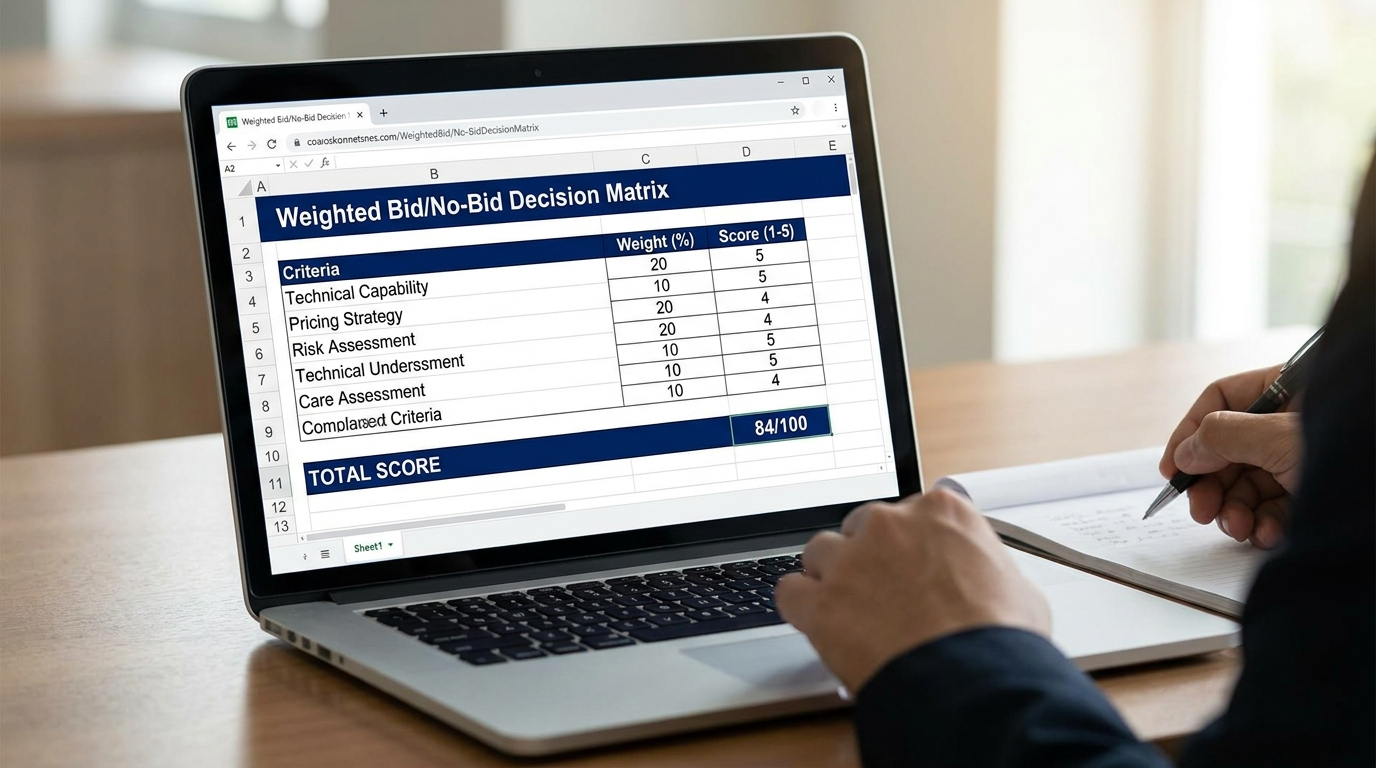
A bid/no-bid decision matrix turns those criteria into a repeatable score. Instead of debating each deal from scratch, you rate every opportunity the same way and let the numbers frame the conversation. Shipley Associates popularized this weighted approach, and the mechanics are simple enough to run in a spreadsheet.
Step 1: Define and weight your criteria
Start with the six criteria above, then weight them for your business. If most of your losses trace back to poor solution fit, give fit a higher weight. Weights should sum to 100 percent so every opportunity is scored on the same scale.
Step 2: Score each opportunity
Rate each criterion from 1 to 5 for the specific deal, multiply by its weight, and total the result. Involve the account owner and a proposal lead so the score reflects both the relationship and the effort required.
Step 3: Set a decision threshold
Agree in advance on the score that triggers a bid, a no-bid, or a conditional bid that needs executive sign-off. A threshold removes emotion from borderline calls and keeps your decisions consistent across the team.
Common bid/no-bid mistakes to avoid
Even teams with a matrix trip over the same patterns:
- Deciding too late, after SMEs have started drafting and sunk-cost bias has set in
- Letting the loudest voice in the room override the score
- Treating every incumbent renewal as an automatic bid without checking for red flags
- Ignoring capacity, so a yes on paper collides with three other deadlines
Watching for RFP red flags before you commit is part of the same discipline. The earlier you spot a wired or unwinnable deal, the more time you save.
Where the bid/no-bid decision fits in proposal management
The bid/no-bid decision is the bridge between capture and response. Good capture management means you have been shaping winnable opportunities long before the RFP drops, so more of your bids clear the threshold on merit. Once you decide to bid, a central content library and a clear response workflow let your team move fast on the deals worth winning.
Want to spend less time on proposals you were never going to win? See how RocketDocs helps proposal teams qualify opportunities and build winning responses faster, so the hours you save on no-bids go straight into the deals you can close.
Looking for the platform behind this? See the RocketDocs platform or book a demo.


