
RFP Red Flags: How to Pre-Screen Proposals Before You Respond
Not every RFP deserves a response. The process of crafting a compelling, accurate proposal demands real resources from your team: time from subject matter experts, review cycles, content coordination, and deadline pressure. Committing those resources to a low-probability opportunity is one of the most avoidable drains on a proposal team's capacity.
A structured pre-screening approach changes that. By identifying red flags early, your team can make a fast, consistent go or no-go decision on every incoming request, protecting the bandwidth you need for winnable business.
Here are six red flags to evaluate before your team commits to a response.

Poor Customer Fit
Start here, because customer fit shapes the value of a win even before you have it. Evaluate whether the issuing company falls within an industry where you have a track record. Consider whether their size, geography, and procurement behavior match your current pipeline, and whether winning this contract would advance or distract from your strategic goals.
A prospect outside your target market is not automatically a pass, but it should trigger honest questions about what the engagement would cost beyond the proposal itself. If onboarding, delivery, or support would require building capabilities you do not currently have, factor that into the go or no-go decision.
No Prior Relationship with the Issuer
When your team has existing contacts at the issuing organization, you gain two advantages: context you cannot get from the RFP document alone, and advocates who can speak to your capabilities during evaluation. Without any history, you are responding into a vacuum.
Specifically, evaluate whether you have access to people involved in the decision or whether the process is being managed entirely through procurement. Procurement-only processes tend to be more rigid, more price-sensitive, and less influenced by qualitative factors like relationship quality or past performance. That does not mean you should pass, but it should inform how you prioritize the response.
Language Written for a Competitor
Read through the RFP for terminology, requirements, or evaluation criteria that seem to describe a specific vendor's capabilities. This is one of the more reliable signals that a competitor shaped the document, either as an advisor during the specification phase or as the incumbent looking to retain the contract.
Particular things to watch for: highly specific technical requirements that only one or two vendors can meet, proprietary process language that mirrors how a known competitor describes their methodology, and evaluation criteria weighted heavily toward attributes you would struggle to demonstrate.
If the RFP reads as though it was written by your competitor, it probably was not written for you.
Blind RFP with No Prior Engagement
A blind RFP arrives without any preceding conversation, relationship, or awareness of the opportunity. You did not know it was coming, you had no input into the requirements, and you have no contacts inside the organization to provide context.
Blind RFPs are not always dead ends, but they correlate with lower win rates because the issuer frequently has a preferred vendor and is issuing the RFP to satisfy an internal procurement requirement. Evaluating whether this is a genuine competitive process or a compliance exercise is worth the ten minutes it takes before your team invests days of effort.
Unrealistic Turnaround Time
An extremely short response window is one of the clearest signals that a decision is already made. When an organization genuinely needs to evaluate multiple vendors and make a sound selection, they build a timeline that allows for meaningful responses.
Before committing, look back at your team's historical win rate on proposals with compressed timelines. If that rate is materially lower than your overall average, the combination of lower win probability and higher team stress is a compounding problem. One option worth trying: request an extension. If the issuer grants it, they are genuinely open to your proposal. If they decline, that tells you something important about where the process stands.
No Opportunity to Ask Clarifying Questions
Good RFPs build in time for prospective respondents to submit questions. This allows you to confirm you understand the scope, surface ambiguities before they become problems in your response, and demonstrate engagement with the requirements.
When a process offers no Q&A window, it usually means one of two things: the issuer already knows who they want and is keeping the field at arm's length, or the requirements themselves are not well defined. Either scenario increases the risk that the response you submit will miss the mark in ways you had no opportunity to anticipate or avoid.
IMAGE 3
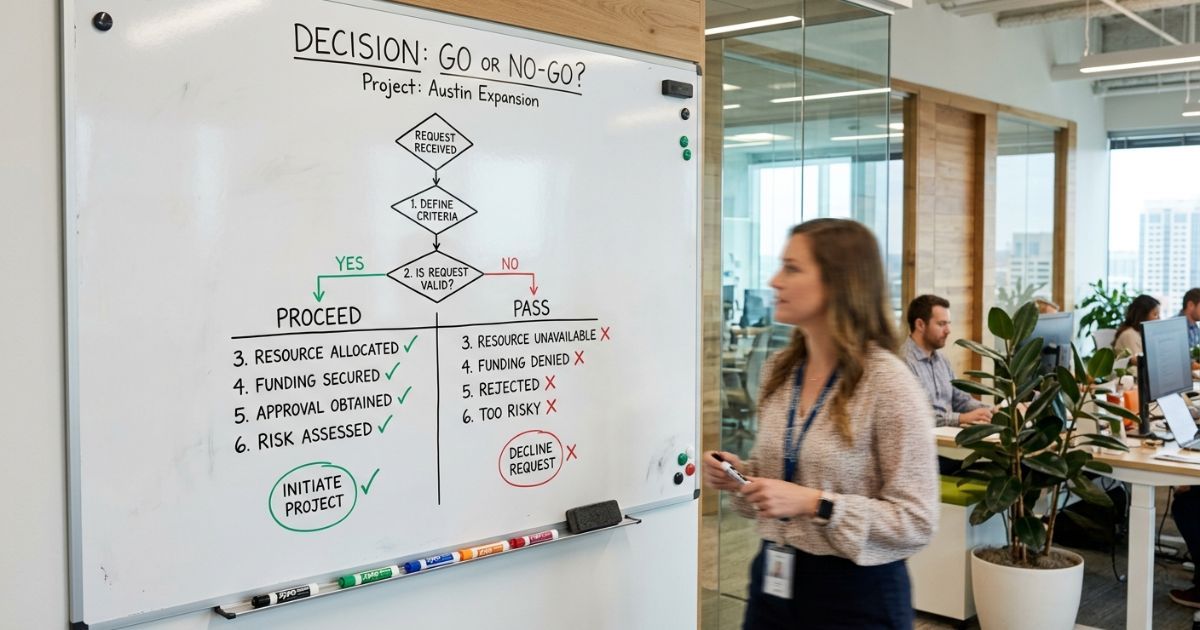
Prompt: A simple go or no-go decision flowchart drawn on a whiteboard with two columns, one labeled proceed and one labeled pass, with checkmarks and X marks in each column.
Placement: Before the closing section.
File name: rfp-go-no-go-decision-framework.jpg
Alt text: Whiteboard showing a go or no-go decision flowchart for RFP pre-screening with two columns
Building Your Pre-Screening Process
One or two red flags on the list above should prompt a conversation, not an automatic pass. The goal is to make an informed decision about whether the likelihood of winning is high enough to justify the cost of responding. A repeatable pre-screening checklist gets everyone on the same page quickly and produces more consistent decisions across your team.
Structured pre-screening is also a foundation for improving your win rate over time. When you track which flags appeared on bids you lost, you build evidence that sharpens future go or no-go calls.
For a broader look at how to manage the full response process after you decide to proceed, see our guides on how to improve your RFP process and roles and responsibilities for a winning RFP team. For teams ready to reduce cycle time across every response, streamlining RFP and DDQ processes covers the workflow patterns that make the biggest difference.
For external reference, the Association of Proposal Management Professionals (APMP) publishes research on bid and no-bid decision frameworks, and Shipley Associates covers pre-qualification methodology in their widely used proposal management guides.
RocketDocs is built to support the entire response workflow: from the initial go or no-go decision through content reuse, SME coordination, and final submission. Schedule a demo to see how teams use the platform to protect their capacity and improve their win rates.
Comparison: High-Probability vs. Low-Probability RFP Signals
| SIGNAL | HIGH PROBABILITY | LOW PROBABILITY |
|---|---|---|
| CUSTOMER FIT | Matches your target market and past wins | Outside your industry or strategic focus |
| PRIOR RELATIONSHIP | Existing contacts and advocates | No prior engagement or touchpoints |
| RFP LANGUAGE | Neutral requirements aligned with your capabilities | Terminology matching a competitor's offering |
| ORIGIN OF OPPORTUNITY | Expected, flagged in advance by your team | Blind arrival with no prior awareness |
| RESPONSE TIMELINE | Reasonable window allowing thorough response | Compressed deadline inconsistent with complexity |
| CLARIFICATION PROCESS | Structured Q&A period offered | No opportunity to ask questions |
Looking for the platform behind this? See the RocketDocs platform or book a demo.


