
A strong RFP response does not start with writing. It starts with knowing exactly where your best content lives, who owns it, and when it was last verified. Without that foundation, even your most experienced proposal writers are working harder than they need to, hunting for answers, second-guessing outdated language, and rebuilding the same responses from scratch with every submission.
This guide walks through a practical RFP content management framework that proposal teams can implement regardless of team size or industry.
Why RFP Content Management Matters
Most organizations have the raw materials for compelling RFP responses scattered across shared drives, inboxes, and individual desktops. The problem is not a lack of content. It is a lack of structure.
Poor content management leads to inconsistent responses, compliance risk from outdated information, and unnecessary pressure on reviewers and subject matter experts at deadline. According to the Association of Proposal Management Professionals (APMP), proposal teams that invest in process and content infrastructure consistently outperform those relying on ad hoc methods.
Building a content management workflow is not a one-time project. It is an ongoing operational discipline.
Build a Formal Content Management Workflow
Before you touch a single file, document your process. A written workflow gives everyone on the team a shared reference point and eliminates ambiguity around who is responsible for what.
Your workflow document should address four things:
- How new content is submitted and approved
- Who has authority to update existing responses
- How often content is reviewed for accuracy
- What happens to content after a project closes
Once drafted, share it with every stakeholder who touches proposals. A workflow that exists only in someone's head is not a workflow.
The stages below are a workable default for what that written workflow should cover, from deciding whether to bid through to submission.
| STAGE | WHAT HAPPENS |
|---|---|
| QUALIFICATION | EVALUATE THE RFP FOR FIT AND DECIDE WHETHER TO PURSUE IT |
| PLANNING | CONFIRM TIMELINE, ROI, AND REQUIRED STAKEHOLDERS |
| KICKOFF | ASSEMBLE THE TEAM AND ASSIGN TASKS |
| DRAFTING | BUILD A FIRST DRAFT FROM EXISTING CONTENT |
| SME REVIEW | COLLABORATE WITH SMES ON GAPS AND STRATEGIC SECTIONS |
| INTERNAL REVIEW | REVISE FOR ACCURACY, COMPLIANCE, AND TONE |
| FINALIZATION | SAVE THE COMPLETED RESPONSE BACK TO THE LIBRARY |
| DELIVERY | SUBMIT THE FINISHED PROPOSAL |
Get Senior Leadership Behind It
Content management initiatives stall when they lack executive support. If decision-makers do not treat content quality as a business priority, review deadlines slip, subject matter experts deprioritize requests, and your library degrades over time. Secure buy-in early and make the business case in terms leadership cares about: faster turnaround, fewer errors, and higher win rates.
Identify and Audit Your Required Content
The next step is a full content audit. Map out every type of content your proposals typically require, including standard Q&A pairs, company policies, org charts, product documentation, compliance certificates, and marketing collateral.
For each content type, document three things:
| CONTENT ATTRIBUTE | WHAT TO CAPTURE |
|---|---|
| Location | Which department, system, or file path |
| Update frequency | Quarterly, annually, after product changes |
| Owner | The specific person responsible for accuracy |
This mapping exercise often surfaces gaps teams did not know existed. It also sets you up for the next phase: categorization.
Categorize Your Content for Fast Retrieval
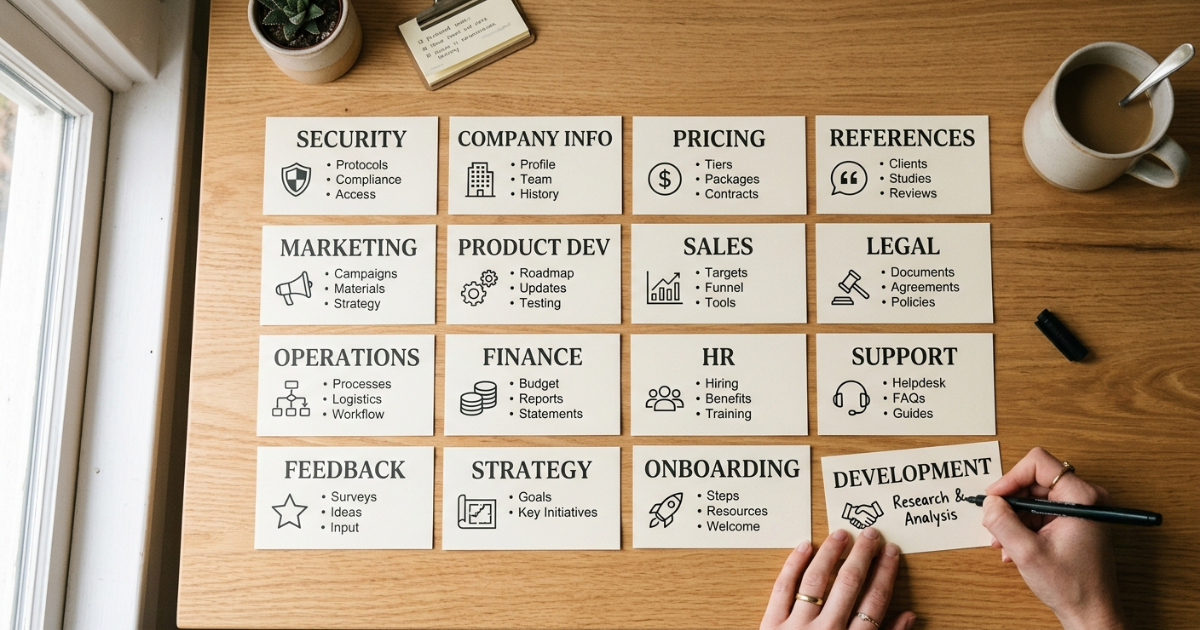
A well-organized content library is only valuable if people can find what they need under deadline pressure. After you have completed your audit, establish a category structure that mirrors how your RFPs are organized.
A standard RFI or RFP table of contents is a good starting template. Common top-level categories include: company information, product and service details, security and compliance, risk management, pricing and commercial terms, and references and case studies.
Aim for 10 to 15 main categories and roughly 25 subcategories. More than that and the system becomes harder to navigate than the chaos it replaced.
Archive, Do Not Delete
Avoid deleting old content outright. Archive it instead, so you retain a record while keeping your active library focused on what is current. RocketDocs' content library is built around this exact structure, letting teams store, tag, and retrieve approved content from any library, at any time.
Assign a Content Manager or Content Committee
Someone needs to own this. Depending on your team size, that is either a dedicated Content Manager or a small Content Committee with rotating responsibilities.
This person or group is responsible for conducting scheduled content reviews, flagging outdated or conflicting responses, consolidating redundant answers, archiving content that no longer reflects your offerings, and ensuring similar questions map to consistent, approved responses.
Consistency is one of the most underrated factors in proposal quality. Reviewers and buyers notice when section three contradicts section seven.
The Four Roles Worth Naming
A successful content strategy starts with clarity about who does what. Mapping out roles early means fewer surprises and less last-minute scrambling later.
Start by identifying an executive sponsor, someone in senior management who can back the new process and help remove roadblocks. Without that buy-in, even a well-designed workflow can stall.
Next, name your administrators. They moderate workflows, manage permission levels, and act as the gatekeepers for your content library. Then divide ownership further: assign content managers to specific libraries or topics so no single person is responsible for an entire database, and so each piece of content has a clear owner who keeps it accurate.
Finally, identify your subject matter experts. Content managers should coordinate directly with SMEs to audit and refresh content on a regular schedule, rather than pulling them into ad hoc fire drills every time a proposal lands. That structure respects your SMEs' time and keeps your content reliable.
Build Strong Relationships With Content Experts
Your content manager cannot know everything. Subject matter experts (SMEs) across legal, security, finance, and product are the people who validate the answers that matter most.
Invest time in educating your SMEs on the proposal process: what you need from them, by when, and why turnaround time matters. Set realistic review schedules and communicate proactively. When SMEs understand the stakes and feel respected as contributors rather than bottlenecks, the whole system runs smoother.
For a deeper look at working effectively with SMEs, see the RocketDocs guide to SME engagement in the RFP process.
Conduct Regular Reviews and Proposal Postmortems
Content review should be a scheduled, recurring activity, not something that happens after an embarrassing error surfaces in a submitted proposal.
After every completed RFP or questionnaire, run a brief postmortem. Identify any new responses that should be added to the library. Flag any existing content that was modified for this submission and needs to be updated globally. Note any questions that stumped your team so you can prepare better answers before the next time they appear.
This feedback loop is what keeps your content library accurate and your team continuously improving. Both the APMP and Shipley Associates emphasize postmortem reviews as a hallmark of high-performing proposal operations.
What to Check in Each Audit
Regular audits prevent that slide. How often you refresh content depends on how fast it changes; some material needs a monthly review, other content holds steady for a quarter or a year. During an audit, your team should:
| AUDIT TASK | PURPOSE |
|---|---|
| ACCURACY CHECK | CATCH OUTDATED OR INCORRECT INFORMATION |
| GAP ANALYSIS | IDENTIFY WHERE NEW CONTENT IS NEEDED |
| TAGGING REVIEW | CONFIRM RESPONSES ARE CATEGORIZED CORRECTLY |
| TONE CONSISTENCY | KEEP LANGUAGE CLEAR AND ON BRAND |
| ARCHIVING | RETIRE MATERIAL THAT IS NO LONGER RELEVANT |

Plan for Turnover
Teams change. People get promoted, move to new roles, or leave the company, and your content process needs to survive that turnover without falling apart. The way to protect against that is training: make sure more than one person understands how your workflow operates and why it is built the way it is.
Document the process, not just the content. A workflow that lives only in one person's head is a liability. A workflow that is written down, taught, and reinforced across the team is an asset that outlasts any single employee.
How RocketDocs Supports RFP Content Management at Scale
Managing a content library in shared drives or spreadsheets works up to a point. As proposal volume grows, so does the risk of version drift, missed reviews, and duplicated effort.
RocketDocs is built around the principle that your content library is your most valuable proposal asset. The Content Library gives teams a single source of truth for approved responses, with version control, ownership tracking, and search that surfaces the right answer in seconds. Paired with automated Workflows, you can trigger review cycles and routing automatically so content stays current without relying on manual reminders.
For teams dealing with stale data risk in their response systems, it is worth reading why your response strategy needs a system of record.
A Practical Starting Framework
If you are building or rebuilding your content management process, start here:
- Document your workflow in writing
- Audit your existing content and map ownership
- Build a category structure that mirrors your RFP format
- Assign a content manager or committee
- Establish a recurring review schedule
- Run postmortems after every submission
- Secure senior leadership support
None of these steps require expensive technology to begin. What they require is discipline, clarity, and organizational commitment. The right platform accelerates each of these steps significantly once the process foundation is in place.
Ready to see what a purpose-built content library looks like in practice? Request a demo at rocketdocs.com to walk through the RocketDocs Content Library with your team's use case in mind.
Looking for the platform behind this? See the RocketDocs platform or book a demo.


