
An invitation to bid (ITB) is a formal solicitation in which a buyer asks qualified suppliers to submit sealed, fixed-price bids for clearly defined work. The buyer evaluates bids on price and stated qualification requirements, then awards the contract to the lowest responsible, responsive bidder, usually without negotiation.
Buyers in construction, public works, and government supply turn to the invitation to bid when the specification is fixed and price is the deciding variable. If your team answers solicitations for a living, knowing what an ITB rewards, and what it punishes, helps you decide where to spend bid effort and how to avoid disqualifying mistakes.
Invitation to bid vs RFP: how they compare
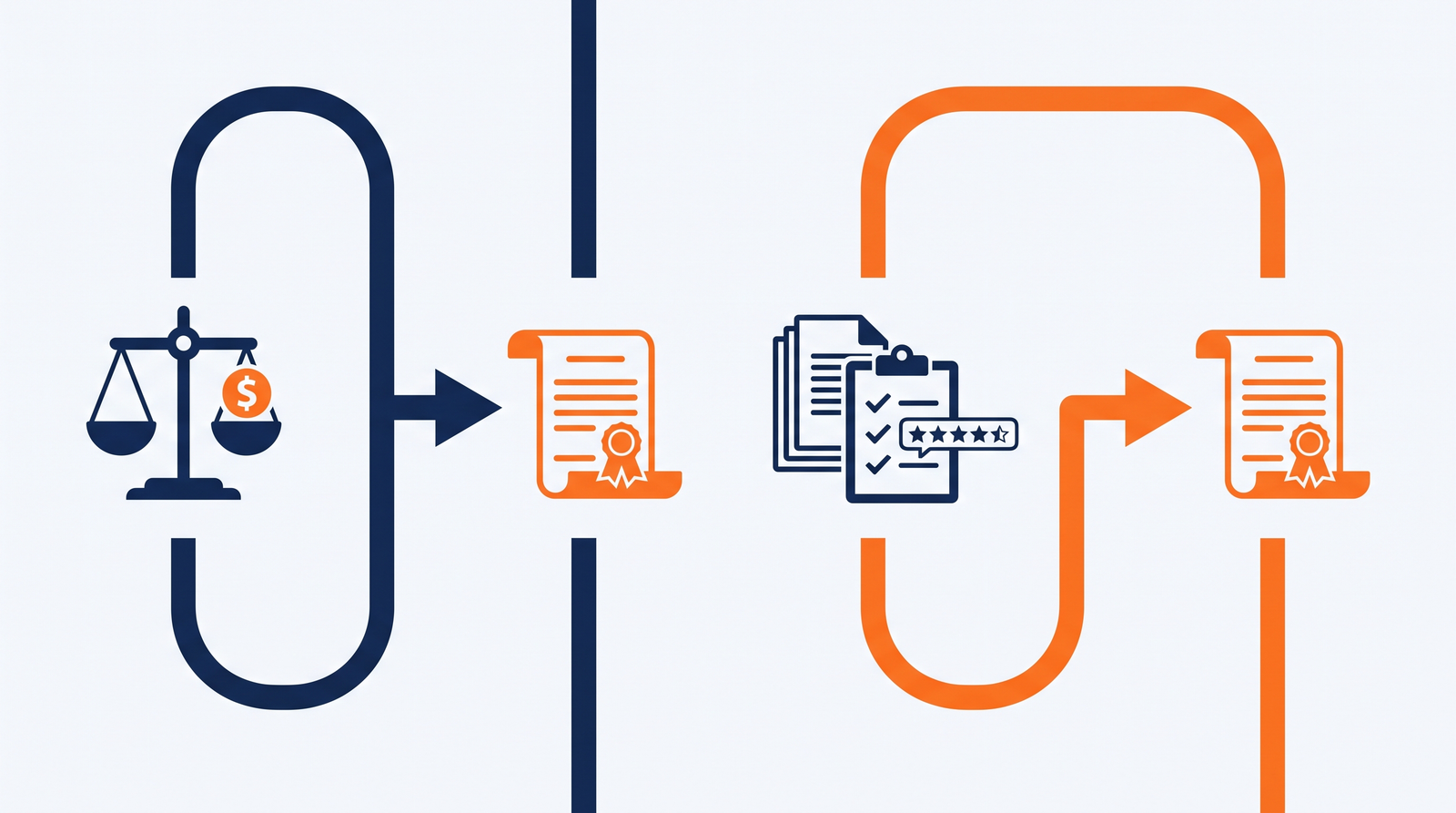
The two documents answer different questions. An ITB asks who can deliver a defined scope for the lowest price. A request for proposal asks who offers the best approach at a fair price. Levelset's comparison of ITBs and RFPs describes an ITB as a sealed bidding method used when competing products or services meet the same specifications, so price is the only real difference. It describes an RFP as a competitive negotiations method used when the end product is unique and the methods are not readily available.
| FACTOR | INVITATION TO BID | REQUEST FOR PROPOSAL |
|---|---|---|
| BEST FIT | CLEARLY DEFINED WORK WITH COMPARABLE SPECIFICATIONS | UNIQUE OR COMPLEX WORK WHERE APPROACHES VARY |
| AWARD BASIS | PRICE AND PRICE-RELATED FACTORS | QUALITY, EXPERIENCE, AND PRICE AGAINST STATED CRITERIA |
| NEGOTIATION | GENERALLY NONE | OFTEN ALLOWED, INCLUDING FINAL BEST OFFERS |
| WHAT YOU SUBMIT | SEALED PRICE BID PLUS REQUIRED FORMS | NARRATIVE PROPOSAL WITH METHODS AND PRICING |
| WINNER | LOWEST RESPONSIBLE, RESPONSIVE BIDDER | BEST OVERALL COMBINATION OF PRICE AND QUALITY |
If your team also fields price quotations, our guide to RFQ vs RFP covers the third common solicitation type and when each one fits.
How an invitation to bid works
Federal agencies call this process sealed bidding and the document an invitation for bids. FAR 14.101 defines sealed bidding as a method of contracting that employs competitive bids, public opening of bids, and awards. Private and local buyers vary in the details, but the federal sequence is a useful model for what to expect.
Step 1: The buyer prepares and publicizes the invitation
The invitation must describe the buyer's requirements clearly, accurately, and completely, without unnecessarily restrictive requirements. It is then distributed to prospective bidders and posted publicly a sufficient time before bids are opened. For you, this is the moment to read every attachment, because the invitation includes all documents furnished for the purpose of bidding.
Step 2: Bidders submit sealed bids
Bids are submitted sealed and opened at the time and place stated in the solicitation. The buyer may also set minimum qualifications that bidders must meet, so confirm early that your company clears them.
Step 3: The buyer evaluates without discussions and awards
Under the federal rules, bids are evaluated without discussions. The contract goes to the responsible bidder whose conforming bid is most advantageous to the government, considering only price and the price-related factors named in the invitation. There is no round of clarifications to rescue an incomplete bid.
When buyers use an invitation to bid
FAR 6.401(a) sets the conditions for the federal government. Contracting officers solicit sealed bids when time permits the solicitation, submission, and evaluation of bids; when the award will be made on price and other price-related factors; when discussions with bidders are not necessary; and when there is a reasonable expectation of receiving more than one sealed bid. The same section allows competitive proposals when sealed bids are not appropriate. That is why a complex or poorly defined scope usually arrives as an RFP, while a fixed specification arrives as an ITB.
How to respond to an invitation to bid
Decide whether to bid at all
Because an ITB is decided largely on price, a bid you cannot win profitably is wasted effort. Check qualifications, capacity, and your realistic cost position first. Our guide to the bid/no-bid decision gives a repeatable way to make that call.
Build a requirements checklist from the invitation
With no discussions, you rarely get a second chance. List every mandatory form, certification, insurance document, and delivery instruction, and assign an owner and a due date to each. Confirm the submission method, the deadline, and the exact opening time and place.
Price from the specification, not from habit
Cost out labor, materials, subcontractors, and overhead against each line item in the bid form. Pricing too low can win the award and lose the margin, while pricing too high loses to the next sealed envelope. Keep your estimate worksheet so your reasoning is clear if the buyer or your own leadership asks.

Submit a conforming bid on time
The award goes to the responsible bidder whose bid conforms to the invitation. A bid that departs from the stated requirements, omits a required document, or arrives after the deadline can give the buyer grounds to set it aside. Finish early, run a final review against your checklist, and keep proof of delivery.
Where response teams lose invitation to bid contracts
Most lost ITBs are not lost on price alone. They are lost on avoidable errors: a missing signature or certification, an addendum that was never read, a unit price that does not match the extended total, or a bid sent to the wrong location. A second reviewer who checks only compliance, separate from the person who built the price, catches most of these before the envelope is sealed.
Managing invitation to bid responses at scale
Company qualifications, references, insurance details, and standard certifications appear in almost every bid. Keeping approved versions in one shared content library means teams stop rebuilding them for each invitation and stop submitting outdated information. Teams that handle ITBs alongside RFPs and RFIs can see how RocketDocs supports that work on the RFP response solution page.
Looking for the platform behind this? See the RocketDocs platform or book a demo.


