
Vendor Cybersecurity Vetting: Your RFP Security Checklist
Third-party data breaches are not rare edge cases anymore. A 2023 Prevalent survey found that 61% of companies experienced one in the prior year. The consequences range from regulatory fines and customer attrition to litigation and reputational damage that takes years to repair.
The vendor selection process is where that risk gets introduced or contained. Embedding cybersecurity criteria into your RFP workflow is one of the highest-leverage steps a procurement or security team can take. This guide walks through exactly how to do that, from the criteria you should require to the ongoing compliance monitoring that keeps your vendor relationships audit-ready.

Why Cybersecurity Due Diligence Matters in Vendor Selection
Your organization's security posture is only as strong as the vendors connected to your systems and data. A vendor with weak access controls or an untested incident response plan becomes your problem the moment a breach occurs.
The business case for rigorous vendor vetting covers three areas. First, regulatory exposure: frameworks like GDPR, HIPAA, and SOC 2 place accountability on organizations for how their third parties handle data. Ignorance of a vendor's practices is not a defense. Second, operational continuity: a compromised vendor can take your workflows offline or corrupt your data at the worst possible moment. Third, customer trust: breach notifications erode confidence quickly, and rebuilding it is expensive.
How Vendor Risk Shows Up in the RFP Process
Many procurement teams treat cybersecurity questions as a formality, buried in a security section that vendors sign off on without scrutiny. The more effective approach is to treat security criteria as qualifying requirements, not optional additions. Vendors who cannot provide current certifications, clear encryption standards, or a documented incident response plan should be filtered out early rather than onboarded and managed reactively.
Key Cybersecurity Criteria to Include in Every RFP
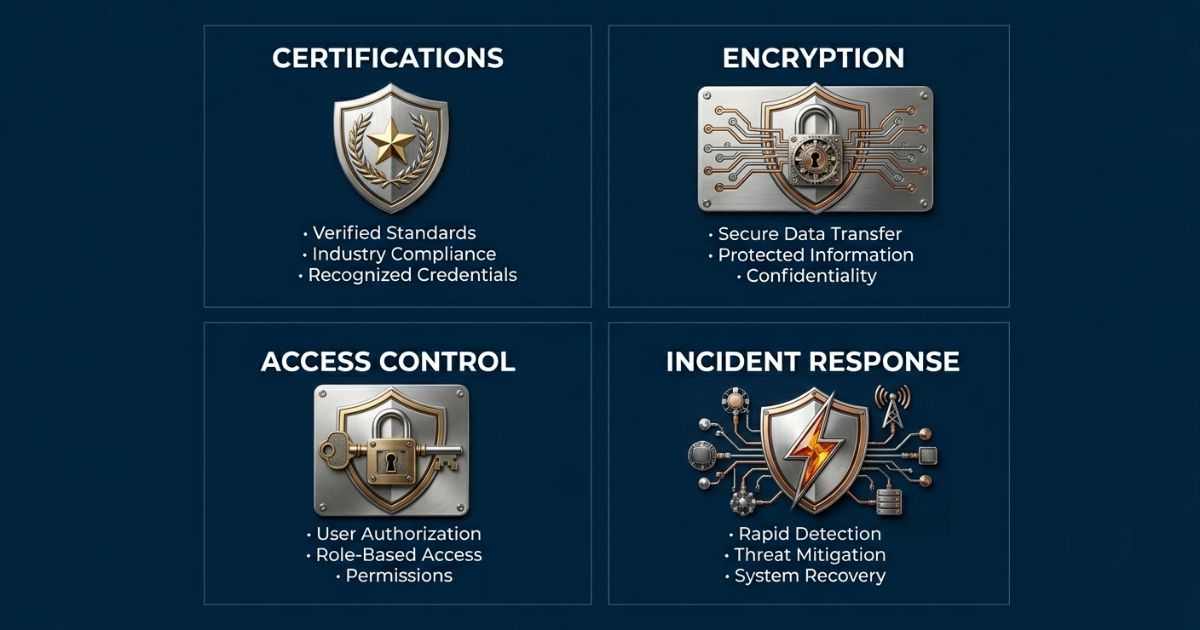
The following criteria form the foundation of a vendor security questionnaire. Each one maps to a real risk vector, and each one should require verifiable documentation, not self-attestation alone.
Security Certifications
Certifications from recognized bodies give you a standardized baseline for comparing vendors. ISO/IEC 27001 covers information security management systems. SOC 2 Type II reports document how a vendor's controls performed over a defined audit period, which is more meaningful than a point-in-time Type I. NIST alignment signals that the vendor has mapped its controls to a recognized risk management framework.
Ask for the actual reports, not just confirmation that they exist. Pay attention to the audit period, the scope, and any exceptions noted by the auditor.
Data Encryption Standards
Encryption is foundational to breach prevention. For data in transit, require TLS 1.2 or higher. For data at rest, AES-256 is the current industry standard. Ask how encryption keys are managed and whether key management is handled internally or delegated to a third-party provider. Vendors who cannot answer these questions clearly should raise a flag.
Access Control and Authentication
Multi-factor authentication (MFA) should be a baseline requirement, not a differentiator. Beyond MFA, look for role-based access control (RBAC), the principle of least privilege, and regular access reviews to confirm that former employees or contractors no longer have active credentials. Ask how the vendor handles privileged access management for administrator accounts.
Incident Response Planning
A documented incident response plan tells you how a vendor will behave when something goes wrong. Ask for the plan itself, not a summary. Look for defined roles and responsibilities, a chain of communication that includes notifying your organization, defined recovery time objectives, and evidence that the plan has been tested through tabletop exercises or simulations within the past twelve months.
| CRITERIA | WHAT TO REQUIRE | RED FLAG |
|---|---|---|
| Security certifications | Current SOC 2 Type II or ISO 27001 report | Expired reports or scope that excludes your use case |
| Data encryption | AES-256 at rest, TLS 1.2+ in transit | Vague answers or no key management documentation |
| Access control | MFA, RBAC, annual access reviews | Shared credentials or no least-privilege policy |
| Incident response | Tested plan with client notification steps | No documented plan or untested for over 12 months |
| Third-party assessments | Annual independent audit or penetration test | Self-assessments only with no third-party validation |
Conducting Security Audits: How to Verify What Vendors Claim
Collecting documents is a starting point, not an endpoint. Verification is where the real diligence happens.

Third-Party Security Assessments
Independent assessments carry more weight than vendor-provided documentation because they introduce a neutral evaluator. Ask whether the vendor undergoes annual penetration testing and who conducts it. Request a summary of the most recent findings and ask how any identified vulnerabilities were remediated. A vendor who is defensive about sharing this information is signaling something.
Security Risk Assessment Questionnaires
A structured questionnaire covers areas that certifications alone may not address: employee security training frequency, software patching cadence, third-party vendor management (your vendor's vendors), physical security at data centers, and backup and recovery procedures. Platforms like RocketDocs allow teams to store approved, reviewed answers to recurring security questionnaire questions, so your own organization can respond consistently when customers vet you in return. Learn more about how RocketDocs handles security questionnaires.
Interviews with Security Personnel
A document review tells you what a vendor says they do. A conversation with their CISO or security lead tells you whether they actually understand it. Schedule a call with the vendor's security team as part of the evaluation process. Ask them to walk through their incident response procedure without prompting. Ask how they would notify your organization if a breach occurred at 2 a.m. on a Sunday. The confidence and specificity of their answers matter as much as the content.
Ongoing Vendor Security Compliance After Contract Signing
Vetting a vendor before you sign is necessary but not sufficient. Security postures change. Personnel changes. Certifications lapse. The vendor you onboarded eighteen months ago may look meaningfully different today.
Regular Compliance Audits
Build audit rights into your vendor contracts. At minimum, require annual recertification documentation. For vendors with access to sensitive or regulated data, biannual reviews are more appropriate. Define what triggers an out-of-cycle review, such as a reported breach, a significant change in the vendor's ownership or technology stack, or a failed audit from another customer.
Security KPIs and Monitoring
Agree on measurable security benchmarks with high-risk vendors. These might include mean time to patch critical vulnerabilities, frequency of security training completion, or uptime of monitoring tools. What gets measured gets managed, and documented KPIs give you a structured basis for escalating concerns or exiting a vendor relationship.
Continuous Monitoring
Ongoing monitoring tools track vendor security health between formal review cycles. These range from threat intelligence feeds that flag if a vendor's credentials appear in breach databases, to questionnaire platforms that prompt vendors to reconfirm their security posture on a scheduled basis. RocketDocs content library capabilities support this pattern by keeping your organization's approved security responses current and audit-ready. See how the content library works.
For additional external guidance on vendor risk management frameworks, the National Institute of Standards and Technology publishes the NIST Cybersecurity Framework at nist.gov/cyberframework, and the Shared Assessments SIG questionnaire provides a widely adopted standardized assessment tool at sharedassessments.org.
Building a Vendor Security Program That Scales
Cybersecurity vetting does not have to be rebuilt from scratch for every RFP. The organizations that do this well have standardized their security question libraries, defined their minimum certification requirements, and built review cadences into their contract templates. When a security questionnaire arrives from a prospective customer asking about your own practices, having those answers documented and approved in a central system means you can respond in hours rather than weeks.
RocketDocs supports both sides of that equation, whether your team is completing inbound security questionnaires or building the vendor evaluation workflows that protect your organization from third-party risk. To see how RocketDocs fits into your workflow, visit the security questionnaire solution page.
Looking for the platform behind this? See the RocketDocs platform or book a demo.


