
Vendor risk management (VRM) is the process of identifying, assessing, and continuously monitoring the risks that third-party suppliers introduce to your organization. It covers cybersecurity, compliance, financial, and operational exposure, typically using security questionnaires, evidence review, and ongoing monitoring to keep each vendor relationship within an acceptable level of risk.
Every supplier you onboard extends your attack surface and your regulatory footprint. One vendor with weak access controls, an expired certification, or a fragile balance sheet can trigger a breach, an audit finding, or a service outage that lands squarely on your team. That is why vendor risk management has shifted from a procurement formality to a core security and compliance discipline. Before building a program, it helps to separate three terms that are often used interchangeably.
| TERM | WHAT IT MEANS | SCOPE | WHEN IT HAPPENS |
|---|---|---|---|
| Vendor risk management | An ongoing program to govern risk across all suppliers | Every supplier relationship | Continuous |
| Vendor risk assessment | A point-in-time evaluation of one vendor's risk | A single vendor | At onboarding and renewal |
| Third-party risk management | An umbrella program covering vendors, partners, and other third parties | All external relationships | Continuous |
What vendor risk management covers
Strong vendor risk management looks at more than firewalls and encryption. Cybersecurity risk is the headline category, and it is where security questionnaires and evidence like SOC 2 reports do most of the work. A complete picture also includes compliance risk, meaning whether a vendor meets obligations such as GDPR, HIPAA, or PCI DSS; financial and operational risk, meaning whether the supplier is stable enough to deliver; and concentration risk, meaning how much damage a single failure would cause. Increasingly, teams also assess fourth-party risk, the subcontractors and cloud providers your vendor depends on. The National Institute of Standards and Technology treats these dependencies as part of cyber supply chain risk management, which is a useful reference for defining risk tiers.
The vendor risk management lifecycle
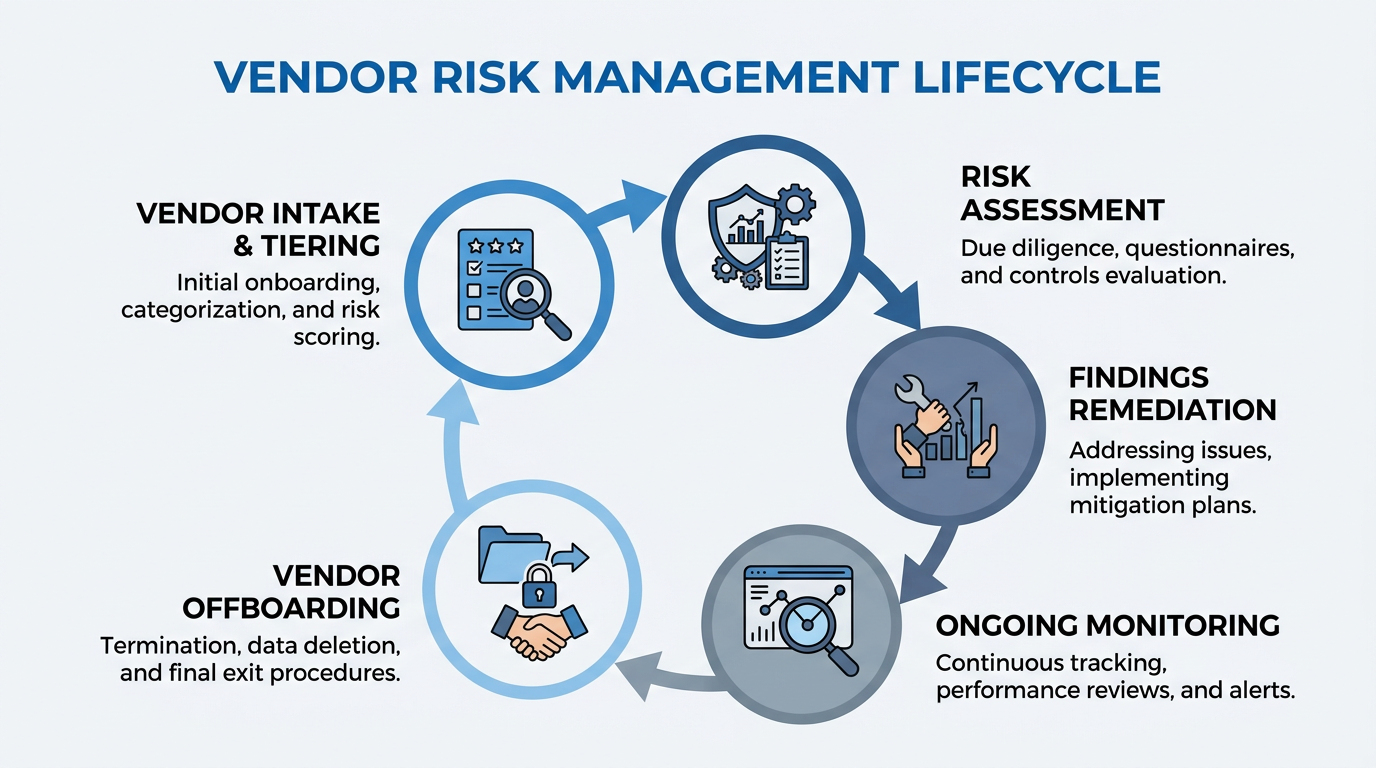
Vendor risk management is continuous, not a one-time gate. Most programs move through a repeatable lifecycle.
It starts with intake and tiering, where you classify each vendor by the data they touch and the criticality of the service. A payroll processor handling employee records warrants far more scrutiny than a stock-photo subscription. Next comes assessment, where you send a security questionnaire, collect evidence, and score the responses against your risk appetite. Remediation follows, where you work with the vendor to close gaps or formally accept and document the residual risk. Monitoring then keeps the relationship under watch through periodic reassessments, certificate-expiry tracking, and alerts on breaches or rating changes. When a contract ends, offboarding revokes access and confirms that data has been returned or destroyed.
The Shared Assessments program, which maintains the widely used Standardized Information Gathering (SIG) questionnaire, frames third-party risk as a full lifecycle rather than a procurement checkpoint, and its materials are a good model for structuring each stage.
How security questionnaires fit into vendor risk management
Security questionnaires are the primary evidence-gathering tool in vendor risk management. When you assess a vendor, you send a standardized questionnaire so responses are comparable across suppliers. The most common frameworks are the SIG questionnaire and the Cloud Security Alliance's Consensus Assessments Initiative Questionnaire (CAIQ), alongside custom questionnaires mapped to NIST controls.
If your organization is on the receiving end, responding quickly is itself a competitive advantage; slow, inconsistent answers stall deals and erode buyer confidence. This is where a clear vendor security questionnaire strategy and response automation pay off, whether you are the assessor building the program or the vendor answering dozens of questionnaires a quarter. The Cloud Security Alliance publishes the CAIQ openly, which makes it a practical baseline for both sides of the exchange.

Building a vendor risk management program that scales
The hardest part of vendor risk management is not the first assessment; it is the hundredth. Programs break down when every questionnaire is treated as a blank page and every answer is rewritten from scratch. The fix is a maintained knowledge base of vetted responses, evidence, and control mappings that your team reuses and improves over time.
This is the same principle behind Knowledge-Centered Success (KCS®), the methodology developed by the Consortium for Service Innovation, which holds that knowledge should be captured, reused, and refined as a by-product of doing the work rather than as a separate project. The KCS Practices Guide sets out the full framework. Applied to vendor risk, every completed questionnaire feeds a living answer library instead of disappearing into a shared drive.
Three practices separate programs that scale from those that stall. First, tier ruthlessly so your best analysts spend their time on the vendors that matter most. Second, standardize on a small set of questionnaire frameworks so answers are reusable across assessments. Third, automate the mechanical work, including drafting responses, routing questions to subject matter experts, and flagging answers that need a human review. Teams that combine a clean answer library with automation can cut questionnaire turnaround dramatically while improving consistency and audit readiness.
Vendor risk management will only grow in importance as supply chains deepen and regulators sharpen their focus on third parties. A program built on clear tiering, standardized questionnaires, a reusable knowledge base, and automation gives you both speed and defensibility. If your team is drowning in security questionnaires, see how RocketDocs helps you build a reusable answer library and automate responses so every assessment moves faster than the last.
KCS® is a service mark of the Consortium for Service Innovation™.
Looking for the platform behind this? See the RocketDocs platform or book a demo.


