
A vendor security questionnaire is a structured set of questions a customer sends to a supplier to evaluate how that supplier protects data and manages information security risk. The most common formats are the Standardized Information Gathering (SIG) questionnaire, the Cloud Security Alliance CAIQ, and NIST-based assessments. Completing one accurately is frequently a condition of closing an enterprise deal, so the questionnaire sits squarely on the revenue-critical path.

What a vendor security questionnaire covers
Whoever sends it, a vendor security questionnaire probes the same underlying question: can we trust you with our data? Expect sections on access control, encryption, secure development, vulnerability management, incident response, business continuity, data privacy, and the use of subprocessors. Buyers also ask you to attach evidence, most often a SOC 2 Type II report or an ISO 27001 certificate. The requests usually come from a procurement, information security, or third-party risk team during onboarding, contract renewal, or an annual review.
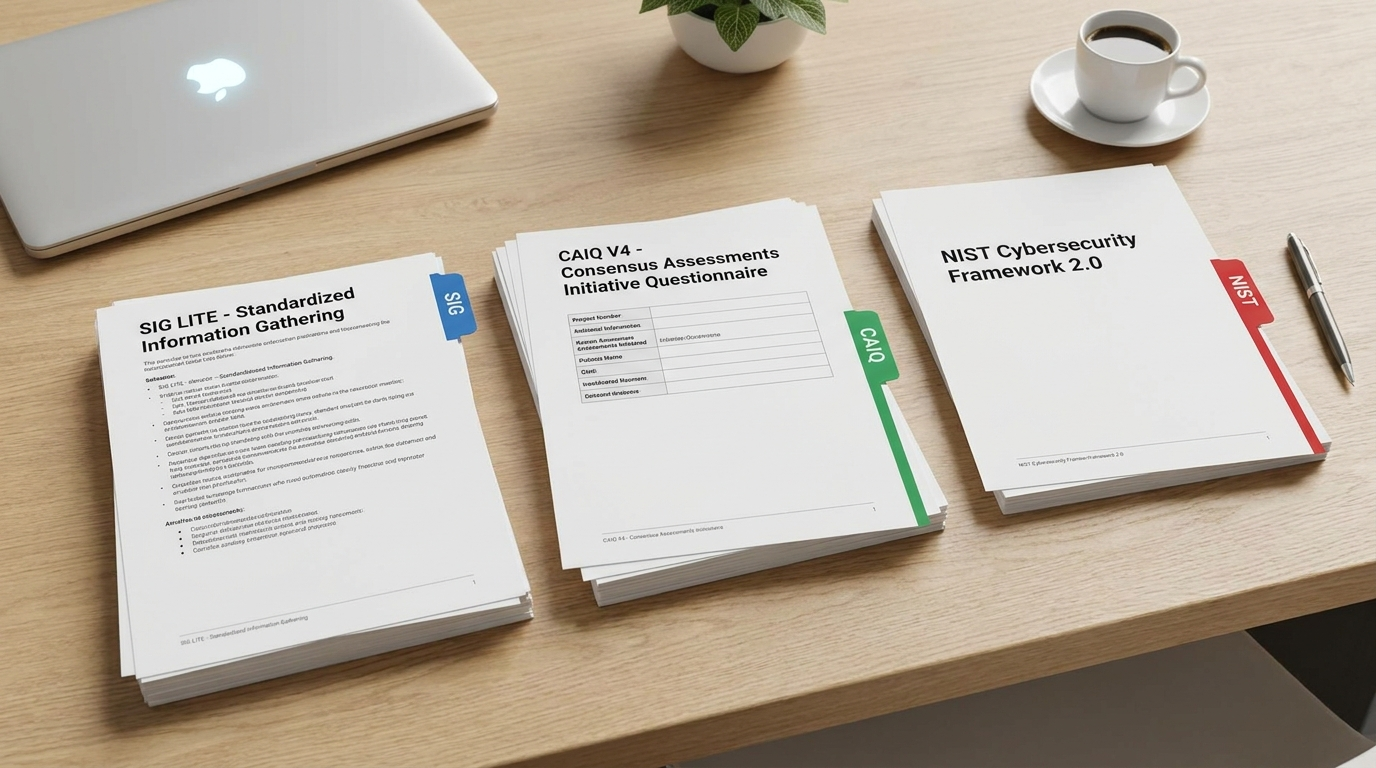
Not every questionnaire looks alike. The table below compares the vendor security questionnaire formats you are most likely to receive so you can recognize each one on sight.
| FRAMEWORK | WHAT IT IS | TYPICAL SCOPE | BEST SUITED FOR |
|---|---|---|---|
| SIG (Standardized Information Gathering) | A Shared Assessments library covering a broad set of risk domains, issued in Core and Lite versions | Hundreds of questions across the full risk picture | Financial services and enterprises standardizing third-party risk |
| CAIQ (Consensus Assessments Initiative Questionnaire) | A Cloud Security Alliance questionnaire mapped to the Cloud Controls Matrix | Roughly 260 yes or no control questions | Cloud and SaaS vendors proving cloud security posture |
| NIST CSF and 800-171 | Assessments built on NIST Cybersecurity Framework functions or 800-171 controls | Varies by control family and maturity level | Government contractors and regulated firms aligning to federal standards |
| Custom questionnaire | A buyer's proprietary spreadsheet with company-specific questions | Unpredictable, often multi-tab Excel | Any customer with unique risk or regulatory needs |
SIG, CAIQ, and NIST: how the frameworks differ
The SIG questionnaire
The SIG is maintained by Shared Assessments and organizes questions across a broad set of risk domains. It ships in two sizes: SIG Core for a deep review and SIG Lite for a lighter touch. Because it is standardized, many financial services firms use it as their default, which means one strong SIG response can be reused across many customers. For a deeper walkthrough, see our SIG questionnaire guide.
The CAIQ
The CAIQ comes from the Cloud Security Alliance and maps directly to the Cloud Controls Matrix, the CSA catalog of cloud security controls. It is built largely from yes or no control questions, which makes it faster to complete than a narrative-heavy format once your answers are documented. SaaS and cloud vendors see it most often. Our CAIQ questionnaire guide breaks down how to fill it in.
NIST-based assessments
NIST-based assessments are built on the NIST Cybersecurity Framework or on the control families in NIST SP 800-171. Government contractors and firms in regulated sectors encounter these most, since federal and defense supply chains expect alignment to NIST controls. Rather than a single fixed form, a NIST assessment is often a buyer mapping of your controls to the framework functions, so clear documentation of what you do and how matters as much as the answers themselves.
Why vendor security questionnaires slow teams down
The problem is rarely any single questionnaire. It is the volume and the overlap. A growing vendor can field dozens of these a year, each asking roughly the same things in a slightly different structure, and each landing on the same handful of subject matter experts. Deadlines are tight, the source content is scattered across past responses and wikis, and answers written last quarter may already be out of date. Multi-tab Excel files make manual copy and paste slow and error-prone, and one wrong answer about data handling can stall a deal in legal review.
How to respond to a vendor security questionnaire faster
Speeding up a vendor security questionnaire is less about typing faster and more about never answering the same question twice. Four practices make the biggest difference.
Build a reusable answer library
Start with a single reusable answer library: the approved, current response to every question you have ever been asked, stored once and reused everywhere. This is the core idea behind Knowledge-Centered Success (KCS®), the methodology developed by the Consortium for Service Innovation, which treats knowledge as a byproduct of solving problems and improves it through reuse. The KCS methodology and its supporting practices apply directly to security questionnaires: capture an answer the first time an expert writes it, then let the whole team draw from it. A well-maintained content library becomes the source of truth that keeps every SIG, CAIQ, and NIST response consistent.
Map frameworks and keep answers current
Map the frameworks to each other so a single approved answer about encryption satisfies the SIG, the CAIQ, and a NIST assessment at once. Then give every answer a clear owner and a review date, so subject matter experts confirm accuracy on a schedule instead of scrambling at deadline. Stale content is the quiet cause of most inaccurate responses, and a review cadence is the cheapest insurance against it.
Automate the repetitive work
Finally, automate the repetitive work. Purpose-built security questionnaire software autofills known answers, handles multi-tab Excel natively, and routes only genuinely new questions to the right expert. Keeping that automation on private AI matters in regulated industries, where sending customer security data to public models is itself a risk. For a step-by-step workflow, see our security questionnaire response playbook.

The bottom line
A vendor security questionnaire is the gate between your team and enterprise revenue, and the format you receive, SIG, CAIQ, NIST, or a custom spreadsheet, determines how you should prepare. Teams that treat every response as reusable knowledge answer faster, more consistently, and with less strain on their experts. See how RocketDocs handles security questionnaires for regulated teams.
KCS® is a service mark of the Consortium for Service Innovation™.
Looking for the platform behind this? See the RocketDocs platform or book a demo.


