
How to Create a Change Management Plan That Actually Works
Change is inevitable. For leaders, the ability to manage it effectively is absolutely crucial for long-term success. Whether you are implementing new technologies, restructuring teams, or shifting strategic goals, a well-defined change management plan is what separates organizations that thrive through transitions from those that stall out.
The stakes are real: a study by KPMG found that 37% of executive teams underestimate the impact of organization-wide change. And across industries, up to 70% of change initiatives fail entirely. Understanding what separates a successful change initiative from a failed one starts with understanding what a change management plan actually requires.
What Is Change Management?
Change management is a structured approach to guiding individuals, teams, and organizations from their current state to a desired future state. It involves planning, implementing, and monitoring changes to achieve specific objectives while mitigating risks and minimizing resistance.
The goal is not simply to execute a transition. It is to ensure that changes are smoothly and successfully integrated into the organization, and that everyone involved is aligned and ready to commit. Without that buy-in, even a technically sound change initiative can collapse.
Benefits of a Solid Change Management Plan
A thoughtful change management plan functions like a detailed roadmap for a complex journey. It shows the route, highlights potential obstacles, and keeps the project on schedule. More concretely, a strong plan delivers several measurable advantages.
Communication barriers get broken down, so every stakeholder stays informed and aligned. Resources are allocated with intention, cutting down on waste. Disruptions to daily operations are minimized because the transition is staged and supported. And risks are identified early, well before they become expensive problems.
Effectively managing change also addresses the human element, which is often the most overlooked piece of the puzzle. Partial implementation is one of the most common failure modes in organizational change. When team members do not understand the "why" behind a decision, resistance grows and adoption stalls. A clear plan ensures everyone understands both what is changing and why it matters.
Types of Organizational Change
Not all change is created equal. Before building your plan, it helps to identify which type of change you are dealing with.
Fundamental change involves significant structural shifts such as mergers, acquisitions, or large-scale reorganizations. These typically require comprehensive, long-horizon planning.
Transformational change focuses on major improvements to systems, processes, or technologies. The goal is to enhance organizational performance and competitiveness in a meaningful, lasting way.
Developmental change covers smaller, faster adjustments made to address an immediate challenge or opportunity. Though limited in scope, these changes can be critical for maintaining operational efficiency and agility.
Change Management Frameworks Worth Knowing
There is no shortage of methodologies for managing change. Three stand out as particularly versatile and well-tested across industries.
The ADKAR Model
Developed by Prosci, ADKAR is an acronym that maps the five outcomes an individual must achieve for a change to be successful: Awareness of the need for change, Desire to support the change, Knowledge of how to change, Ability to implement the change, and Reinforcement to sustain it. It is especially useful for tailoring communication and training to specific groups within your organization.
The Kubler-Ross Change Curve
Originally developed to describe the stages of grief, this model has become a widely used framework for understanding emotional responses to organizational change. It traces a path through shock, denial, frustration, depression, experimentation, and acceptance. Mapping where individuals fall on this curve helps leaders address emotional resistance before it undermines progress.
Lewin's Change Management Model
Kurt Lewin's Unfreeze, Change, Refreeze model remains one of the most durable frameworks in organizational science. First published in the 1940s, it breaks change into three stages: preparing the organization to accept that change is necessary, moving to the new desired state, and then solidifying that new state so it becomes the norm. Its simplicity makes it easy to communicate across all levels of an organization.
Key Components Every Change Management Plan Needs
A complete change management plan should address seven core elements.
Description of the Change: A clear articulation of what is changing, including any new processes, technologies, roles, or structures being introduced.
Context and Rationale: The "why" behind the change, supported by market data, competitive pressures, or internal inefficiencies that justify the initiative.
Impact Analysis: An honest assessment of which departments, teams, and roles will be affected, and how workflows and productivity may shift during the transition.
Roles and Ownership: A clear map of who is responsible for what, including decision-making authority. Ambiguity here is one of the most common causes of stalled initiatives.
Resources and Budget: A realistic accounting of the financial, human, and technological resources required, with funds allocated to match the plan's actual demands.
Timeline and Milestones: A phased schedule with defined checkpoints that allow leadership to track progress and course-correct before small delays become large ones.
Goals and Objectives: Measurable success criteria that align with the organization's broader strategic objectives and provide a clear basis for evaluating outcomes.
Steps to Build Your Change Management Plan
Step 1: Define the Change
Collaborate with your team to map current processes, identify gaps, and define the desired end state. Clarity here prevents the vague scope that undermines so many initiatives before they get started. Understand both the magnitude of the change and how it aligns with your strategic goals.
Step 2: Build and Communicate the Plan
Develop the core structure of your plan and communicate it to all stakeholders. Use a proven framework like ADKAR to segment your messaging by audience. Different groups within your organization will need to hear different things, and a one-size-fits-all rollout typically falls flat.
Step 3: Design Your Training Approach
Build a training program that meets your team members where they are. Consider existing skill levels, the new capabilities required, and how responsibilities will shift. For large-scale changes, ensure that every person who plays a role in the transition understands exactly what that role entails.
Step 4: Roll Out in Stages
Implement the change incrementally, monitoring progress at each stage and building in feedback loops. Staged rollouts reduce disruption and give your team time to adapt without being overwhelmed. Too much change too fast is a reliable way to generate resistance and rework.
Step 5: Reinforce and Celebrate
Once the transition is complete, take stock of what went well. Recognizing milestones maintains momentum and signals to your team that their effort was valued. Continue reinforcing the change over time by sharing positive outcomes and iterating on the new process based on what you learn.
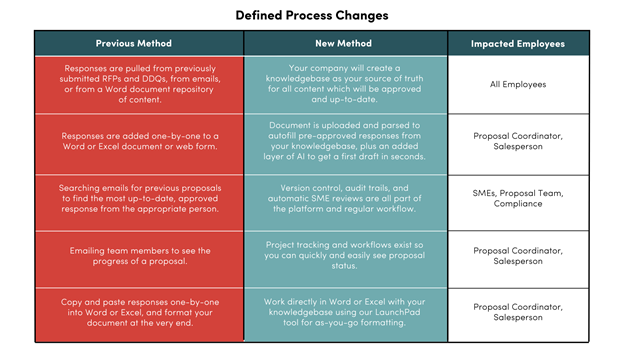
The table below illustrates how a change management plan might look when applied to a response management transition, comparing what teams did before and after adopting a structured platform approach.- Ability: Develop the ability to implement the change.
- Reinforcement: Reinforce the change to sustain it.
This model was originally developed by change management company Prosci, and represents a tried and true approach to navigating just about any change.
Kubler-Ross Change Curve
The Kubler-Ross model is one you’ve probably heard of, because it is one commonly associated with grief. It maps out the emotional responses individuals may experience during change, such as shock, denial, frustration, and acceptance. Understanding these stages helps in addressing emotional challenges.
Lewin's Change Management Model
One of the foundational models for understanding organizational change was developed by Kurt Lewin in the 1940s and remains relevant today. His model, known as Unfreeze-Change-Refreeze, outlines a three-stage process for implementing change.
Lewin, who was both a physicist and a social scientist, used the analogy of changing the shape of a block of ice to explain how organizations can transition from one state to another. This model emphasizes preparing for change, implementing the change, and then solidifying the new state.
Key Components Every Change Management Plan Needs
Robust Description of Change
Clearly articulates what is changing within the organization. This includes detailing new processes, technologies, roles, or structures being introduced.
Clear Context and Rationale
Explains why the change is necessary. Ideally provides as much background information as possible, such as market trends, competitive pressures, or internal inefficiencies, that justify the need for change.
Thorough Impact Analysis
Identifies which parts of the organization will be affected by the change. This includes departments, teams, and specific roles, as well as the anticipated impact on workflows and productivity.
Identifies Who’s In Charge
All individuals and groups involved in or affected by the change should be included in your plan. It should define their roles, responsibilities, and level of influence over the change process. The clearer you are here, the less trouble you’ll have during the infamous “messy middle” period.
How RocketDocs Supports Change Management in Response Teams
For many organizations, switching to a new response management platform represents exactly the kind of transformational change described above. It touches processes, tools, roles, and habits simultaneously.
RocketDocs is built to make that transition as manageable as possible. Our platform centralizes your content library into a single, auditable source of truth, so your team is no longer stitching together responses from scattered emails and outdated Word documents. Onboarding, training resources, and a dedicated help desk ensure that every user understands the platform from day one rather than months after go-live.
For proposal coordinators and salespersons managing the day-to-day of proposal work, the LaunchPad tool lets your team work directly in Word or Excel while pulling from approved content in real time, removing friction from the workflow without forcing anyone to abandon the tools they already know.
You can learn more about how RocketDocs approaches content management and workflow transitions in these related resources:
- Streamlining RFP and DDQ Processes
- Mastering RFP Content Management
- RFP Content Management: Build a Library That Wins
For more on change management best practices, the Prosci ADKAR methodology is documented at prosci.com, and McKinsey's research on organizational transformation is worth reviewing for any leader navigating a significant change initiative.
Looking for the platform behind this? See the RocketDocs platform or book a demo.


