
7 Ways to Write More Persuasive RFP Proposals
Winning an RFP is rarely about having the best product. It is about communicating your value so clearly and specifically that the evaluator feels the decision made itself. Most proposals fail not because of weak offerings, but because of generic writing, feature-heavy arguments, and missed opportunities to connect with what the buyer actually cares about. These seven techniques will help your team close that gap.

1. Customize Every Response to the Specific Buyer
Before a single word is written, go back to the RFP itself. Talk to your sales rep, and if possible, talk to the client. What is driving this initiative? What outcomes matter most to this evaluator's organization?
Use their terminology throughout your response. If the RFP says "scalable infrastructure," do not write "flexible architecture." Mirror their language without quoting them verbatim. Evaluators read dozens of proposals. The ones that feel written for them stand out immediately.
This is also where your content library earns its value. A well-maintained library lets your team pull accurate, approved answers quickly, then customize the top layer for the buyer rather than rewriting everything from scratch. See how the RocketDocs platform helps teams build and maintain that library.
2. Write Directly to the Reader
Persuasive writing uses "you." Not passive voice. Not "the client will benefit from" or "our company provides." Lindsay Camp, author of "Can I Change Your Mind?", calls "you" the single most important word in persuasive writing, and it applies directly to proposals.
Compare these two versions:
| VERSION | EXAMPLE SENTENCE |
|---|---|
| WEAK | The platform offers teams streamlined workflows. |
| STRONG | Your team can cut response time in half with automated workflows. |
2.1 Highlight Benefits Over Features
Features describe what your solution does. Benefits explain why that matters to the person reading the proposal. Proposal teams consistently over-index on features because they are easier to list, but evaluators make decisions based on outcomes.
Marketer Theodore Levitt made this point memorably: people do not want a quarter-inch drill, they want a quarter-inch hole. Apply that thinking to every section. If you describe a feature, follow it with the business result it produces for this specific buyer.
3. Make Your Differentiators Explicit
If a competitor can say the same thing, it is not a differentiator. Evaluators know this, even if they cannot always articulate it when reading your proposal.
Go beyond "we have deep industry experience" and get specific. How many implementations have you completed in this vertical? What does your implementation timeline look like compared to the industry average? What do clients get from your team that they cannot get elsewhere?
Frame differentiators in positive terms. Do not position against competitors by name. Instead, describe what makes your approach distinctly better, and let the contrast speak for itself.
4. Back Every Claim With Verifiable Evidence
Neil Cobb and Charlie Divine, authors of "Writing Business Bids and Proposals for Dummies," emphasize that assertions without evidence are a red flag to experienced evaluators. If you say you deliver faster implementations, prove it. If you claim your platform reduces errors, cite the data.
Evidence types that carry weight in proposals include:
| EVIDENCE TYPE | EXAMPLE |
|---|---|
| CLIENT STATISTICS | 40% reduction in response time at a Fortune 500 client |
| CASE STUDIES | Named client outcomes with measurable results |
| CERTIFICATIONS | SOC 2 Type II, ISO 27001 |
| INDUSTRY DATA | Third-party research supporting your claims |
| TESTIMONIALS | Direct quotes from reference clients |
The Association of Proposal Management Professionals (APMP) provides frameworks specifically for evidence-based proposal writing and is a valuable resource for any serious proposal team.
5. Decide What 10% You Want Them to Remember
Research consistently shows that people retain a small fraction of content they read. Cognitive scientist Carmen Simon, author of "Impossible to Ignore," frames this as a strategic question: what 10% of your proposal do you most want the evaluator to carry out of the room?
Once you know the answer, weave that message throughout. Put it in your executive summary, reinforce it in the technical sections, and echo it in your pricing rationale. Repetition, when done intentionally, reinforces memory. Repetition without strategy just adds word count.
6. Use Visuals to Communicate What Text Cannot
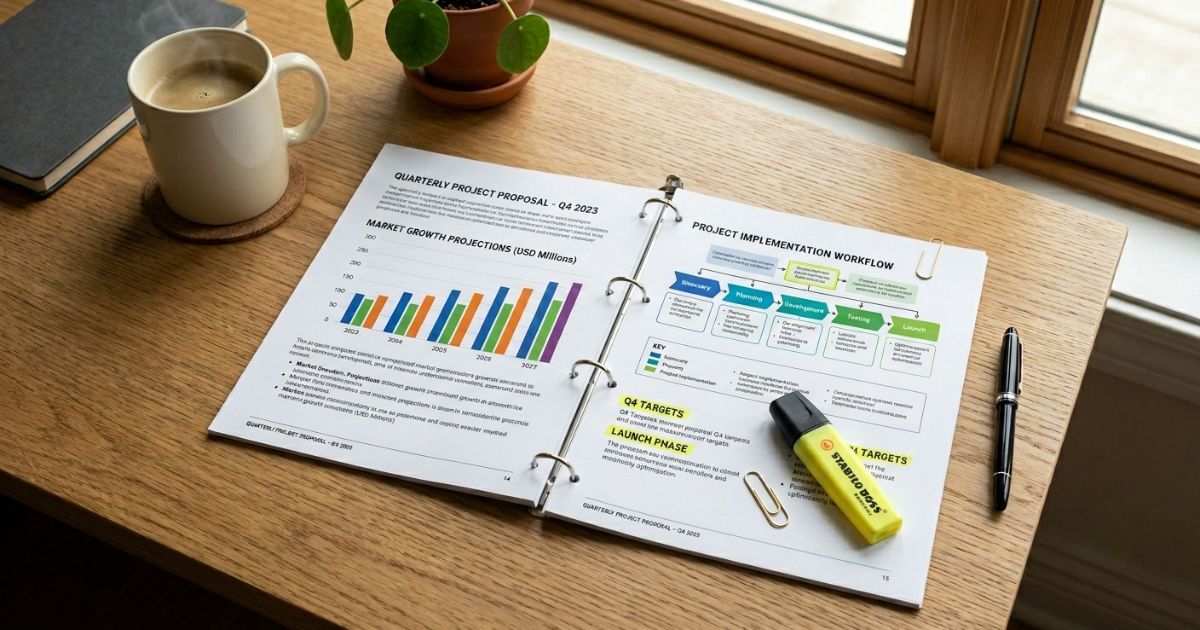
Charts, process flows, and comparison graphics serve two functions in proposals. They communicate complex information faster than prose, and they give evaluators a resting point when reading dense content.
Use visuals for implementation timelines, integration architecture, pricing structures, and before-and-after comparisons. Always label every graphic. An unlabeled chart forces the reader to interpret it, which is work you should be doing for them.
RocketDocs users can store approved visuals directly in the content library, making it faster to pull relevant graphics into each proposal without recreating them from scratch. Learn more about enterprise-grade content library capabilities.
7. Structure for Scannability
Evaluators often review proposals under time pressure. Long, unbroken paragraphs lose readers quickly. Structure each section so that a reader skimming the headers and bullet points gets the main argument, and a reader going deep gets the supporting detail.
Lead each section with your strongest point. Close with a reinforcing summary or a clear transition. The Shipley Associates Proposal Guide is a widely used reference for professional proposal structure and is worth the read for any team serious about improving win rates.
For teams managing high proposal volumes, the structure question is also a workflow question. See how RocketDocs Workflows helps teams build consistent, scalable proposal processes.
Writing a persuasive proposal is a skill. Like any skill, it improves with deliberate practice and the right systems supporting the team. If your current process makes it hard to customize quickly, source strong evidence, or maintain consistency across writers, the problem is upstream from the proposal itself.
Ready to see how RocketDocs helps proposal teams write faster and win more? Book a free demo today.
Looking for the platform behind this? See the RocketDocs platform or book a demo.


