
A business proposal is a formal document that offers your product or service to a prospective client and makes the case for choosing your company over competitors. It covers the client's problem, your recommended solution, pricing, timeline, and proof you can deliver, all structured to move a buyer toward a yes.
Learning how to write a business proposal well is one of the highest-leverage skills in sales. A sharp proposal shortens the sales cycle, pre-empts objections, and signals that you understand the buyer better than the competition does. This guide walks through the types of proposals, what to include, a seven-step writing process, the right format and length, and how to scale proposal writing without burning out your team.
Solicited vs. unsolicited business proposals
Every business proposal falls into one of two types, and the difference shapes how you write it. A solicited proposal responds to a buyer who has asked for one, often through a formal request for proposal (RFP) or an informal conversation. An unsolicited proposal is one you send proactively to a prospect who has not requested it, which means it has to work harder to earn attention and establish relevance.
Solicited proposals have a built-in advantage: the buyer has told you what they want, so you can map your response directly to their stated criteria. Unsolicited proposals trade that clarity for timing and initiative. If your proposal supports a financing request, the U.S. Small Business Administration offers guidance on the business planning that lenders expect to see alongside it.
What to include in a business proposal
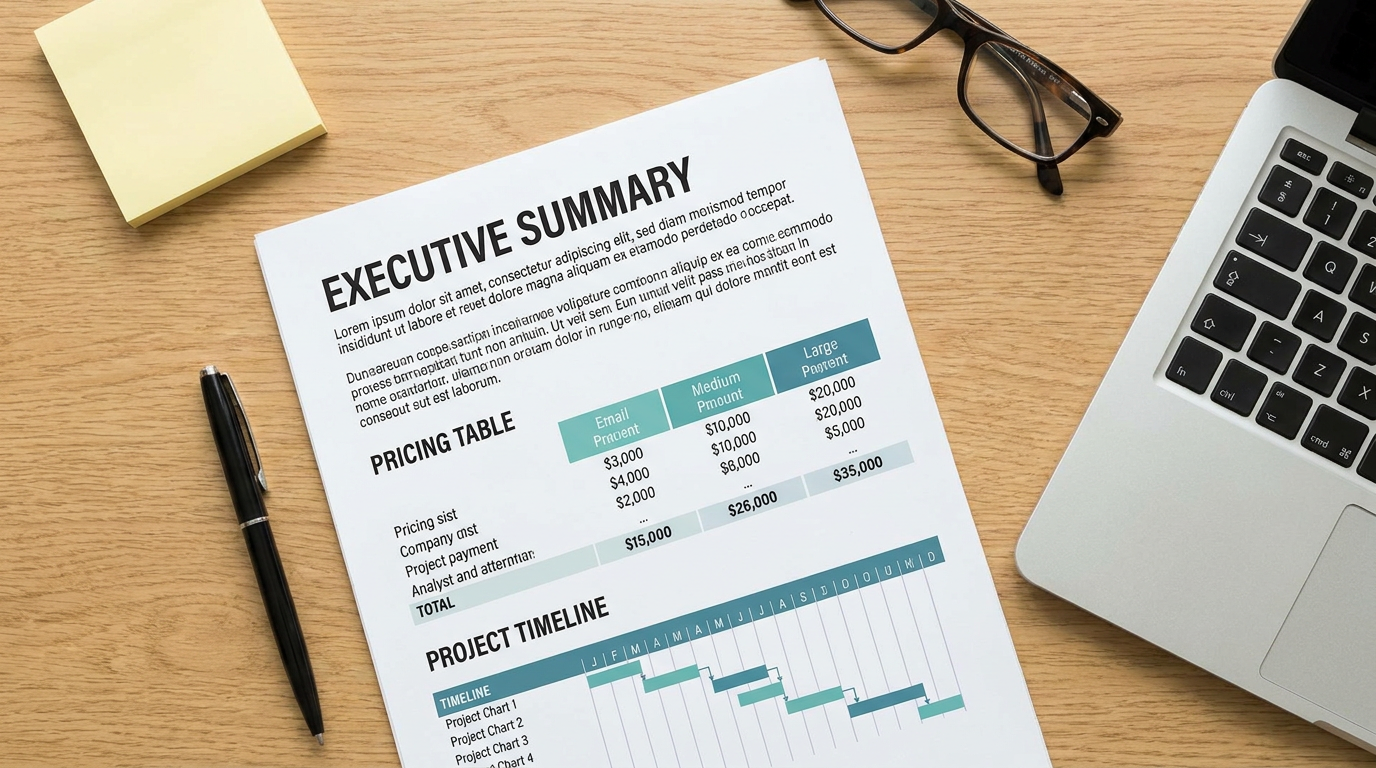
The strongest proposals follow a predictable structure, because buyers skim. A clear, familiar format lets an evaluator find pricing, scope, and proof without hunting for them. The table below breaks down the seven sections nearly every effective business proposal contains and what each one needs to accomplish.
| SECTION | PURPOSE | WHAT TO INCLUDE |
|---|---|---|
| Title page | Set a professional first impression | Your company name, the client name, the proposal title, and the date |
| Executive summary | Sell the outcome in under a minute | The client's problem, your recommended solution, and the headline benefit |
| Problem statement | Prove you understand the client | A specific description of the challenge in the client's own terms |
| Proposed solution | Show exactly what you will deliver | Scope, approach, deliverables, and how the solution solves the problem |
| Pricing and timeline | Remove uncertainty about cost and schedule | Transparent pricing options, payment terms, and key milestones |
| Proof and credibility | Reduce the buyer's perceived risk | Case studies, references, relevant results, and team qualifications |
| Call to action and terms | Make the next step obvious | How to accept, contract terms, and a signature or approval line |
How to write a business proposal in seven steps
With the structure in place, here is a repeatable process for turning a blank page into a proposal that wins.
1. Research the client before you write a word
Start by understanding the client's business, goals, and decision criteria. For a solicited proposal, reread the RFP and note every requirement and evaluation weight. For an unsolicited one, mine the prospect's website, recent news, and any discovery calls. The research phase is where your win themes are born.
2. Open with an executive summary that sells the outcome
The executive summary is the most-read part of any proposal. Lead with the client's desired outcome, not your company history, and keep it to a few tight paragraphs. Write it last, once you know the full story. For a deeper treatment, see our guide to writing an RFP executive summary.
3. Frame the problem in the client's language
Restate the challenge using the words the client used. When a buyer sees their own problem described accurately, they trust that your solution will fit. Vague problem statements are the fastest way to signal a templated, one-size-fits-all pitch.
4. Present a solution, not a feature list
Connect every element of your offering back to the problem. Describe the scope, approach, and deliverables in terms of the result the client gets, not the mechanics of what you do. This is where persuasive proposal writing matters most.
5. Make pricing transparent
Present pricing clearly, ideally with tiered options so the buyer can choose their level of investment. Hidden or confusing pricing erodes trust and invites delay. Pair the numbers with a realistic timeline and milestones so the client can picture the engagement.
6. Prove you can deliver
Back your claims with evidence: case studies, measurable results, references, and relevant credentials. Buyers discount unsupported superlatives, so specificity wins. One quantified result outperforms a paragraph of adjectives.
7. Close with a clear call to action
End by making the next step obvious. Spell out how to accept, what the terms are, and who to contact. A proposal that trails off without a clear path forward loses momentum exactly when the buyer is ready to move. If you also respond to formal RFPs, our sales proposal guide covers how to adapt this structure.
Business proposal format and length
There is no universal page count, but the best business proposals are as long as they need to be and no longer. Use a clean, consistent business proposal format with headings, white space, and visuals that make the document easy to scan. Many teams start from a proven business proposal template or example, then tailor it to each client rather than writing from scratch every time. Professional standards from the Association of Proposal Management Professionals can help teams benchmark their process against a recognized body of knowledge.
Scale proposal writing with a content library
Writing every proposal from scratch does not scale. Teams that produce proposals at volume rely on a content library: a single source of truth for approved answers, boilerplate, case studies, and pricing language that anyone can reuse. Reuse is not cutting corners; it is how you keep quality high while cutting cycle time.
This is the same principle behind Knowledge-Centered Service, the methodology developed by the Consortium for Service Innovation. The KCS methodology treats knowledge as a byproduct of solving problems and improves answers as they are reused, a model that maps directly onto proposal content and any structured knowledge base where reuse compounds over time.

A modern response management platform brings that library into the proposal itself, surfacing the right approved content as you write and keeping it current as your business changes. See how a well-built RFP content library pays off across every proposal your team sends.
Ready to write winning proposals faster? RocketDocs helps sales and proposal teams reuse approved content, collaborate with subject matter experts, and respond to RFPs and proposals in a fraction of the time. Request a demo to see how it works for your team.
Looking for the platform behind this? See the RocketDocs platform or book a demo.


