
An RFP cover letter is a one-page introduction that accompanies a proposal responding to a request for proposal. It greets the evaluator by name, states the opportunity, summarizes why your firm fits, and points to the proposal inside. It sets tone and credibility before the buyer reads a single requirement.
Every response team writes them, yet few treat them as strategy. Buyers open dozens of proposals in a single procurement cycle, and the cover letter is the first thing they read. Done well, it signals that your submission was written for this buyer and not pulled from a folder. This guide covers what to include, how to write one, a reusable template, and the mistakes that cost you the read.
Teams frequently blur the cover letter with the documents around it. The table below shows how it differs from the executive summary, the transmittal letter, and the proposal body, so you know exactly what belongs on that first page.
| DOCUMENT | PURPOSE | LENGTH | WHERE IT SITS |
|---|---|---|---|
| Cover letter | Introduces your firm and signals fit to the evaluator | Half to one page | First page, ahead of the proposal |
| Executive summary | Sells the solution and its value in depth | One to three pages | Inside the proposal body |
| Transmittal letter | Confirms formal submission and administrative compliance | Half page | Attached to the package |
| Proposal body | Answers every requirement in full detail | Varies | Core of the response |

What an RFP Cover Letter Is, and What It Is Not
An RFP cover letter is not a sales pitch, and it is not the executive summary. Its job is narrow: acknowledge the request, prove you understood it, and give the evaluator a reason to keep reading. Keep it to a single page, because anything longer competes with the proposal itself. The letter is about connection and credibility; the detailed selling happens in the executive summary and the body. For a full view of where each piece fits, see our guide on how to respond to an RFP.
What to Include in an RFP Cover Letter
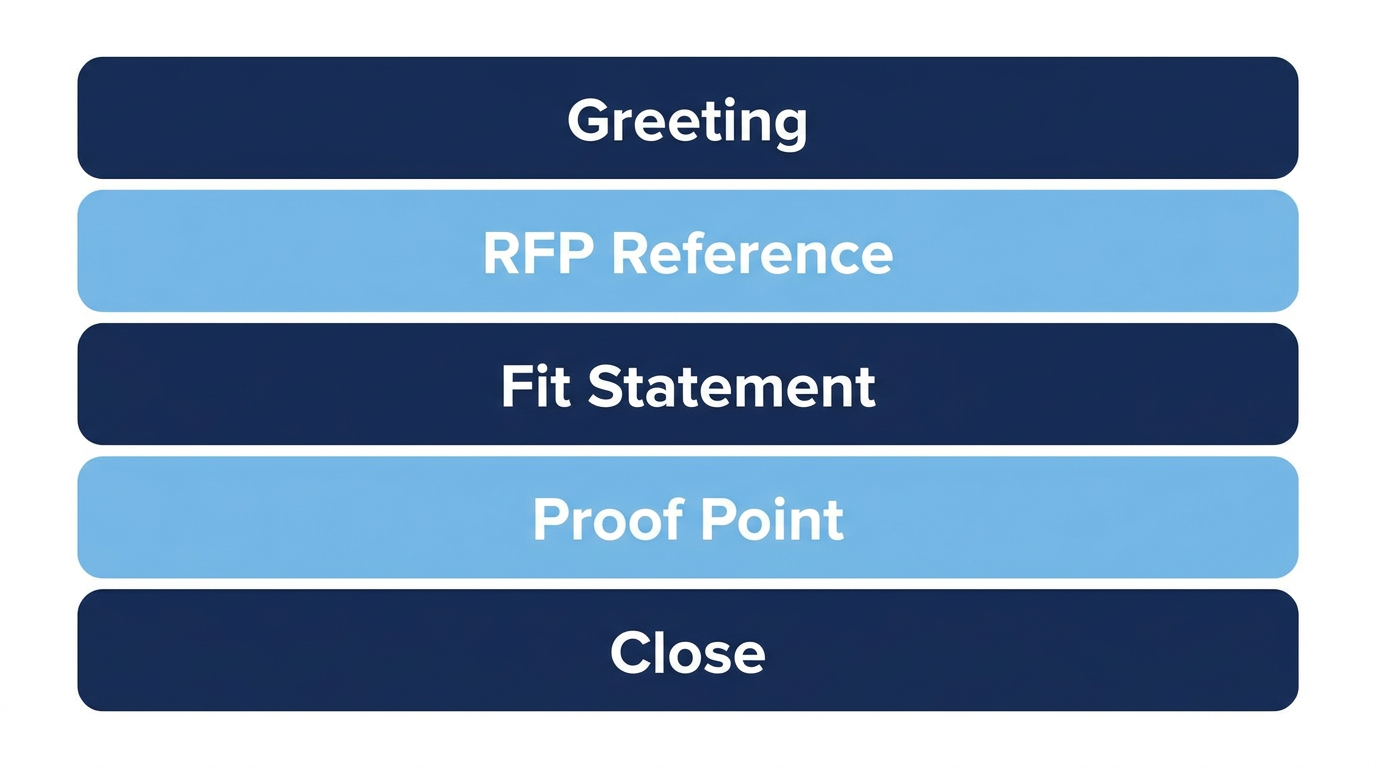
A strong RFP cover letter covers five things without padding:
- A direct greeting to the named contact or evaluation committee.
- A clear reference to the RFP title, number, and due date so the buyer can file it correctly.
- Two or three sentences on why your firm fits, tied to the buyer's stated goals.
- One credible proof point, such as a relevant client outcome or certification, that earns trust fast.
- A courteous close with a signature, direct contact details, and a line inviting next steps.
Avoid restating the whole proposal. If your executive summary is doing its job, the cover letter can stay short and confident. Our guide to the RFP executive summary explains how to divide that labor so the two documents reinforce rather than repeat each other.
How to Write an RFP Cover Letter, Step by Step
Writing an RFP cover letter is faster when you work in a fixed order:
- Open with the buyer, not yourself. Name the organization and the outcome they described in the RFP.
- Confirm the specifics. Reference the RFP number and deadline in the first paragraph.
- State your fit in one tight paragraph. Match your strengths to their evaluation criteria, not to a generic list of services.
- Add one credible proof point, whether a metric, a comparable client, or a relevant accreditation.
- Close with a clear next step and a real person's contact information.
Formatting conventions matter here. Follow standard business-letter structure with a date, recipient block, salutation, body, and signature, as outlined by the Purdue Writing Lab. For public-sector work, confirm submission requirements against the issuing agency's instructions, since federal buyers on platforms such as SAM.gov often specify exact cover-page and transmittal formats.
RFP Cover Letter Template
Use this structure as a starting point, then tailor every line to the specific buyer. A template speeds up the mechanics; it never replaces personalization.
| SECTION | WHAT TO WRITE |
|---|---|
| Heading | Your letterhead, the date, and the buyer's name, title, and organization |
| Salutation | Dear followed by the evaluator name or Evaluation Committee |
| Opening | Reference the RFP title, number, and due date, and thank them for the opportunity |
| Fit paragraph | Two to three sentences matching your strengths to their stated goals |
| Proof point | One metric, client outcome, or credential that builds trust |
| Close | A clear next step, your signature, title, and direct contact details |
Common RFP Cover Letter Mistakes to Avoid
The fastest way to weaken a cover letter is to make it about you. Openings like We are pleased to submit waste the most valuable line on the page. Other frequent errors include leaving another client's name in a reused draft, misstating the RFP number, running past one page, and closing without a named contact. Guidance from the Association of Proposal Management Professionals stresses that evaluators reward responses that mirror the buyer's language and requirements, so use their terminology rather than your internal jargon.
Speed Up Cover Letters With a Content Library
Most teams rewrite the same fragments on every bid: the firm description, the differentiators, the proof points. Storing those approved blocks in a searchable content library lets writers assemble a tailored letter in minutes while keeping the personalization evaluators notice. This is the idea behind Knowledge-Centered Success (KCS), the methodology from the Consortium for Service Innovation: capture reusable knowledge once, keep it current through use, and reuse it in the flow of work. The KCS methodology and its practices knowledge base show how each answer improves every time someone relies on it.

RocketDocs applies the same principle across the full response. Its content library and private AI help proposal teams reuse vetted answers, cover letters included, without losing the human touch that wins deals. See how teams build a library that scales in our guide to RFP content management.
Ready to stop rewriting the same cover letter on every bid? Explore the RocketDocs platform to see how a governed content library and purpose-built AI help your team respond faster and win more work.
KCS® is a service mark of the Consortium for Service Innovation™.
Looking for the platform behind this? See the RocketDocs platform or book a demo.


