
An RFP process template turns the stages of responding to a request for proposal into a reusable checklist: the same owners, deadlines, and quality gates on every bid, so nothing gets skipped when the clock is short. This page gives you that template and checklist. For the full walkthrough of every stage on both the buyer's and responder's side, start with our step-by-step RFP process guide, then come back here to turn it into a repeatable system.
The RFP Process in Brief
The RFP process is how an organization responds to a request for proposal, the formal document a buyer issues to invite competitive bids. On the responder side, the process is a workflow: qualify the opportunity, assign the work, draft and review answers, then submit before the deadline. Because the same questions about pricing, security, and implementation resurface across nearly every RFP, treating the process as a template rather than a one-off is what separates teams that scale from teams that scramble.
The Seven Stages, as a Checklist
Most winning teams follow the same seven stages. The table below is a template you can lift directly: it names what happens at each stage, who owns it, and how long it usually takes so you can build a realistic timeline the moment an RFP lands.
| STAGE | WHAT HAPPENS | WHO OWNS IT | TYPICAL TIME |
|---|---|---|---|
| 1. Qualify | Decide if the RFP is worth pursuing | Sales and leadership | 1 to 2 days |
| 2. Kickoff | Assign roles, set the timeline, read requirements | Proposal manager | 1 day |
| 3. Assign questions | Route sections to subject matter experts | Proposal manager | 1 to 2 days |
| 4. Draft answers | Experts write or reuse approved content | SMEs and writers | 3 to 7 days |
| 5. Review | Check accuracy, compliance, and messaging | Reviewers and legal | 2 to 3 days |
| 6. Finalize and submit | Format, proof, and deliver before the deadline | Proposal manager | 1 to 2 days |
| 7. Debrief | Capture wins, losses, and reusable answers | Whole team | 1 day after decision |
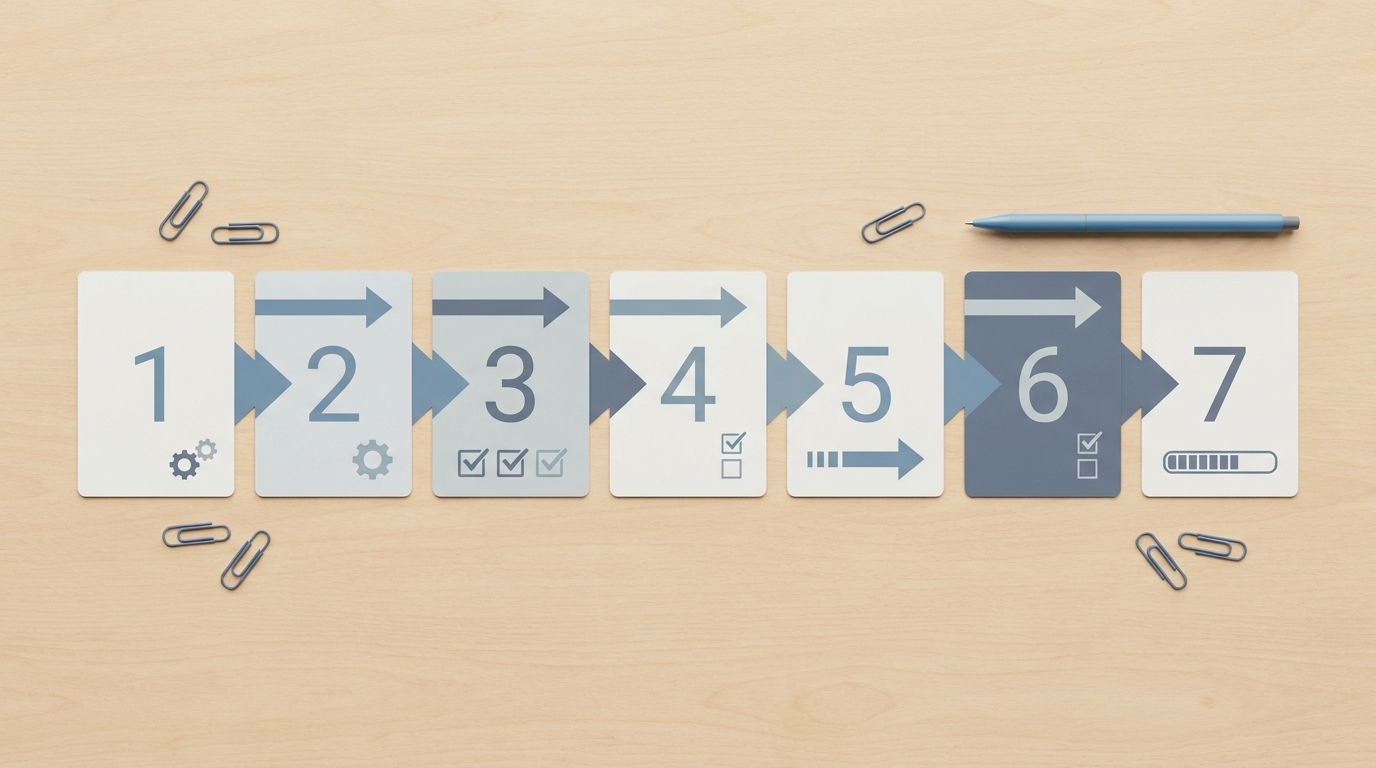
The qualify stage matters most, because saying no to a poor-fit RFP protects the time you need to win the right ones. A quick go or no-go score against fit, budget, and incumbency keeps the pipeline honest before anyone drafts a word.
An RFP Process Template You Can Reuse
Turn the stages above into a working checklist. Copy these steps into your project tool at kickoff and assign an owner and a due date to each one.
- Confirm the deadline, submission format, and evaluation criteria before you commit.
- Name a single owner for the response, plus a backup.
- Break the RFP into sections and map each one to a subject matter expert.
- Pull first-draft answers from your approved content library, then tailor them to the buyer.
- Build in a review pass for accuracy, compliance, and win themes.
- Proof the final document and submit with time to spare.
- Log the outcome and update your content library after every bid.
That final step is the one most teams skip, and it is the one that compounds. Proposal professionals, including members of the Association of Proposal Management Professionals, consistently find that a maintained answer library is the biggest lever on both speed and quality across the RFP process.
How to Speed Up the RFP Process

The slowest stages are drafting and review, and both shrink dramatically with reuse. Since a large share of any RFP repeats questions you have answered before, a curated content library lets writers start from an approved answer instead of a blank page. A dedicated RFP response solution can auto-match incoming questions to that library, so a first draft that used to take days takes minutes.
The other lever is coordination. Routing questions to the right expert, tracking status in one place, and running a single structured review keeps the RFP process from stalling in email threads. Teams that manage this on a response management platform often cut total turnaround time in half. For deeper playbooks on RFPs, DDQs, and security questionnaires, browse the RocketDocs resource library.
The Bottom Line
A strong RFP process is not bureaucracy; it is the difference between a calm, repeatable win engine and a scramble against the clock. Standardize the seven stages, work from a reusable template and checklist, and feed every answer back into a shared library, and each bid gets faster and more consistent than the last. If your team wants to compress that timeline, see how RocketDocs helps you run the RFP process end to end.
Looking for the platform behind this? See the RocketDocs platform or book a demo.


