
How to Draft a Winning Sales Proposal: 5 Tips That Actually Work
A sales proposal is one of the most consequential documents a sales team produces. Done well, it wins business. Done poorly, it hands the deal to a competitor. Yet many teams still treat proposals as one-off documents, drafted under pressure with no repeatable system behind them.
This guide breaks down five practical tips that help you draft a winning sales proposal faster and with greater confidence, whether you are responding to a formal solicitation or pitching a client directly.
What Is a Sales Proposal?
A sales proposal is a document that pitches your product or services to a prospective client. It details the deliverables, benefits, and costs involved in a proposed engagement. A successful sales proposal communicates three things clearly: what your product or service does, the specific value it creates for that client, and why your team is the right one to deliver it.
The goal is to impress and reassure the prospective client enough to earn their business.
Why Most Sales Proposals Fall Short
Before getting to the tips, it helps to understand the most common failure modes. Most underperforming proposals share at least one of these traits: they lead with the vendor instead of the client, they include outdated or inaccurate information, or they were assembled so quickly that they feel generic.
The good news is that all three problems are solvable with the right approach.
5 Tips for Drafting a Winning Sales Proposal
1. Start from a Template
Starting your sales proposal from a well-designed template lets you skip the blank-page problem and move straight into customization. A consistent template structure ensures that every proposal your team produces maintains the same formatting, branding, and flow, which signals professionalism and builds client trust.
Good templates include dedicated sections for an executive summary, solution overview, pricing, case studies, and next steps. They also leave room for visuals. Charts, process flows, and diagrams often communicate complex information more clearly than paragraphs of text, and they make proposals easier to skim.
The key is to treat the template as a starting point, not a finished product. Every proposal should be customized to the specific opportunity, even if the structure is standardized.
One Administrator in Education Management described their experience using RocketDocs templates this way: their team used a set of clean, pre-built templates to rapidly generate customer-facing proposals and export them as Word files, allowing them to produce 45 to 60 proposals in a single month.
2. Focus on the Benefits for Your Prospect
The most common proposal mistake is spending too much time describing your own capabilities and too little time connecting those capabilities to the client's specific situation. Every section of a winning sales proposal should be framed around the prospect, not the vendor.
Before writing, research the client's industry, their competitive landscape, and the challenges they are most likely navigating. Then position your solution as the answer to those specific pressures. This is what separates a personalized proposal from a generic one, and it is often the difference between a win and a loss.
Ask yourself this about every paragraph: does this help the client understand what their world looks like after working with us? If not, revise it.
3. Include Testimonials and Case Studies

Claims without evidence are just marketing copy. Prospective clients are far more likely to believe in your solution when you can point to documented results from similar clients.
Build a library of case studies and client testimonials organized by industry, use case, and deal size. When drafting a proposal, pull the most relevant examples and frame them in context. Do not just paste a testimonial in; explain why it is relevant to this particular client's situation.
Performance statistics, measurable outcomes, and named client references carry significant weight in competitive proposals. If you have them, use them.
RocketDocs maintains a content library that makes it easy for proposal teams to store, tag, and retrieve approved case studies and testimonials so the right proof points are always at hand.
4. Present Multiple Pricing Options
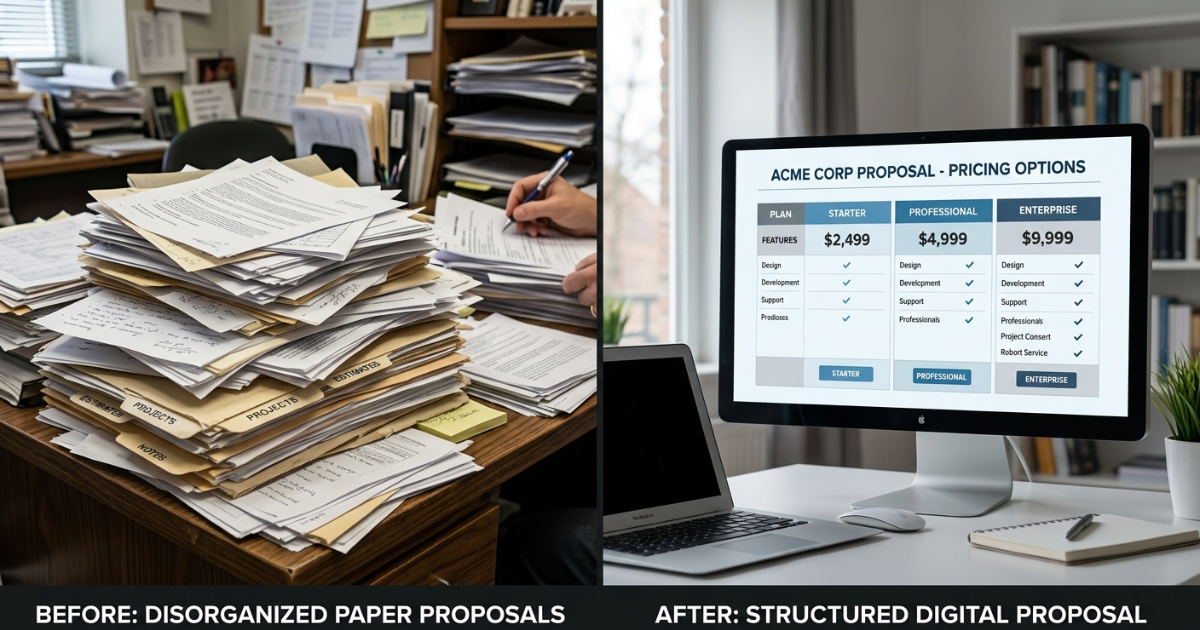
A single pricing option puts your prospect in a binary decision: yes or no. Three pricing options change the conversation entirely. Now the prospect is choosing between packages, not deciding whether to engage at all.
Structure your tiers from lowest to highest. This approach reduces initial sticker shock and allows you to highlight the incremental value at each level. It also positions you as your own competition, which is a far better outcome than having the prospect shop your pricing against a competitor's.
Each tier should be self-contained with clearly described deliverables and benefits. Make it easy for the prospect to see exactly what they get at each investment level.
5. Ensure All Information Is Accurate
In regulated industries like financial services and healthcare, proposal accuracy is not just a quality concern, it is a compliance requirement. But even outside regulated sectors, an inaccurate proposal damages credibility and can create legal exposure if a client relies on figures or commitments that turn out to be wrong.
A centralized content library functions as your single source of truth. Assign ownership of each content category to the team members best positioned to keep it current: compliance language to legal, pricing to finance, capability statements to product, and so on. When you pull content from that library, you can be confident it reflects current, approved information.
This is especially important for high-volume proposal teams. Manual version control across shared drives and email threads is a reliable path to errors.
Using a Proposal Generator to Scale the Process
If your organization sends a high volume of proposals, a dedicated proposal generator can significantly reduce the time each proposal takes to produce. Tools like RapidDocs let sales teams build proposals from pre-approved templates, pull content directly from a managed library, and export polished, branded documents in a fraction of the time it would take to build them manually.
The return on investment is straightforward: fewer hours per proposal, higher consistency across submissions, and more capacity to pursue additional opportunities.
A Senior Sales Engineer at a U.S.-based organization described being able to respond to proposals quickly using fewer resources, saving their sales team hours on proposals, statements of work, and presentations. A user in financial services noted that RocketDocs made their proposal creation process fast and easy to use.
Putting It All Together
A winning sales proposal is not a one-time creative effort. It is a repeatable process built on good templates, client-focused messaging, credible proof points, smart pricing structure, and accurate content.
The teams that consistently win proposals are the ones who have invested in the infrastructure to support that process, and who treat every proposal as an opportunity to demonstrate exactly how well they understand the client in front of them.
To learn more about managing proposal content at scale, explore mastering RFP content management or see how RocketDocs' content library keeps your source material current and accessible.
Looking for the platform behind this? See the RocketDocs platform or book a demo.


